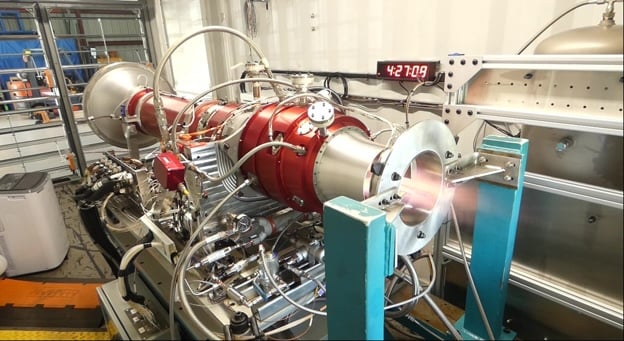
GEK800 Serial Number 1 successfully ignited during the test at Kratos’ X-58 facility. The companies said the result represented a 100% success rate for this critical development phase and cleared the way for the next stage of testing.
Recently designated the F143, the GEK800 is intended to provide high-performance propulsion for advanced cruise missiles while supporting cost-effective manufacturing. Kratos and GE Aerospace are seeking to combine modern engineering and production methods with the affordability required for wider deployment of strike systems.
“The combined Kratos, GE Aerospace, and Government test team has demonstrated exceptional focus, discipline, and schedule execution,” said Chris Rawlings, vice president of Kratos’ Defense Engine Portfolio. “This team sets the benchmark for operational efficiency and provides a refreshing reminder that our nation can develop turbine engines affordably and at pace.”
The companies are positioning the engine as a practical option for the Department of War and allied defense prime contractors seeking to field strike capabilities quickly. The GEK800 is also intended to support attritable weapons, where controlling production and lifecycle costs is central to delivering larger numbers of systems.
Kratos and GE Aerospace said the X-58 test validated the engine’s technological architecture, reliability and readiness for integration. Their approach is designed to allow prime contractors to offer cruise missile systems that retain required performance while competing effectively for government procurement programmes.
“With this latest milestone, the GEK800 engine continues to demonstrate strong performance and durability,” said Jorge Perez, general manager of Edison Works Advanced Combat Engines at GE Aerospace. “Our collaboration with Kratos is delivering a highly capable propulsion system designed to meet the demanding requirements of cruise missile applications.”
The successful ignition moves the programme closer to the companies’ goal of manufacturing the engine in large volumes. Kratos said it is continuing to meet development milestones and accelerate the schedule as it prepares to support advanced cruise missile programmes.
“Kratos continues to achieve milestones and accelerate program schedules as we prepare for large volume production of our GEK800 engine to support advanced cruise missile systems,” said Stacey Rock, president of Kratos’ Turbine Technologies Division. The programme remains focused on delivering an engine that combines cruise missile performance with lower lifecycle costs.