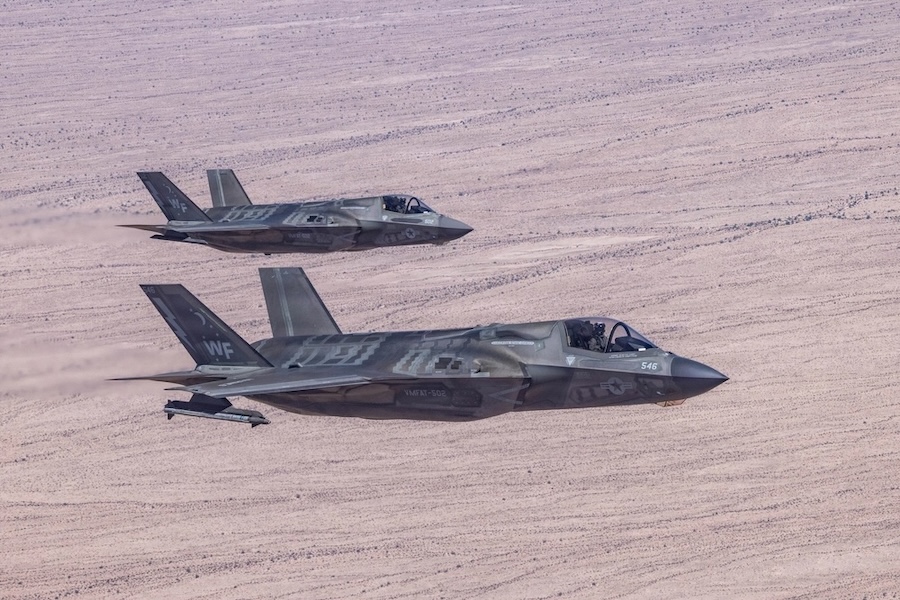
The latest Modernized Selected Acquisition Report shows that the increase is spread across development and procurement rather than a single element of the program. Research, development, test and evaluation costs grew by about $19 billion, while procurement estimates increased by nearly $32 billion.
The report also raised unit recurring flyaway estimates, which represent the cost of producing an aircraft and its engine. The Air Force’s conventional-takeoff F-35A rose 7.3 percent to $78 million in constant 2012 dollars, compared with $72.7 million in the previous report.
The carrier-capable F-35C, operated by the Navy and Marine Corps, increased 6.6 percent to $93.4 million in 2012 dollars from $87.65 million. The Marine Corps’ short-takeoff-and-vertical-landing F-35B posted the largest percentage increase, rising 10.5 percent to $110.3 million from $99.78 million.
Those historical-dollar figures do not disclose what the government is paying for each variant in the newest production lots. The F-35 Joint Program Office told Air & Space Forces Magazine that current-year prices by variant are controlled unclassified information and cannot be released.
Development costs now stand at $106.6 billion, with the program office pointing to a revised estimate for the Power Thermal Management Upgrade. The office said the revision reflects updated requirements and assumptions for the effort.
The program has also revised schedules for Block 4 modernization, the engine core upgrade and the power and thermal management effort, adding years and costs. A refinement of the planned Block 4 capabilities accounted for about $900 million of the $19 billion increase in research and development spending, according to the office.
Block 4 is a broad modernization package covering weapons, sensors, sensor fusion and other mission systems. The F-35 program is prioritizing 55 capabilities, including kill-chain improvements for air-superiority and suppression-of-enemy-air-defenses missions, as well as integration of new weapons.
Procurement growth reflects a separate group of pressures tied more directly to producing later-model aircraft. The program office cited production of the upcoming APG-85 radar, higher production-support expenses, the Power Thermal Management Upgrade requirement, contractors’ actual costs and negotiated pricing for Lots 18 and 19.
The Pentagon and Lockheed Martin finalized a $24.29 billion agreement in September 2025 for 296 aircraft in those two lots. Engine agreements announced by Pratt & Whitney and the program office in April were valued at a combined $6.6 billion, bringing the implied average across all variants to about $104.4 million when the aircraft and engine deals are combined.
Inflation and higher material prices are adding pressure beyond the cost of the new hardware. The military also plans to defer some F-35 purchases into later years outside the current budget cycle, meaning those aircraft will be exposed to additional inflation before they are contracted.
The Marine Corps is changing its planned procurement mix by shifting some purchases from F-35Bs to carrier-based F-35Cs. Because the replacement F-35Cs would be bought later than the F-35Bs previously planned, the program office expects inflation and higher maintenance costs to add to the total estimate.
Despite the higher forecast, the Pentagon described the F-35 as a “mature enterprise” with more than 1,200 aircraft operating in 20 countries. The report cited the program’s move into full-rate production in March 2024 and the fielding of Technology Refresh 3 hardware, which provides the basis for Block 4.
“The growing global demand speaks for itself,” the Pentagon said in the report. “The F-35’s value proposition is unmatched.”
The program is now concentrating on long-term capability improvements and efforts to reduce sustainment costs across the expanding fleet. That shift places more of the financial burden on modernization, readiness and integration rather than on proving the basic aircraft design.
Lockheed Martin said the report reflects that change in emphasis as production and international demand continue to grow. “The latest MSAR report shows the combat-proven F-35 program moving into full-rate production, resuming high-volume development deliveries and growing globally,” said Mireya Villarreal, Lockheed Martin’s spokesperson for the F-35 program.
Source: Air & Space Forces Magazine.