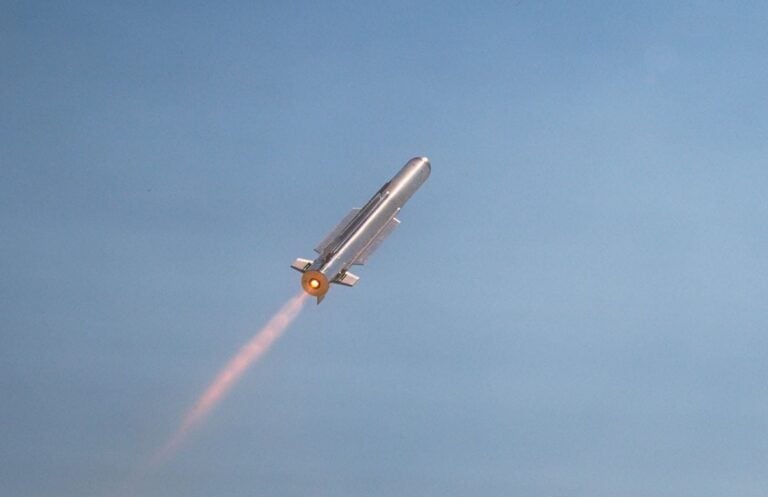

MALD is designed to replicate the radar signature of high-value aircraft, forcing enemy air defences to detect, track and engage a decoy instead of crewed aircraft, unmanned systems or strike weapons. Raytheon says the system is built for stand-in operations, flying close to threats to reduce risk for other assets moving through contested airspace.
The production plan is helped by a line that Raytheon says remains warm, with major tooling and test equipment still in place. The line is currently used for sustainment, assembly and testing work, giving the company a faster path to restart than building a new industrial base.
“Every piece of major tooling is in place. We’re not rebuilding a line; we’re re-energizing it,” said Justin Jenia, Vice President, Strike Initiatives, Air & Space Defense Systems at Raytheon. The company said many of the engineers and technicians who have worked on MALD for more than two decades remain involved in the programme.
Raytheon has spent the past two years using internal research and development funding to improve MALD reliability, qualify additively manufactured airframes and develop new payloads. Its modular design allows engineers to replace the nose section with a jammer, kinetic warhead or future mission kit.
“Adapting proven systems for new missions is what we do best. It’s faster, smarter and dramatically more affordable for customers,” Jenia said. Raytheon said MALD can be integrated onto new aircraft platforms in days and has demonstrated launch from cargo aircraft, a capability it says no other decoy has shown.
Initial production would begin in Tucson, Arizona, where Raytheon aims to support rapid early deliveries. The company also expects to establish a second line in Europe to support longer-term demand from allies, subject to required approvals.
“Europe has a strong industrial base, and we’re committed to partnering with it – a true ‘built in Europe, for Europe’ approach that expands capacity and gets capability to allies faster,” Jenia said. Raytheon is already working with suppliers in the United States and Europe to prepare for higher production rates.
For early production, the company plans to rely on proven propulsion options, including the Pratt & Whitney TJ150 engine. It is also assessing additively manufactured engines as a longer-term option, while additively manufactured airframes are expected to reduce build time and simplify mission adaptation.
Raytheon is positioning MALD as an “affordable mass” system, a lower-cost expendable weapon that can be fielded in large numbers. The role has gained attention as drone swarms and dense air defences increase risk for aircraft and long-range weapons in current conflicts, including in Ukraine.
“Affordable mass means fielding weapons in large numbers that the enemy still has to take seriously,” said J.D. Word, director of Tactical Strike Requirements and Capabilities at Raytheon. “MALD delivers that – a proven, modular, lower cost system that soaks up enemy fire and protects the assets that truly matter.”