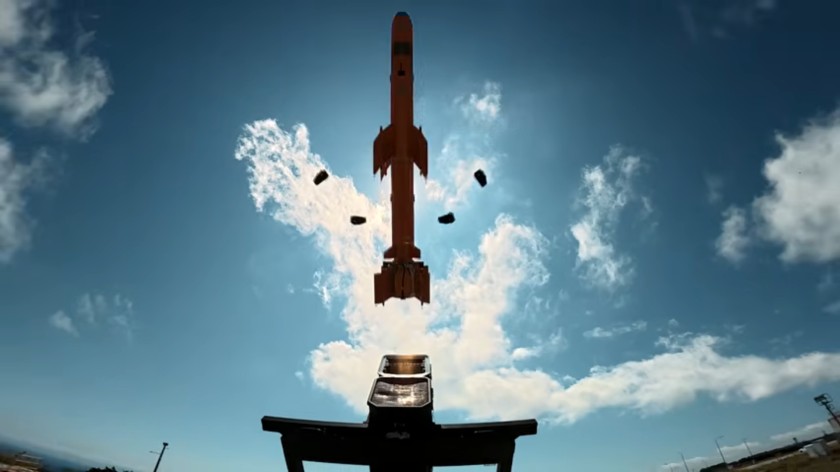
The Turkish defence company disclosed the trials on 28 August. A new-generation imaging infrared seeker guided both missiles during the terminal phase of their flights.
The tests also evaluated a new fuel system integrated into Çakır and intended to extend its operational range. Roketsan did not provide figures for the expected increase.
In its ground-launched configuration, Çakır uses a booster for the initial phase of flight. After the booster separates, propulsion is provided by the KTJ-1750 turbojet engine developed jointly with Kale Arge.
Roketsan puts the missile’s weight at about 275 kilograms without the booster. The complete ground-launched configuration weighs approximately 330 kilograms.

The latest trials followed an air-launch test conducted from a Baykar Bayraktar Akıncı TİHA combat drone near Sinop on the Black Sea coast on 11 May 2023. That test was the first public in-flight demonstration of the KTJ-1750 engine.
Roketsan unveiled Çakır in March 2022 as a modular family of precision-guided weapons for air, naval and land platforms. The missile can be carried by aircraft, helicopters, unmanned strike aircraft, uncrewed surface vessels, tactical wheeled vehicles and surface ships.
Çakır has a stated range of more than 150 kilometres. Its guidance system combines inertial navigation with jam-resistant satellite navigation.
A two-way data link allows operators to update targets during flight, abort a mission or order another attack. The missile can follow terrain over land and use a very-low-altitude super sea-skimming profile over water to make detection by hostile air defence systems more difficult.
Roketsan also says Çakır can identify targets autonomously with the support of artificial intelligence algorithms. The mobile-launch trials expanded the missile’s publicly demonstrated employment options beyond the earlier air-launched configuration.