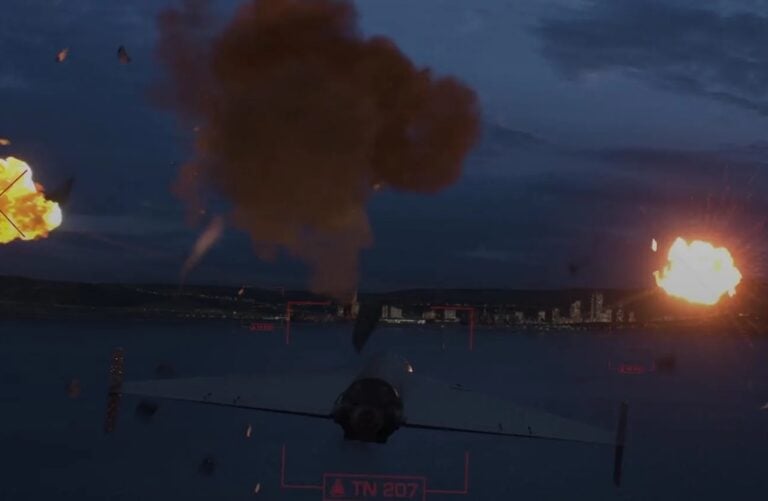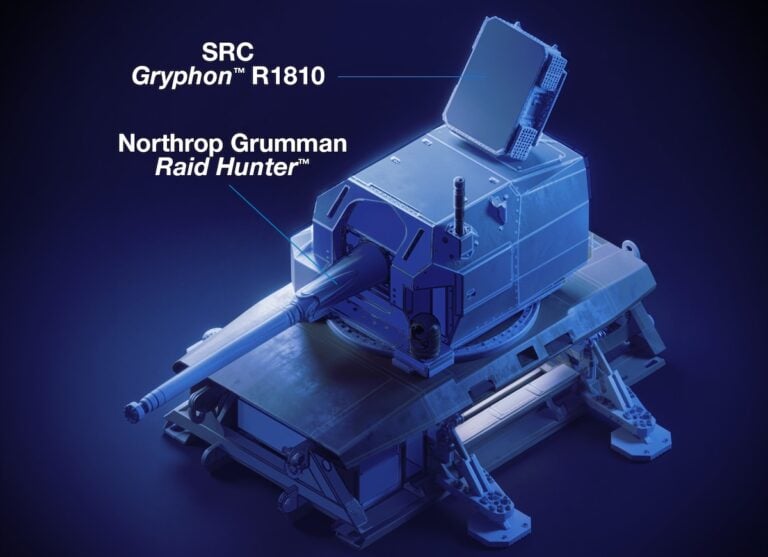
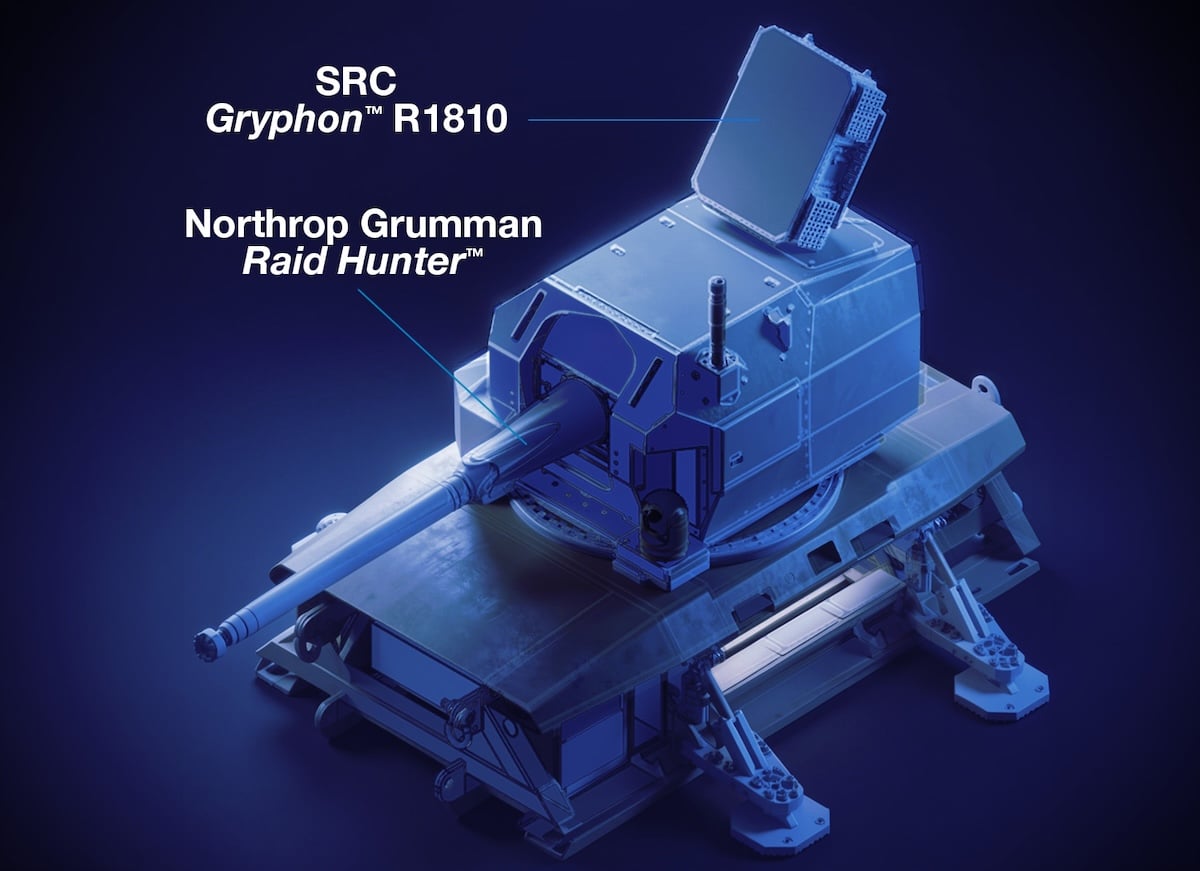
Raid Hunter combines networked control, Bushmaster Chain Gun technology and guided 50mm ammunition. The system is intended to protect military bases, airfields and critical infrastructure against high-volume attacks.
The R1810 builds on SRC’s Gryphon R1540, using the same core electronics and antenna array modules. It doubles the number of subarrays per panel from four to eight, increasing the antenna aperture to improve range and accuracy.
SRC lists designed detection ranges of up to 21.6 kilometers for Group 1 unmanned aircraft and 49.4 kilometers for Group 3 systems. The R1540’s corresponding ranges are 12.7 kilometers and 30.2 kilometers.
The shared architecture allows SRC to draw on technology it has already developed and manufactured. The larger R1810 addresses the more demanding tracking requirements of precision fire control.
A single R1810 panel can be paired with a turret-mounted weapon to follow both a target and the round launched to intercept it. That capability supports repeated engagements against multiple incoming threats.
“Defending our forces against drones, particularly when many threats arrive at once, is one of the most urgent challenges facing the U.S. military and its allies,” said Kevin Hair, SRC’s president and chief executive. “Our work on Raid Hunter reflects the depth of SRC’s counter-UAS radar expertise and the trust Northrop Grumman has placed in our team.”
“As Raid Hunter’s radar provider, we developed the R1810 to deliver the precise, longer-range tracking this system needs to help protect service members and critical assets,” Hair said. SRC identified sustained tracking across successive engagements as a requirement for defending against coordinated drone swarms.
The R1810 can also be configured with four panels for 360-degree surveillance on other missions. It expands a Gryphon radar family covering air surveillance, counter-drone operations and precision fire control.
The smaller R1540 remains available for missions that do not require the R1810’s additional range and accuracy. Together, the systems offer different levels of detection and tracking capability for surveillance and weapon-control applications.