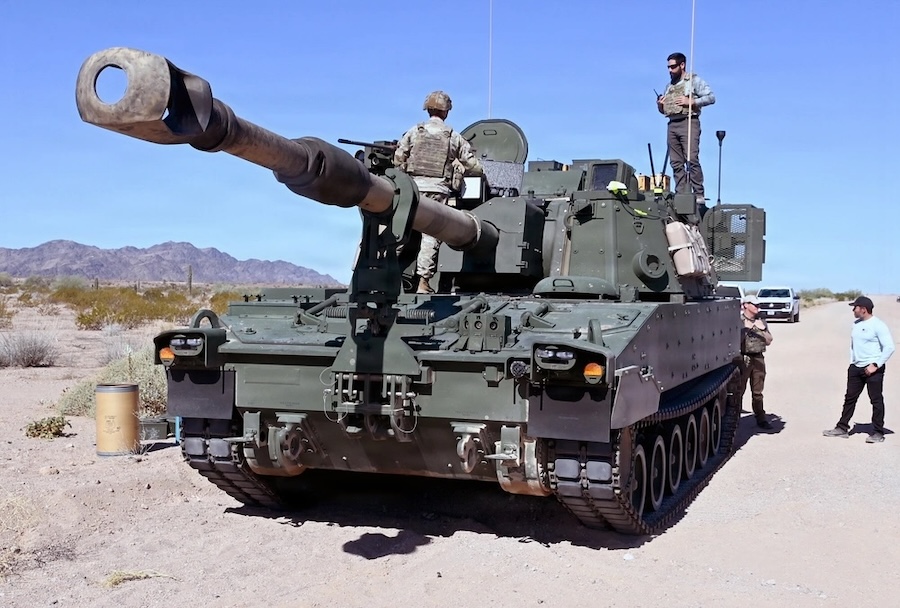
CROWS allows gunners to operate different mounted weapons from inside an armored vehicle. The system is designed to protect crews from small arms fire and improvised explosive device blasts that previously posed risks during turret operations.
The system uses a gyro-stabilized mount and a fully integrated fire control system. These features support high-precision targeting and a high probability of a first-burst hit, including when an armored vehicle is moving.
“We’re testing enhanced technology such as better cameras and the effects of weapon loading and firing while integrated on the platform,” said Rafael Ortiz, YPG test officer. The developmental testing has moved from concept to live testing on YPG’s ranges in just over a year.
The Army said the effort has been driven by real-world changes in how modern wars are fought. A major element of the project is that the installation package was developed as an internal Department of War effort rather than through a traditional original equipment manufacturer supplier.
The project moved rapidly from initial concept to a production-representative design through PM HS partnerships within the U.S. Army DEVCOM community. The Army said this internal collaboration significantly accelerated the development timeline.
“Open hatch operations are no longer feasible,” said Ms. Connie English, project lead for U.S. Army Capability Program Executive Offensive Fires. “With the low-profile CROWS, the Soldiers have increased survivability.”
Earlier versions of CROWS were not feasible for the Paladin, which the release described as the most potent self-propelled howitzer in the United States’ arsenal. The Paladin’s 155 mm main gun can fire up to four rounds per minute, requiring components rugged enough to withstand substantial recoil blowback force.
“The old CROWS has a larger profile, so having it installed on the Paladin did not meet transportation requirements,” said Martin Velasquez, YPG team lead. “The blast overpressure effects of the Paladin’s main gun repeatedly firing would break things on the old CROWS. The updated CROWS-LP has a smaller profile and is modified to be more robust.”
Soldiers from Fort Bliss, Texas’ 4th Battalion, 1st Field Artillery Regiment and the Transformation Integration Directorate at Fort Sill, Oklahoma, tested the LP-CROWS over multiple weeks at YPG. The testing used realistic scenarios grounded in concepts of operations.
YPG’s Threat Systems Target Branch has the largest single repository of foreign threat systems in the continental United States. The branch can also fabricate highly realistic replicas for testing.
“The Soldiers are going to scan and engage the targets,” said Velasquez. “The Soldiers are providing feedback on the new system: the old system was just a manual gun; this is the first time they have control of the small caliber gun from inside the vehicle. We’re also going to be doing more follow-on testing running durability miles.”
Another feature being tested at YPG is intended to give the Paladin counter-small unmanned aircraft system capability. The capability would support detection and defeat functions while crews remain under closed-hatch operations.
“We’re working with PM Crew Served Weapons who have worked with other program offices to put radar onto the CROWS to detect unmanned aerial systems,” said English. “Now we’ll have detected and defeat capability under closed hatch operations.”
U.S. Army Yuma Test Center has been designated as the primary dedicated interagency counter-UAS test and training range since the establishment of Joint Interagency Task Force 401 by Secretary of War Pete Hegseth last August. The testing therefore aligns with YTC’s role in counter-UAS research and experimentation.
“YTC was designated as the lead in counter-UAS research,” said Katharina Grenn, test manager for U.S. Army Combat Capabilities Development Command Ground Vehicle Systems Center. “I think by just performing our experiments here and being in-step allows us to maintain that glide path and work hand in hand toward the technology evolution.”
The testers said they received support from dozens of YPG range personnel across multiple shops. “I think over the course of this test and the previous one we have received phenomenal support,” said Grenn.
“We’re going through this learning hand in hand to expedite and deploy a new weapons system.” The continued testing will include follow-on durability work as the Army evaluates the low-profile system for Paladin and M992A3 integration.