The multinational exercise runs from Aug. 15 through Sept. 13 at the Joint Multinational Readiness Center in Hohenfels. It brings together U.S. and allied units to improve interoperability, cohesion and combat readiness.
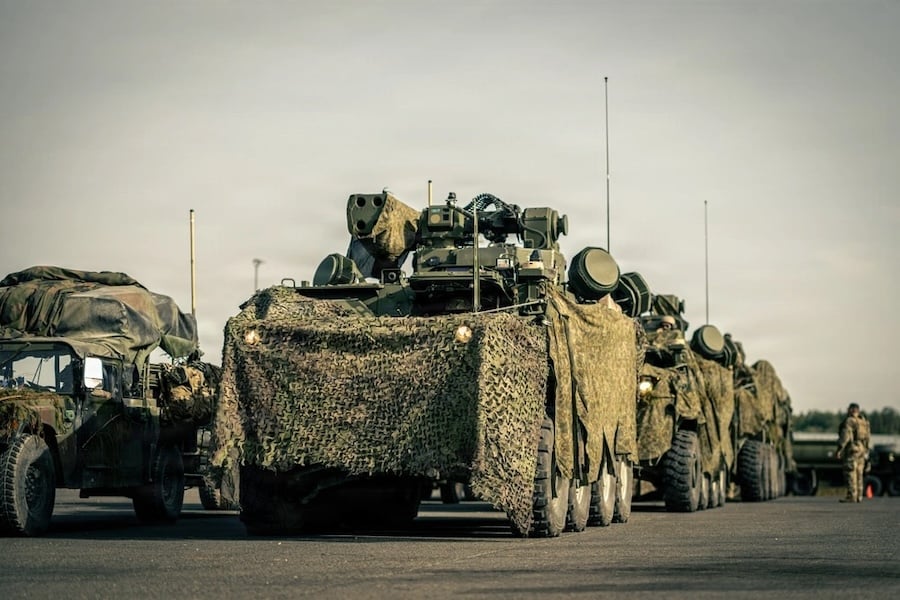
A platoon from Alpha Battery, 5th Battalion, 4th Air Defense Artillery Regiment, is operating the SGT STOUT systems. Previously known as Maneuver Short-Range Air Defense, or M-SHORAD, the system provides mobile protection against aerial threats.
The platoon is supporting the 173rd Mobile Brigade Combat Team (Airborne). Its mission includes protecting Bravo Battery, 4th Battalion, 319th Airborne Field Artillery Regiment, while the unit delivers fire support for maneuver forces.
Drone threats present a growing problem for artillery positions and command posts. SGT STOUT gives units more time to detect and respond to incoming aircraft before they reach their targets.
Without dedicated air defense, howitzer crews may have to use shotguns, small arms or drone-disruption equipment for local protection. Assigning soldiers to that role can leave artillery crews short-handed during deployment and firing operations.
That division of labor was tested on Aug. 28, when Bravo Battery moved several M119A3 towed howitzers into a firing position. SGT STOUT crews secured the airspace while the artillery unit prepared to support maneuvering forces.
“The [SGT STOUTs] are a tremendous asset for us,” said U.S. Army 2nd Lt. Gordon Turner, a platoon leader assigned to Bravo Battery. “The more help that we have from these [M]-SHORAD guys to focus on the UAS threats, we can enable our guys and use them most effectively to shoot artillery.”
SGT STOUT is designed to detect, identify, track and defeat hostile unmanned aircraft. Its presence can help artillery units remain at their firing positions and sustain support for ground operations.
“With the incorporation of air defense on this kind of rotation right here, it allows us to see how a maneuver [unit] would employ us,” said 1st Lt. Christopher Barkley, executive officer for Alpha Battery. He said the systems were positioned to provide early warning across the training area.
“If we do receive any contact, and that can come from a UAS threat, we have to pick up and move to the next location,” said Turner. “But if we can deal with that threat before it affects us then we can stay at our firing point and continue to provide fires to the maneuver unit.”
The training shows how air defense can directly improve the survivability and effectiveness of artillery formations. It also gives both branches an opportunity to refine their coordination during a large-scale multinational exercise.
The 52d Air Defense Artillery Brigade provides integrated air and missile defense support to U.S. Army Europe and Africa. Its mission includes protecting assets and maneuver forces against drones, helicopters and fixed-wing aircraft.