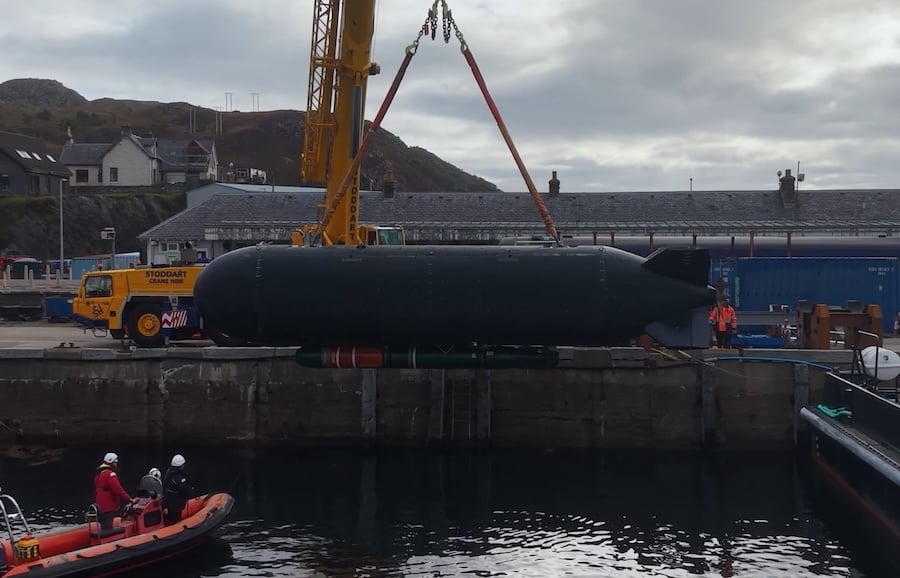
The torpedo was carried beneath XV EXCALIBUR during the demonstration at the British Underwater Test and Evaluation Centre. Conducted through Project Broadsword and Trial Iron, the test validated the mechanical, electrical and software links between the U.S. weapon and the British platform.
The trial also demonstrated the potential for American and British torpedo systems to be used across allied autonomous vessels. That interchangeability is a central objective of AUKUS Pillar 2, which covers cooperation on advanced defence technologies between the United States, Britain and Australia.
“Proving that we can seamlessly launch a U.S. heavyweight torpedo from a Royal Navy autonomous underwater vehicle validates our shared vision for true interchangeability,” said Adm. Daryl Caudle, Chief of Naval Operations. “By integrating weapons, payloads, and mission architectures across allied platforms, we are increasing the flexibility, scale, and combat power of our combined forces and ensuring they are ready to meet the strategic demands of tomorrow.”
The Department of the Navy Rapid Capabilities Office approved the project in February 2026. The partners completed the demonstration in less than seven months, moving from approval to an operational launch within the same year.
The project brought together the Rapid Capabilities Office, OPNAV N97, the Royal Navy, the Defense Innovation Unit and Naval Undersea Warfare Center Keyport. Industry partners and the Navy’s Direct Reporting Portfolio Manager for Robotic and Autonomous Systems also supported the effort.
Vice Adm. Robert Gaucher, Director of Submarine Programs, described the trial as an early step towards adding weapons to autonomous undersea platforms. “Demonstrating the launch of a U.S. torpedo from a UK extra-large unmanned underwater vehicle (XLUUV) is an important early step in developing lethality in our undersea autonomous systems.”
AUKUS members are seeking to use autonomous technology to add lower-cost strike capacity and strengthen deterrence in the Pacific and Euro-Atlantic regions. Adapting commercial and allied undersea vehicles for weapons deployment could give commanders more distributed options in contested waters.
“This effort is proof that the DONRCO and our mission partners are fundamentally redefining how defense technology is accelerated,” said Vice Adm. Seiko Okano, director of the Rapid Capabilities Office. “We are not waiting 10 years for a single bespoke platform; we are pioneering a modular, software-defined, open-systems approach that integrates allied hardware with commercial innovation to rapidly scale distributed lethality.”
The Navy plans to extend the work through Project CUTLASS using Anduril’s Dive-XL uncrewed undersea vehicle. The next phase will examine advanced payload integration, command-and-control architectures and tactical employment scenarios.
Established in August 2025, the Rapid Capabilities Office is tasked with delivering operational capabilities within zero to three years. Its approach focuses on adapting existing and emerging technologies to meet urgent fleet requirements.