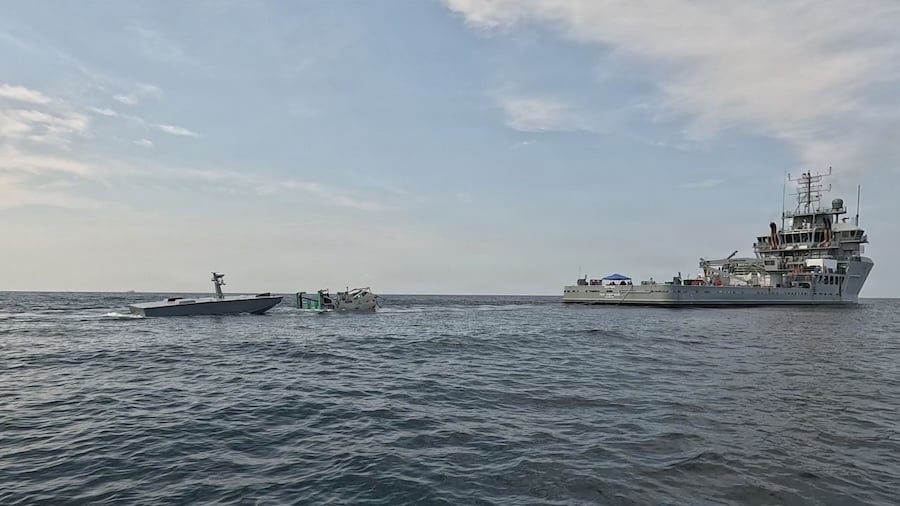
The Aug. 11 demonstration paired the Navy-owned T38 vessel with Sealartec’s towable capture and connection device. A Navy-industry team took the system from concept to testing on the water in seven months.
USNS Vindicator towed the refueling device during the event off Joint Expeditionary Base Little Creek-Fort Story in Virginia. It transferred a total of 400 gallons of fuel to the T38.
The team carried out dozens of full capture, refueling and release exercises at sea, alongside tests at a pier. The system completed about 100 connection cycles over several days, including the main demonstration.
Naval Air Warfare Center Weapons Division’s Blue Water Instrumentation unit is developing the capability to support hypersonic and precision long-range fires testing. Those missions can extend thousands of miles beyond fixed ranges and require widely dispersed data-collection assets.
“But the underlying challenge applies more broadly— every time an unmanned vessel must return to port for fuel, we lose persistence, reduce coverage and redundancy, and interrupt the mission,” said Spencer Holloway, director of the unit’s Future Capabilities Office. At-sea refueling could allow vessels and their sensors to remain on station without pausing operations for a return to port.
U.S. Fleet Forces Command official Ronald Raymer said the system could expand the Navy’s use of unmanned vessels in higher-risk areas. “This will allow us to have greater reliance on unmanned vessels instead of manned and we can push the USV into higher threat areas without risking manned vessels and personnel,” Raymer said.
The demonstration brought together Blue Water Instrumentation, Maritime Tactical Systems and Sealartec. U.S. Fleet Forces Command and the Naval Surface Warfare Center’s Dahlgren and Carderock divisions sponsored the event.
Two Navy acquisition organizations provided the contracting support needed for the work. Their involvement allowed the government and industry participants to test changes and refine the equipment during the seven-month development period.
“Another major takeaway involved our roadmap for transitioning from a remotely operated refueling process to a fully autonomous architecture,” Sealartec Chief Executive Amitai Peleg said. The planned system would use automated communications and maneuvering algorithms to guide an unmanned vessel into position with little human involvement.
The Navy’s next milestone is a fully autonomous test covering rendezvous, approach, capture, fuel transfer, disconnection and return to mission. Current work is focused on reducing command-and-control delays and integrating new local positioning systems.