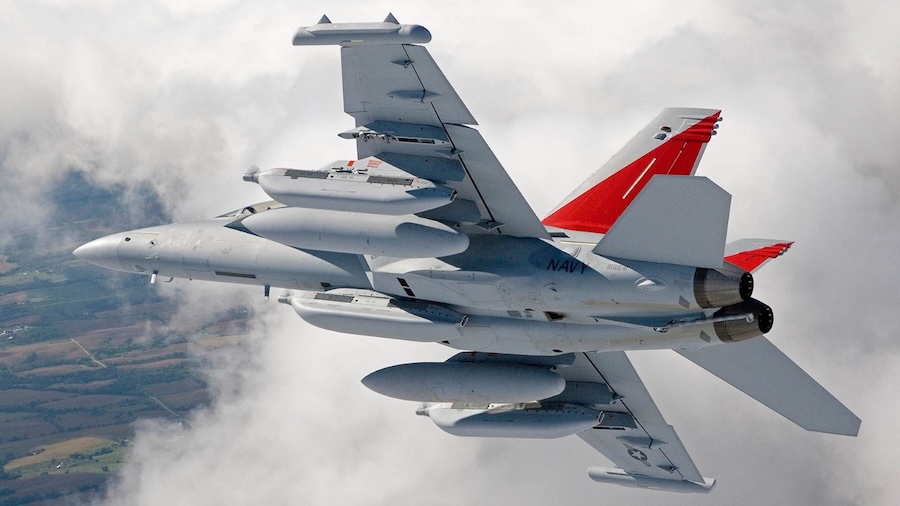
The first Growler, designated EA-1, flew from Lambert International Airport in St. Louis, Missouri, on Aug. 15, 2006. Boeing test pilot Ricardo Traven and chief weapons system operator Rick Junkin were at the controls.
“From the first flight, that I had the pleasure to pilot with my WSO Rick Junkin, it was obvious to us what a terrific capability and future this aircraft would blaze in the years that followed,” Traven said. Development had formally started in December 2003 under a five-year System Development and Demonstration contract between Boeing and the U.S. Navy.
The EA-18G was developed to replace the Northrop Grumman EA-6B Prowler and perform electronic warfare missions including surveillance, jamming and suppression of enemy air defenses. Based on the F/A-18 Super Hornet, the Growler can operate from aircraft carriers and conduct both stand-off and escort jamming missions.
“I started my career flying the EA-6B Prowler,” said former U.S. Navy Growler pilot Paul “Disco” Ritter. “It was an amazing machine — it was fun, like flying a farm truck. Transitioning to the Growler was like upgrading to a Ferrari.”
The first EA-18G was delivered to the Naval Air Test Center at Patuxent River, Maryland, in September 2006, followed by the first fleet aircraft for Electronic Attack Squadron VAQ-129 in June 2008. Growlers completed their first combat deployment in 2011, and Boeing delivered the 100th aircraft to the Navy in May 2014.
Australia became the first country outside the United States to operate the aircraft after Boeing unveiled the first Royal Australian Air Force Growler in July 2015. Boeing inducted the first EA-18G into the Growler Modification Program in March 2021 to support compatibility with Next Generation Jamming capabilities.
Boeing said Growlers have recently supported U.S. and allied operations in the Red Sea, Venezuela and other parts of the Middle East by jamming enemy air defenses. The aircraft can also collect threat information and provide targeting data, threat warnings and protection to platforms including the F/A-18 and F-35.
“The Growler provides added layers of protection for the entire air wing by gathering information on threats not seen in real time and provides that target data, threat warning, and protection to other aircraft like the F/A-18 or the F-35,” Ritter said. “No other military aircraft does what it does, and it has changed how the air wing operates and performs strikes.”
“The range of the threats our military faces today have increased tremendously, and the layered electromagnetic effects the Growler provides reduces the capability of those threats we face,” Ritter said. “The Growler gives our air wing a clear advantage in the fight.”
The Growler Modification Program will increase processing power, improve detection capabilities and enable the aircraft to employ Next Generation Jamming pods. Boeing is also developing the Growler Block II capability suite to extend the EA-18G’s electronic warfare capabilities and support continued protection of U.S. and allied forces.