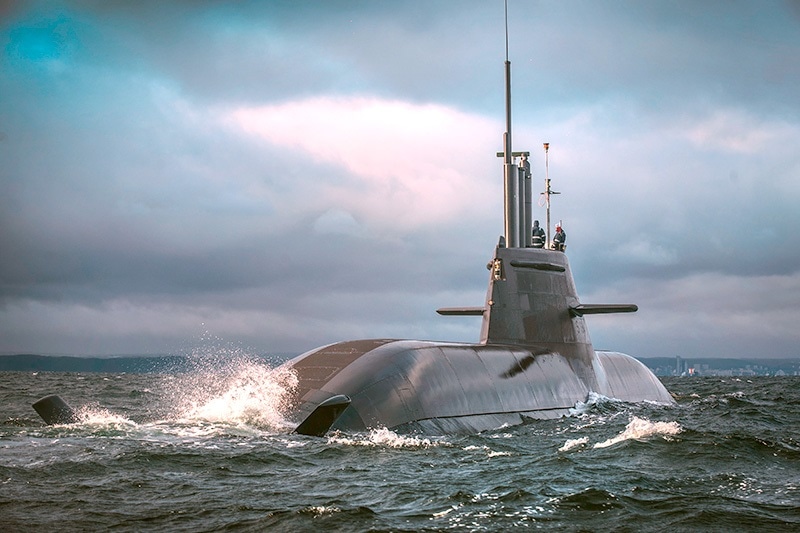
The information indicates that up to 50,000 jobs on average could be created in Canada over the next five years if the federal government selects the German-made submarine. Over the lifetime of the deal, the combined impact of German government and TKMS investments could create more than 654,695 job years of employment.
Until now, the German and Norwegian governments and TKMS had been reluctant to disclose detailed economic benefits tied to their bid. German Defence Minister Boris Pistorius referenced the figures while speaking at the CANSEC defence trade show.
CBC News reported that many of the proposed investments could be delivered within the first two years after a decision by the Carney government. Canada is considering the German-Norwegian offer against a competing proposal from South Korea’s Hanwha Ocean shipyard.
Both companies submitted bids at the beginning of March. They were later given additional time to strengthen their economic proposals and explain how their bids would support Canada’s economy and employment.
Industrial offsets and investment are playing an important role in the competition because Canada’s planned fleet of 12 submarines is expected to be built overseas. The programme is one of the most significant naval procurement decisions now facing the federal government.
TKMS is proposing the construction of two maintenance facilities in Canada, one on each coast. The facilities would use blueprints from an existing centre established in Norway.
The company has also signed teaming agreements with four Indigenous development organisations. The proposal further includes manufacturing centres for heavy torpedoes and anti-torpedo systems.
Another element of the German-led offer includes the potential establishment of a facility to test and possibly build hypersonic missiles. TKMS also wants to produce submarine propulsion systems and batteries in Canada.
Beyond the military components, the German government is proposing large investments in the Port of Churchill in Manitoba. The plan is intended to help move critical minerals and liquefied natural gas to market.
Germany also wants to establish a carbon capture facility through a joint venture with the province of Alberta. These non-military investments form part of the wider economic package attached to the submarine bid.
The federal government is also expected to weigh the geopolitical implications of the decision. Philippe Lagassé, an associate professor at the Norman Paterson School of International Affairs at Carleton University, said the choice would send a broader strategic signal.
“Selecting the German Norwegian boat indicates a deeper commitment to the NATO alliance, an alliance that could solidify mutual defence of the Canadian Arctic, which is something that Canadians are hinging towards and have been considering now for European allies,” Lagassé said.
He said selecting the Korean submarine “would indicate an openness” to a new type of arrangement in the Indo-Pacific. The comment reflects the different strategic directions represented by the two competing bids.
Competition for the multibillion-dollar contract has intensified. Last weekend, the South Korean submarine ROKS Dosan Ahn Chang-ho arrived off the coast of British Columbia for exercises with the Canadian Navy.
The newly built 3,000-ton KSS-III submarine is the type Hanwha Ocean wants to sell to Canada. The federal government has told both bidders that it intends to make a decision by the end of June.
Source: CBC News.