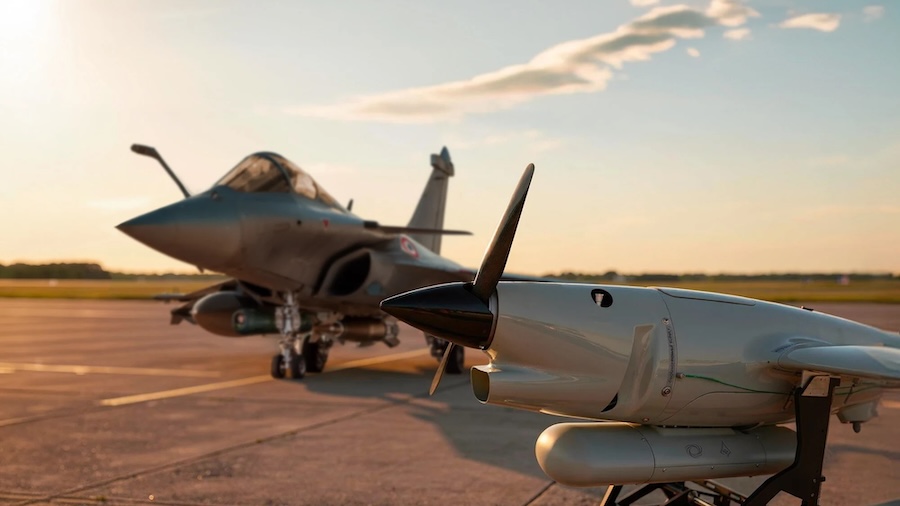
NAMIB was jointly developed by Dassault Aviation and Harmattan AI and is designed to detect, identify and geolocate electromagnetic emissions, including signals from air defence systems. The payload can be carried by tactical drones, including quadcopters, as well as by longer-endurance fixed-wing unmanned aircraft.
During the flight, NAMIB discreetly detected and precisely geolocated a radar located several dozen kilometres away. The target location was then transmitted to the Rafale, which simulated a strike against it.
The companies said development of NAMIB began in January 2026. The payload is one of the main projects under their strategic partnership, which is focused on integrating advanced autonomous capabilities into the next generation of air combat systems.
“This flight demonstrates the Rafale’s real and tangible multi-domain collaborative combat capabilities. The F4 standard architecture enables seamless communication with a very broad range of operational assets, including ground forces, allowing it to effectively leverage new capabilities, such as NAMIB’s electromagnetic detection and geolocation functions”, said Eric Trappier, Chairman and CEO of Dassault Aviation.
“It also provides another illustration of the Rafale’s continuous adaptation to evolving operational requirements, and, in this case, to ‘high-low mix’, that is, the combination of highly sophisticated systems with autonomous and expendable effectors.”
“Electronic warfare has become a decisive factor in achieving operational superiority. Through NAMIB, we are demonstrating that these capabilities can now be deployed on lightweight autonomous systems operating close to the threat.”
“This achievement highlights the complementary strengths of Dassault Aviation and Harmattan AI, combining decades of experience in air combat systems with our expertise in autonomy and embedded intelligence. Together, we are demonstrating that it is possible to accelerate the integration of disruptive technologies for the benefit of the armed forces and lay the groundwork for the collaborative combat architectures of tomorrow”, said Mouad M’Ghari, Co-Founder and CEO of Harmattan AI.
The demonstration points to a growing role for uncrewed systems in electronic warfare and collaborative combat. By placing an electronic-warfare payload on a drone, the concept allows detection and geolocation tasks to be carried out closer to the threat while keeping the crewed aircraft at greater distance.
Harmattan AI develops autonomous robotic defence systems for missions including air defence, intelligence, surveillance and reconnaissance, strike, electronic warfare and command and control. The company said its systems are built for real-world operations in contested environments and are intended to support Western and allied countries.
Dassault Aviation said it has delivered more than 10,000 military and civil aircraft to over 90 countries during the past 110 years. Its portfolio includes the Rafale fighter, Falcon business jets, military drones and space systems, and the company reported about 15,000 employees and revenue of €7.4 billion in 2025.