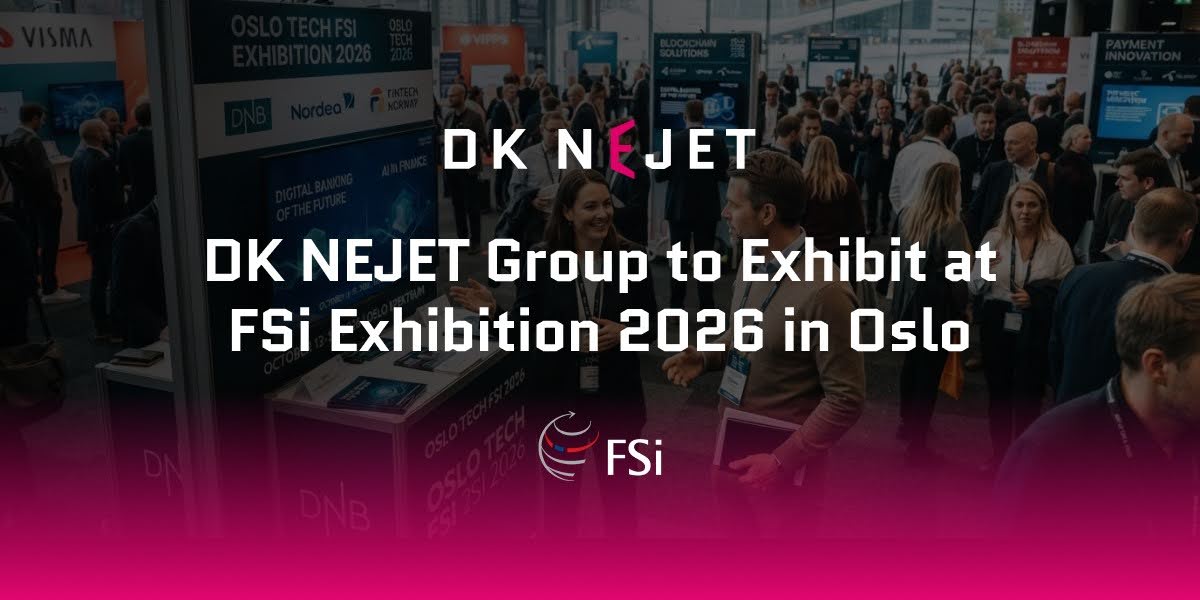
The FSi Exhibition 2026, held on 25–26 August at NOVA Spektrum in Lillestrøm, brought together representatives from the Norwegian government, armed forces, police, diplomatic missions, and the defence industry.
DK NEJET Group, a software-focused autonomous systems company operating in Ukraine, Latvia and Norway, used the exhibition to present its capabilities and discuss requirements emerging from the war in Ukraine and the wider European defence build-up.
Focus on autonomy and scalability
DK NEJET’s Group’s Head of Strategic Projects said the exhibition highlighted Norway’s parallel focus on national defence development and support for Ukraine.
“The biggest takeaway from FSi was seeing Norway invest more heavily in its own defence build-up while, in parallel, continuing to support Ukraine and actively learning from what’s happening on the ground there. The two aren’t competing priorities — they’re feeding each other. What that tells you is that European defence is moving from a model of outsourced capability to one of sovereign, resilient, distributed capability built for peer-to-peer threat environments.
What stood out most, walking the floor, was the sheer number of new, innovative companies present alongside the established primes. The industry floor felt noticeably more crowded with fresh players than in previous years — a sign of how fast this space is opening up. But that also means that with so many new entrants appearing, you need to move quickly to stay visible and differentiated. Being an early mover isn’t enough anymore.
The lessons coming out of Ukraine are shaping buyer priorities directly: protecting operators, cutting down the maintenance and logistics footprint needed to keep systems running, and reducing the training burden required to field them. That’s translating into strong demand for cost-effective, autonomous UAVs and UGVs — and specifically for swarm capability, where one operator can control multiple assets instead of needing a dedicated crew per platform.
Attrition rates in real combat mean systems have to be inexpensive enough to lose without breaking the budget, which rules out exquisite platforms as the default. Autonomy is being pushed further down the mission chain — target tracking, navigation in GPS-denied environments, coordinated multi-unit behaviour — specifically to reduce a mission’s dependence on a highly trained operator staying present and unjammed throughout. And swarm logic is increasingly seen as the practical answer to saturation-style threats, where a single system simply can’t respond fast enough on its own.
What’s needed most is capability that can scale fast — cost-effective interception and autonomy that keeps operators safe and can be fielded without long lead times, because the pace of the threat isn’t waiting for traditional development cycles. Our consortium with several Norwegian companies is a direct answer to that: combining autonomous systems, resilient communications and munitions expertise into one European-built, European-sustained platform.”
Lessons from Ukraine
According to DK NEJET Group, discussions at FSi reflected several priorities that are increasingly shaping the development and procurement of autonomous systems:
- reducing the exposure of operators;
- lowering maintenance, logistics and training requirements;
- improving performance in GPS-denied and communications-contested environments;
- enabling one operator to control multiple platforms; and
- developing affordable systems that can be produced and deployed at scale.
The company said that swarm capability is increasingly being assessed in terms of operational performance, including the number of platforms that can be coordinated, communications latency, resilience to electronic warfare and overall cost.
“The biggest opportunity is to keep growing that model — proven, affordable technology developed in close contact with the units using it, delivered through partnerships that let Europe build and sustain its own capability rather than depend on it from outside. That’s where we should be putting our energy.”
About DK NEJET Group
DK NEJET Group describes itself as a software-focused autonomous operations provider. The company develops swarm-coordination software, autonomous platforms and training programmes for operators.
The group works with government, industry and research partners in Ukraine, Latvia, Norway and other European countries.
According to company figures, more than 90 units have been deployed in active operations, while its distributed team includes more than 200 personnel. DK NEJET Group reports a 67% field success rate for its systems.