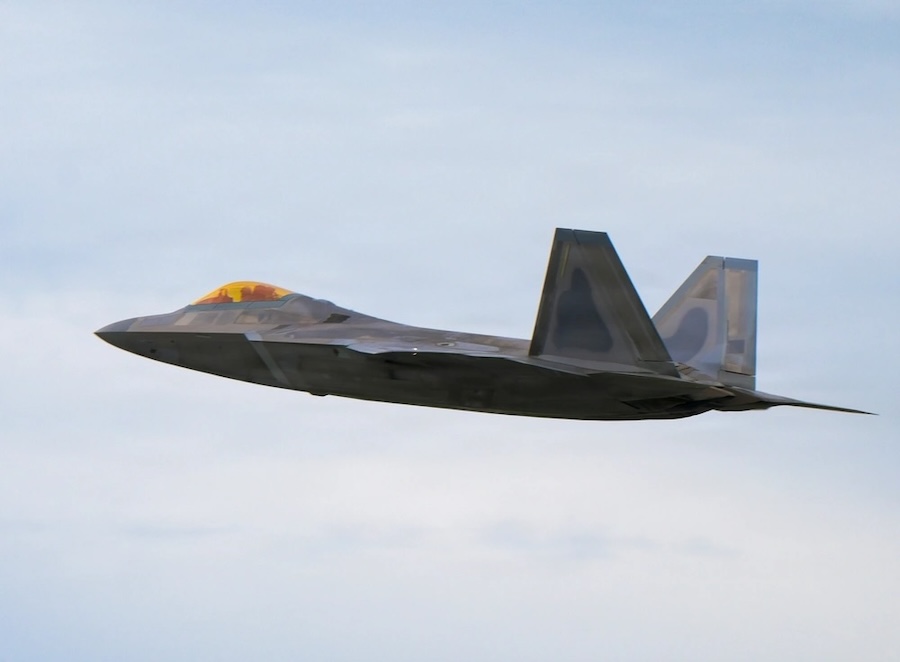
The F-35Cs came from Marine Fighter Attack Squadron 251 at Marine Corps Air Station Cherry Point, North Carolina. F-22s from the Air Force’s 3rd Wing at Joint Base Elmendorf-Richardson, Alaska, provided the other fighter element.
E-3 Sentry aircraft operated by the 961st Airborne Air Control Squadron at Kadena Air Base, Japan, also participated. Their presence added airborne command-and-control capability to the joint fighter operations.
Red Flag-Alaska 26-3 was designated a Special Technical Operation flag, allowing forces to synchronize capabilities across air, space and cyberspace. The scenarios introduced operational disruptions intended to replicate conditions associated with peer and near-peer adversaries.
“We focus on integrating STO effects into the battlespace to provide realistic degradations that our forces can expect to see in a peer and near-peer conflict,” said U.S. Air Force Capt. Jason Bentley, 354th Operation Group Detachment 1 Red Flag 26-3 team lead. “For example, we leverage non-kinetic effects, which are military or strategic actions that achieve goals without using physical destruction or traditional explosive force that disrupt and complicate coordination for our forces.”
Participants practiced coordinating joint and coalition operations against complex air-defense systems. They also combined a broad range of effects to overcome those threats in a contested environment.
“Working with the Air Force during this exercise has been a great opportunity to learn from each other and see how different teams approach the same challenges,” said U.S. Marine Corps 1st Lt. Phil English, an F-35C pilot assigned to VMFA-251. “We’ve been able to talk through different exercise scenarios, share our experiences and learn what works well from one another.”
The Joint Pacific Alaska Range Complex provided 120,000 square miles of airspace for the training, with primary operations based at Eielson Air Force Base and Joint Base Elmendorf-Richardson. The range allowed participants to progress from individual skills to complex, large-scale engagements.
Red Flag-Alaska is sponsored annually by Pacific Air Forces and has a long history of allied and partner participation. The training is intended to exchange tactics and procedures, improve interoperability and support layered operations for homeland defense and power projection.