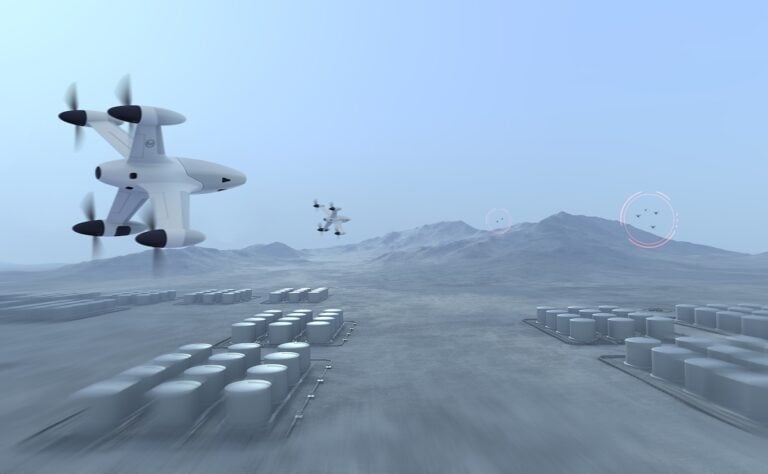
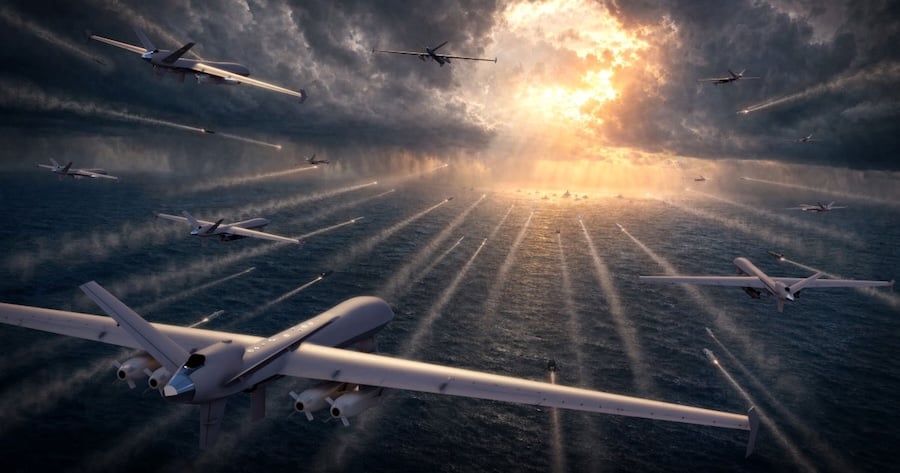
Wildfire is designed to be scalable, mission-focused and tolerant of combat losses. Its intended role is to provide significant aircraft numbers for demanding operations in which cost and the ability to replace losses shape operational capacity.
General Atomics has limited the aircraft to a defined set of capabilities rather than attempting to replicate every function of its existing platforms. The company said those design choices are intended to balance payload, range, affordability and production scale.
Wildfire will carry multispectral targeting sensors and other mission equipment for intelligence, surveillance and reconnaissance. The aircraft was also designed to accommodate different effectors, including long-range precision-strike weapons.
The platform will use mission-autonomy technology based on the approach adopted for the FQ-42A Collaborative Combat Aircraft now in production for the U.S. Air Force. Human operators will control Wildfire through U.S. government-provided autonomy software rather than a conventional ground control station.
That model is intended to reduce crew requirements and allow one operator to control multiple aircraft. General Atomics said it will also support faster responses during combat and help operations continue when communications or other systems face disruption.
Wildfire sits within the company’s Massed Modular Aircraft concept, combining autonomous operation with a flexible payload architecture. The design is intended to support deployments in larger numbers across a focused range of reconnaissance, surveillance and strike missions.
The aircraft draws on more than three decades of General Atomics’ work in uncrewed aviation. The company has delivered more than 1,600 Predator, Reaper, SkyGuardian, Avenger and FQ-42A aircraft, which have recorded nearly 10 million flight hours, mostly in combat.
General Atomics unveiled Wildfire on September 10, 2026, as a clean-sheet addition to its uncrewed aircraft portfolio. The company said the design incorporates lessons from large-scale global operations and changes made in response to evolving battlefield requirements.