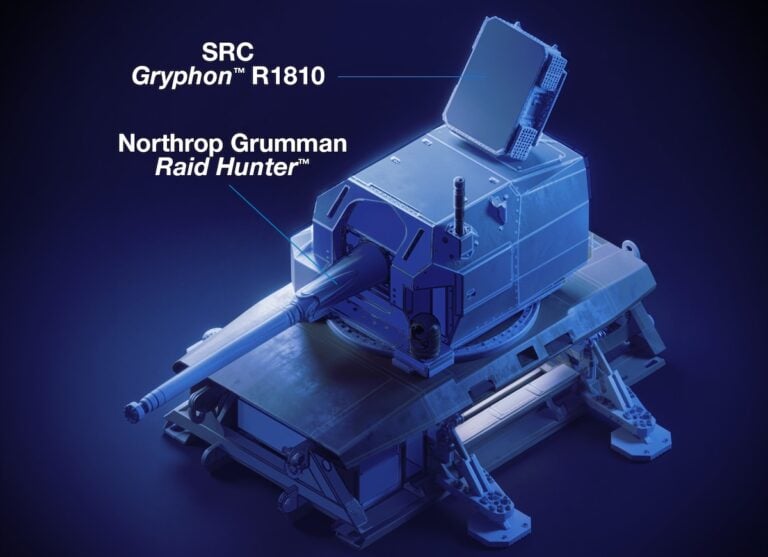
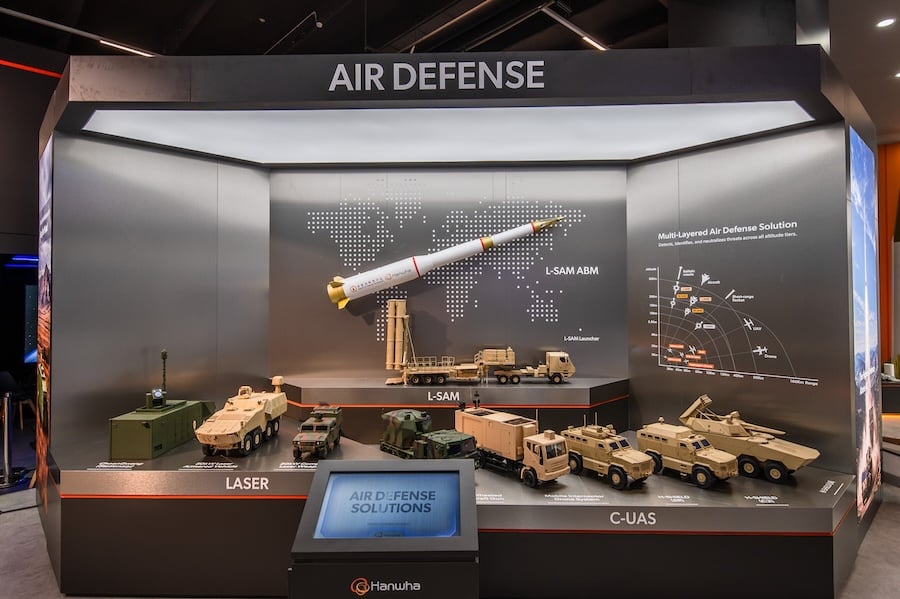
The proposed architecture combines the L-SAM long-range air defence system with the H-SHORAD short-range system. Lower-tier protection comes from the H-Shield counter-drone system and a wheeled 40 mm counter-UAS platform.
Hanwha Systems’ command-and-control technology connects the individual layers into an integrated network for detecting, tracking and engaging targets. The architecture also works with interceptor drones.
The air defence portfolio forms a central part of the companies’ joint exhibition at the 34th International Defence Industry Exhibition in Kielce. Hanwha says the systems address the requirements of Poland and other NATO members in Central and Eastern Europe and the Baltic region.
Laser weapons provide an additional layer against unmanned aircraft. Hanwha Systems presents Cheongwang, the first South Korean laser weapon system in service, along with a 50 kW laser mounted on an armoured vehicle and a 20 kW tactical system.
Hanwha says one use of Cheongwang costs about PLN 6, providing an economical method of engaging small drones. The system neutralises such targets within several seconds.
The air defence push represents a new phase in Hanwha’s relationship with Poland. The cooperation dates back to the 2014 selection of K9 chassis for the Polish Krab self-propelled howitzer and now includes K9 artillery systems and K239 Chunmoo launchers, which are known in Poland as Homar-K.
“The K9 and Homar-K programmes have shown that we can turn declarations into concrete action,” says Jacek Cyrek, President of the Management Board of Hanwha Aerospace Europe. “Today, we want to expand this cooperation into additional areas, from artillery and ammunition, through air defence and unmanned systems, to new technologies.”
Cyrek says Hanwha’s plans support both national security and Poland’s domestic defence industry. “Our goal is to build in Poland and with Poland the expertise and capabilities that strengthen the country’s security and the sovereignty of its defence industry.”
Hanwha also presents a manned-unmanned teaming concept linking a K9A1 howitzer with an unmanned amphibious multiple-launch rocket system and the H-UGV unmanned ground vehicle. The arrangement assigns fire-support missions to the crewed platform while unmanned vehicles conduct reconnaissance and manoeuvre tasks.
The maritime section includes unmanned surface vessels intended for potential naval modernisation programmes in the Baltic region. Among them is the Striker-S, an unmanned surface vessel integrated with a Chunmoo launcher.
Artillery remains a significant part of the exhibition, led by the K9A2 and new 155 mm ammunition technologies. Hanwha Aerospace is also holding discussions with Poland on further cooperation under a third executive contract for the K9 self-propelled howitzer programme.
Hanwha Systems separately demonstrates an artificial intelligence platform that analyses real-time electro-optical, infrared and synthetic aperture radar satellite imagery. Its algorithms detect and classify objects, analyse patterns and identify anomalies to shorten data-processing and decision-making times.