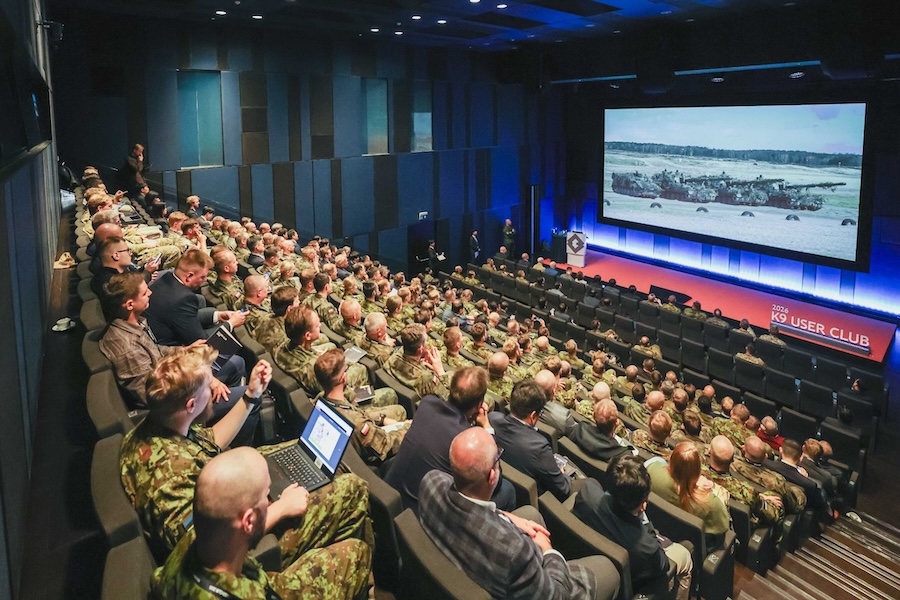
The South Korean group presented the concepts at the fifth K9 User Club in Tartu, Estonia. The forum brought together more than 200 military and industry representatives from seven K9 operator nations, with Spain and Sweden attending as observers.
Hosted by the Estonian Defence Forces from 2 to 4 September, the meeting focused on operational lessons, maintenance, ammunition interoperability, training and future requirements. Participants also examined opportunities for closer cooperation across the K9 user community.
“The K9 has established itself as an outstanding and highly capable artillery system,” said Major General Viktor Kalnitski, Deputy Commander of the Estonian Defence Forces. “Its performance, reliability, and operational capabilities have earned the trust of a growing number of NATO allies and partner nations.”
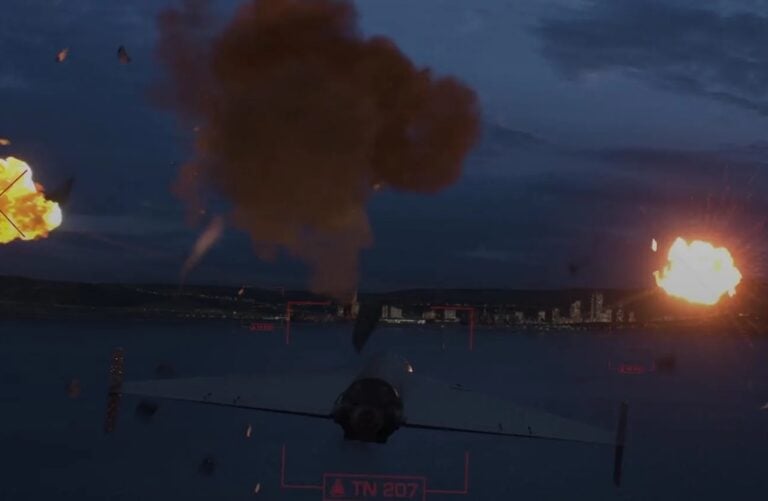
At the centre of Hanwha’s proposal is a vertical take-off and landing fire-guidance drone integrated directly into K9 fire missions. The aircraft detects and tracks targets, generates coordinates and sends the data to the fire-direction system.
The drone can remain over the target area throughout an engagement, supporting target acquisition, observing impacts and conducting battle-damage assessment. Hanwha said continuous aerial coverage would help artillery units engage moving or time-sensitive targets while reducing their reliance on forward observers in exposed positions.
The concept shifts attention from improving the howitzer alone to shortening the entire sensor-to-shooter cycle. Hanwha described it as the next stage in K9’s development into a connected and networked artillery system.
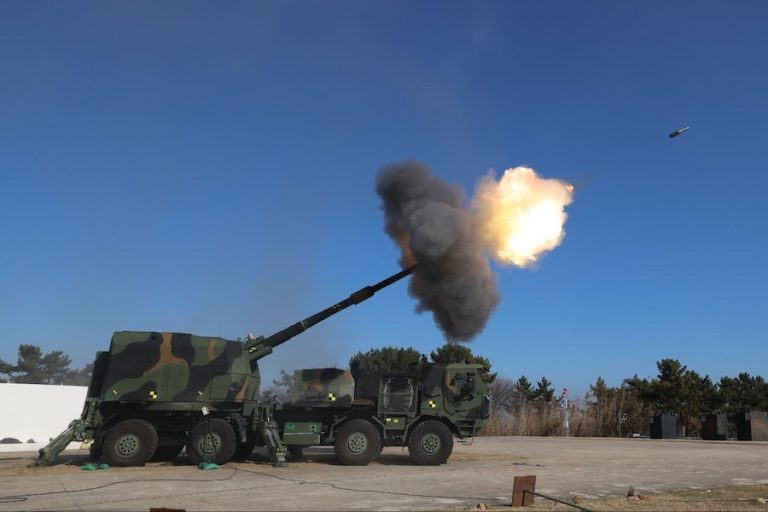
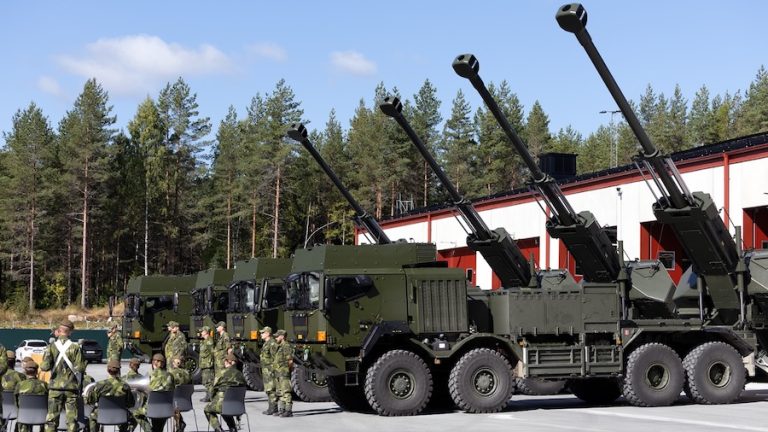
The company also outlined wheeled artillery concepts using established K9 technologies, including the K9A2’s fully automated turret. These configurations are intended to offer greater operational mobility and deployment flexibility while retaining the platform’s existing technology base.
Hanwha also cited its selection for the US Army’s Mobile Tactical Cannon prototype programme as evidence of its expanding work in mobile artillery. The company is positioning the K9 technology base to support multiple tracked and wheeled configurations.
Alongside the new operating concepts, Hanwha presented its TOMMS Sustainment Portal for spare-parts procurement and logistics. The system combines requests for quotations, quotations, purchase orders and delivery tracking on a single digital platform.
A catalogue within TOMMS covers between 700 and 800 frequently requested components. Hanwha plans to connect the portal with its spare-parts warehouse in Poland to strengthen support for European operators.
The company ultimately intends to use maintenance and operational data to forecast demand and position components before they are needed. Hanwha expects that approach to increase availability and fleet readiness while reducing lifecycle support costs.
“The K9 User Club has become much more than an annual gathering,” said Peter JK Bae, Senior Executive Vice President and Head of Hanwha Aerospace’s MRO Business Division. “Every lesson learned in the field helps shape the next generation of K9 capabilities—from new operating concepts and mobility solutions to smarter sustainment.”
More than 2,400 K9-family systems have been ordered by over 10 countries across Europe, Africa and the Asia-Pacific region, according to Hanwha. Its technology roadmap extends from the digitalised K9A1 and automated K9A2 to the planned autonomous and uncrewed K9A3 and future wheeled artillery systems.
Participating countries host the K9 User Club on a rotating basis. Australia is scheduled to hold the next forum in 2027.