

The program brings together the Ministry of National Security, Israel Innovation Authority, IAI, the Technion and the Israel Fire and Rescue Authority. Its first flight test has been completed, with additional trials planned across different operational scenarios and field conditions.
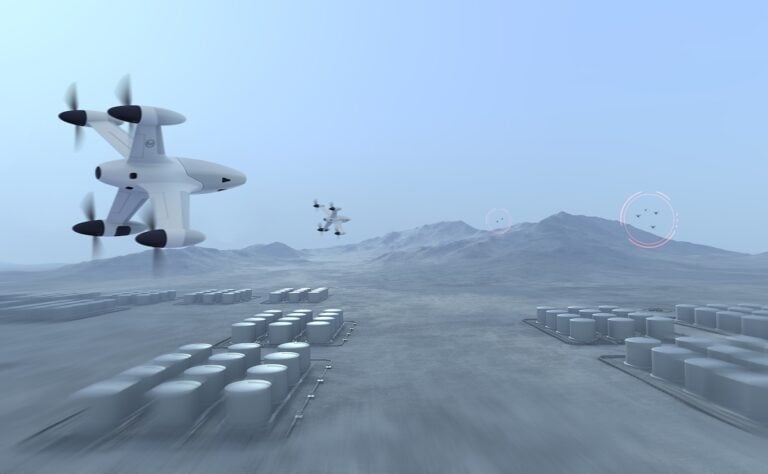
IAI integrated a dedicated fire-detection system onto the APUS 25 tactical unmanned aircraft. The vertical takeoff and landing platform can operate without a runway, fly at high altitude and remain airborne for extended periods.
The payload combines daytime, night-vision and infrared cameras. Its infrared sensors are designed to identify fire hotspots in darkness and through dense smoke.
Spectral image-processing algorithms and artificial intelligence analyze incoming data in real time. The system detects anomalies, identifies fire outbreaks and calculates their location from high altitude.
The partners said a single aircraft could monitor hundreds of square kilometers. The system is designed to detect fires within minutes and determine their location with meter-level accuracy.
The APUS 25 uses an internal combustion engine rather than electric motors or batteries. IAI said the configuration supports extended surveillance missions in difficult terrain and changing weather conditions.
A firefighter will define the search area by marking a polygon on a digital map. After takeoff, the aircraft will operate autonomously and scan the selected area for four to five hours.
The drone will position itself at an optimal observation point and provide a continuous operational picture. The data is intended to support incident management, decision-making and the deployment of firefighting resources.
“This project represents another step forward in advancing innovative technological capabilities for Israel’s security and emergency organizations,” said Yaron Schone, Head of R&D Technology Department at the Israel Ministry of National Security. “The combination of drones, artificial intelligence, and advanced data-processing capabilities has the potential to enable earlier fire detection, improve operational situational awareness, and shorten response times in the field.”
“For many years, IAI has been developing advanced technological solutions for complex challenges across both defense and civilian domains,” said Moshe Levy, EVP and GM of IAI’s Military Aircraft Group. “This unique project demonstrates our ability to leverage our expertise, operational experience, and capabilities in aviation, artificial intelligence, and autonomous systems to address an issue of both national and global importance.”
“Climate change and the increasing frequency of extreme weather events require us to develop the future capabilities of the Israel Fire and Rescue Authority today,” said Lieutenant General Eyal Caspi, Commissioner of the Israel Fire and Rescue Authority. “We are investing in advanced technologies that will enable earlier detection, enhanced command and control, and faster responses to large-scale wildfire events.”
The planned trials will assess the system under changing terrain, weather and operational conditions. The objective is to help emergency organizations identify and contain fires before they develop into large-scale wildfires.