
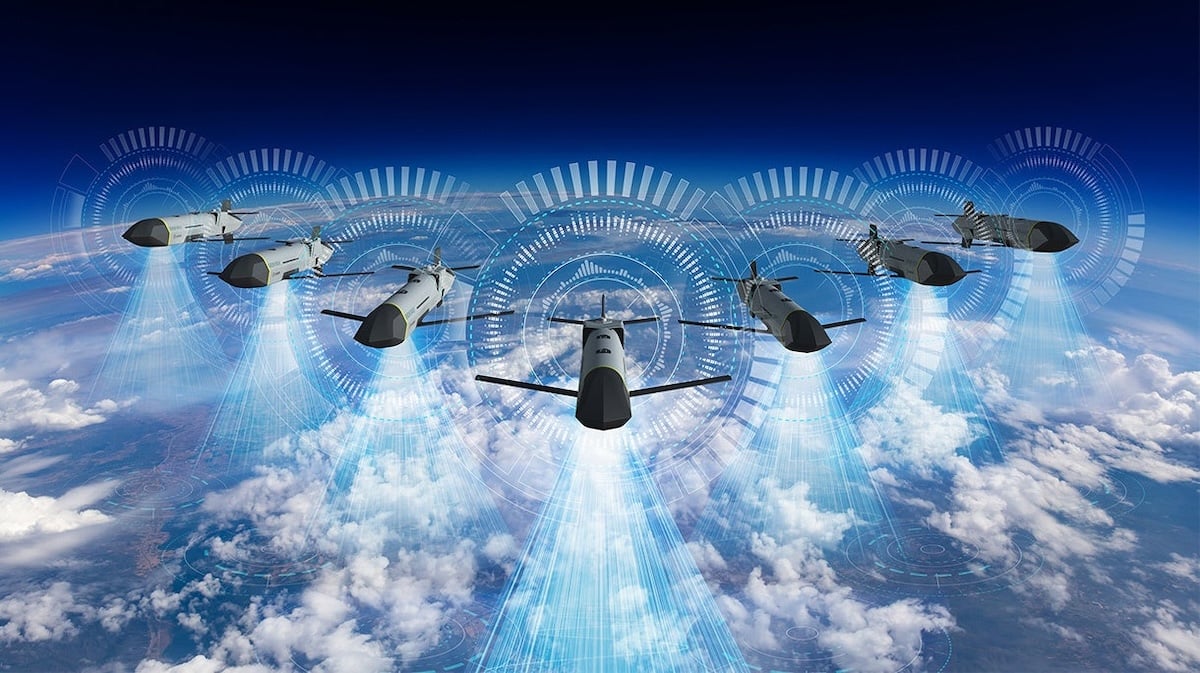
The portfolio consists of Red Wolf, intended for kinetic strikes, and Green Wolf, which carries an electronic warfare payload. Both use a common air vehicle to limit integration requirements and reduce logistical demands.
The company recorded 13 fixed-wing aircraft launches, three rotary-wing aircraft launches and 44 ground launches. Across the 60 flights, the vehicles supported 10 radios, six electronic warfare payloads, one seeker and integration of two autonomy engines.
Shared platform, different missions
Red Wolf and Green Wolf use modular designs that allow payloads to be changed as mission requirements evolve. Their software supports real-time collaboration in flight, dynamic retargeting and coordinated autonomous swarming.
L3Harris said the vehicles can provide electronic support, electronic attack and long-range precision strikes as separate missions. With autonomy, those capabilities can also operate together in a cooperative swarm.
The vehicles can be configured for recovery. The company said their launch flexibility and adaptable payloads support integration into current and future military force structures.
Testing informs further development
L3Harris said flight data has supported development, while demonstrations for military users have helped refine the human-machine interface and operational concept. Its launched-effects portfolio has demonstrated increasing capability since 2021.
The company draws on 20 years of air vehicle production experience, including delivery of more than 1,200 released effects. It said that experience underpins further work on autonomous vehicle interfaces and systems.
L3Harris cited geopolitical events as a driver of growing demand for launched effects. It also said the Department of War is accelerating investment in launched effects and autonomous systems.