Saab said it has not signed a contract or received an order related to the announcement at this stage. The company said the decision confirms GlobalEye as NATO’s chosen solution for its future AEW&C capability.
NATO has identified the need to replace its existing airborne early warning and control capability. The planned acquisition is part of a broader effort to modernise and strengthen the Alliance’s surveillance and situational awareness capabilities.
“We are honoured and proud to support NATO in its next-generation AEW&C capability,” said Micael Johansson, President and CEO of Saab. “We are confident that GlobalEye is the right choice for the Alliance, delivering proven capability, adaptability and long-term operational advantage.”
“Today’s announcement clearly positions GlobalEye as the world-leading solution for advanced airborne early warning and control,” Johansson said. “We look forward to the next steps in the negotiations.”
Saab said GlobalEye would enable NATO to monitor large areas of land, sea and air. The company said the system would significantly improve the Alliance’s ability to detect and respond to a wide range of threats.
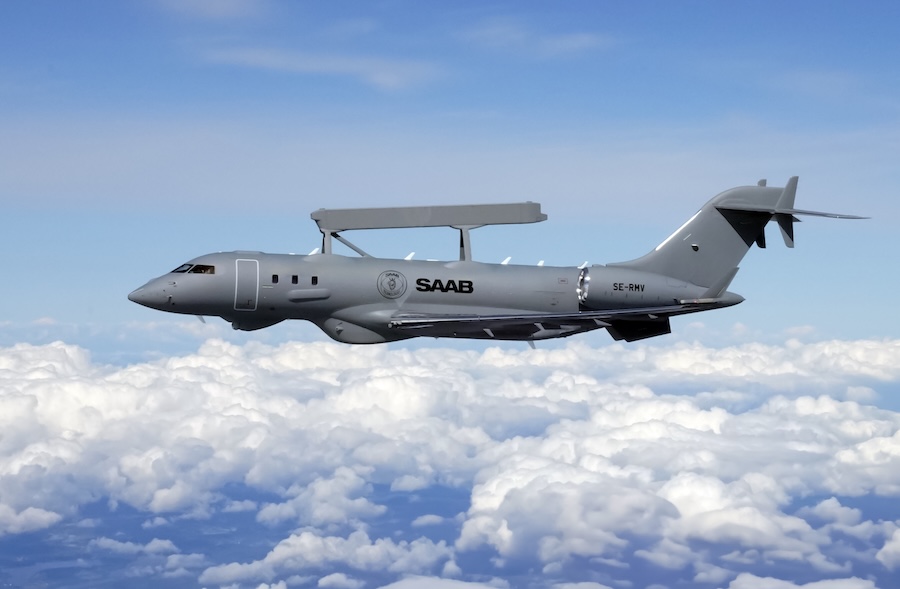
GlobalEye combines Saab’s Erieye Extended Range radar with an advanced sensor suite and a multi-domain Command and Control system. The system is installed on a Bombardier Global 6500 aircraft.
As an AEW&C system, GlobalEye provides long-range detection with high update rates. Saab said it can identify low-observable and stealthy threats, as well as drones, ballistic and hypersonic missiles, including in complex environments with heavy clutter and electronic jamming.
Saab will now proceed to formal negotiations with the NATO Support and Procurement Agency. The talks are intended to secure a contract for NATO’s future airborne early warning and control capability.