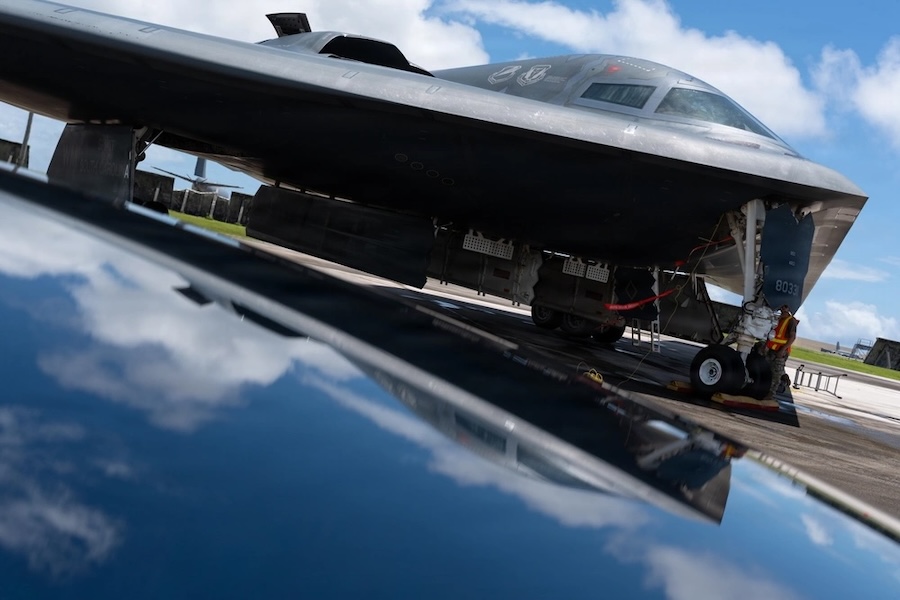
Chief Executive Officer Kathy Warden linked the B-21 to that technological lineage during Northrop Grumman’s second-quarter 2026 earnings call on July 21. She pointed to the B-2 Spirit and B-21 as signature examples of the company’s flying-wing technology.
Warden opened the call by recalling the B-2’s July 4 flyover of Washington, calling the aircraft “a symbol of American strength and ingenuity.” She said Northrop Grumman’s technologies had helped transform the aerospace and defense industry, specifically citing the flying-wing design embodied in both stealth bombers.
The company is now moving deeper into the B-21 production cycle. The central question is whether the Air Force will increase the scale and pace of that effort beyond the current program of record.
Asked whether the service was considering a B-21 fleet larger than 100 aircraft, Warden said an agreement already reached with the Air Force gives it scope to examine both faster production and a larger program.
“The agreement we reached with the Air Force does allow them to consider accelerating production into a larger program of record,” Warden said. Northrop Grumman is working with the service on the analysis, which she expects the Air Force to complete by the end of 2026.
Warden did not identify a possible new fleet size or disclose the production rates being considered. She also did not predict the outcome of the Air Force review.
B-21 activity is already becoming more significant within Northrop Grumman’s aerospace business. Chief Financial Officer John Greene said Aeronautics Systems sales increased 13% in the second quarter, driven partly by higher B-21 volumes.
Program execution has also improved the financial position of the bomber work. Greene said B-21 execution had been strong during the year and was helping move overall program profitability in a positive direction.
Northrop Grumman raised its 2026 sales outlook for Aeronautics Systems to approximately $14 billion. The revised forecast reflects higher B-21 sales as the program continues to ramp, along with increased volumes on mature production programs.
Supporting that growth requires additional industrial capacity. Northrop Grumman expects capital expenditures to remain around 4.5% of sales in 2027 and 2028 while it invests in infrastructure for the B-21 production ramp.
Warden said the company’s previous investments in advanced capabilities and manufacturing capacity were now positioning it for stronger growth. She specifically identified the B-21 among the programs benefiting from those investments.
That combination of established flying-wing expertise, higher B-21 volumes and continued factory investment places advanced air power at the center of Northrop Grumman’s Aeronautics growth strategy. The Air Force’s assessment of a larger B-21 program could further increase the scale of that production effort.
The B-2 remains the technological reference point in Warden’s remarks, but management provided no new program or modernization update for the Spirit. The company’s current investment and production focus is firmly on the B-21 and the industrial capacity required to deliver it at higher volumes.