
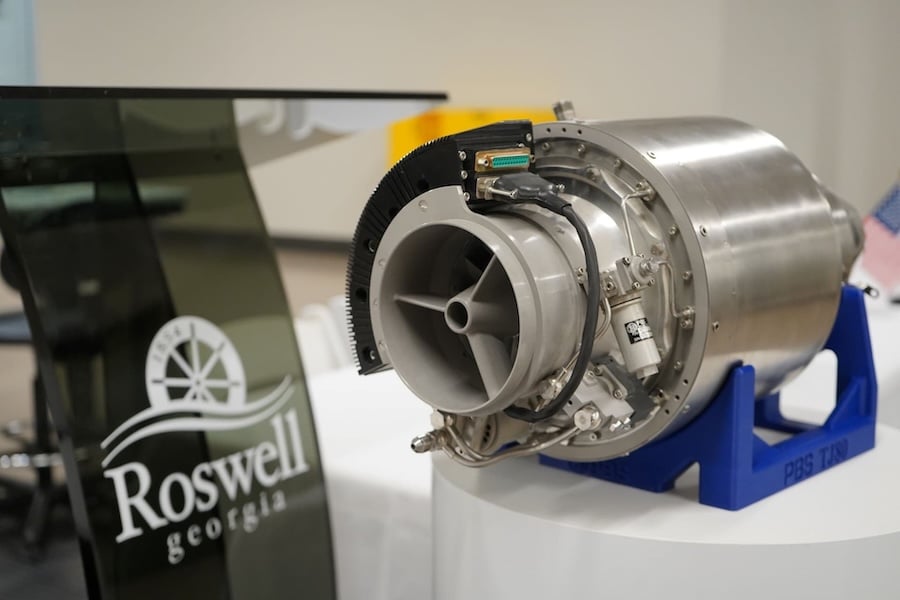
The addition includes two engine test cells that are already operating. It is PBS Aerospace’s second completed buildout in 12 months and increases the facility’s total footprint to 30,000 square feet.
PBS Aerospace started production at the site in September 2025 after investing $20 million in the initial facility. The plant was built and brought online in less than a year and now employs 90 people, including a significant number of veterans.
The investment addresses a common constraint in engine manufacturing because every unit must undergo testing before delivery. Additional assembly space alone cannot raise output when test-cell availability limits the number of completed engines that can be shipped.
PBS Aerospace funded the expansion before a U.S. program of record was in place to support it. The company has now begun planning a second production shift in anticipation of additional government requirements.
“When we decided to build in the United States, our goal was to expand our capabilities to meet expected future demand from the US Government,” said William Didden, owner of PBS GROUP. “We continue to increase capacity so that, as additional demand emerges, we can support as much of it as possible.”
The expansion comes while the Department of War is seeking larger volumes of affordable munitions from a supply base that was not structured for current demand. PBS Aerospace said its decision to build ahead of orders was intended to make production capacity available when customers require it.
“Precision turbojet development and manufacturing takes years to master and cannot be improvised,” said Petr Kádner, Chief Executive Officer of PBS GROUP. “What our teams have done in Roswell is take that capability and knowledge and put it on American soil at American speed.”
“For our customers, what matters is capacity that is actually available,” said Jakub Fischer, Managing Director of PBS Aerospace. “That is why we did not wait for future orders and instead invested in expanding our production and testing capabilities ahead of demand.”
“We finished this expansion, brought the test cells online, and we are producing engines in that space today,” said Erin Durham, Chief Executive Officer of PBS Aerospace. “We have demonstrated we can build highly reliable, combat-proven engines in high quantities right here in Georgia.”
The project follows a $3 million U.S. Air Force prime contract awarded to PBS Aerospace in March 2026. The contract supports the Family of Affordable Mass Munitions and other active Air Force programs and was the company’s first publicly disclosed prime award directly from the U.S. government.
“Every government I have worked with is asking the same question right now: who can actually build these engines at volume and how soon,” said Jan Havránek, Chief Government Relations and Strategy Officer at PBS Aerospace. “The answer has to exist on the factory floor before it can exist in a program plan.”
PBS Aerospace is the U.S. subsidiary of aviation technology manufacturer PBS GROUP and has operated in the American market for more than a decade. The company supplies turbojet engines to the U.S. Department of War and commercial customers.