The company said SPY-6 advances integrated air and missile defense at sea by giving the Navy greater awareness to detect, track and respond to advanced threats. Raytheon also said the radar supports interoperability across the fleet and with allied forces, strengthening readiness and regional security.
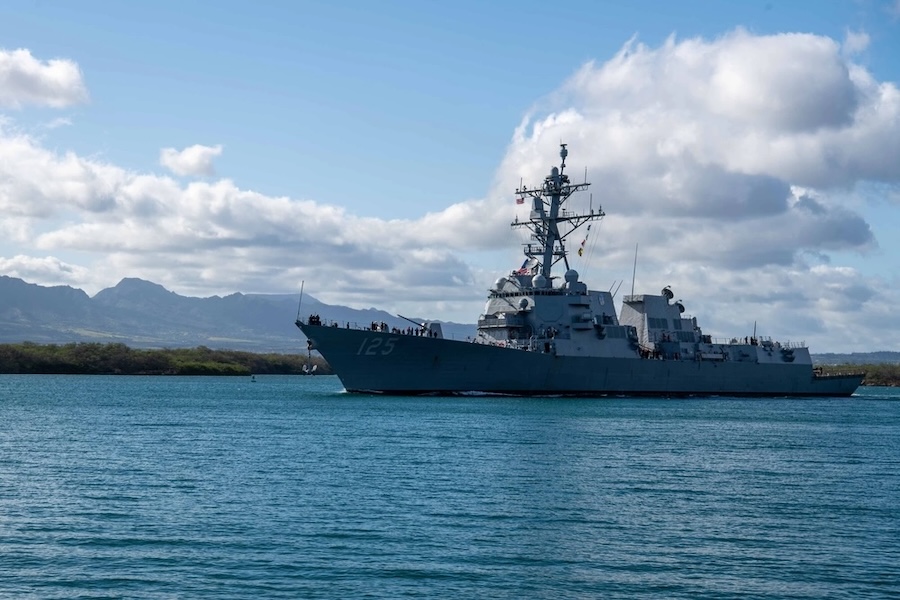
Pacific Dragon concluded Aug. 15 after operations off Kauai and at the Pacific Missile Range Facility in Hawaii. The exercise was the eighth iteration of the biennial multilateral air and missile defense event.
U.S. Third Fleet executed Pacific Dragon with support from the Missile Defense Agency. Forces from Australia, Italy, Japan, the Republic of Korea, Chile and Spain participated, with Chile and Spain joining for the first time.
The participating nations conducted multilateral ballistic missile defense operations and exchanged information through tactical data links. Multi-mission events combined ballistic missile defense and integrated air and missile defense scenarios.
The exercise also included simulated ballistic target-tracking events designed to employ and improve each nation’s air and missile defense capabilities. Participants evaluated cooperative tactics, operational procedures and information-sharing methods.
The Missile Defense Agency used Pacific Dragon to gather live-tracking data, validate sensor performance and refine the Aegis Ballistic Missile Defense system. The agency has participated since the exercise began, using the series to develop regional defenses and Maritime Theater Missile Defense capabilities with partner nations.
SPY-6 can simultaneously defend against ballistic, cruise and hypersonic missiles, hostile aircraft and surface ships, according to Raytheon. The company said the radar provides greater detection range, higher sensitivity and more accurate discrimination than legacy systems.
The radar’s targeting data is designed to improve the performance of Navy weapons, including every Standard Missile variant. SPY-6 is intended to provide air and missile defense capabilities across seven classes of Navy ships.
Each SPY-6 version uses common hardware and software built around radar modular assemblies. The self-contained antennas can be combined in different configurations to meet the requirements of individual ships and missions.
Raytheon said the modular design improves reliability and reduces maintenance costs. SPY-6 radars are being installed on new Flight III destroyers, frigates, aircraft carriers and amphibious warships, while older Flight IIA destroyers and legacy carriers are receiving backfits.