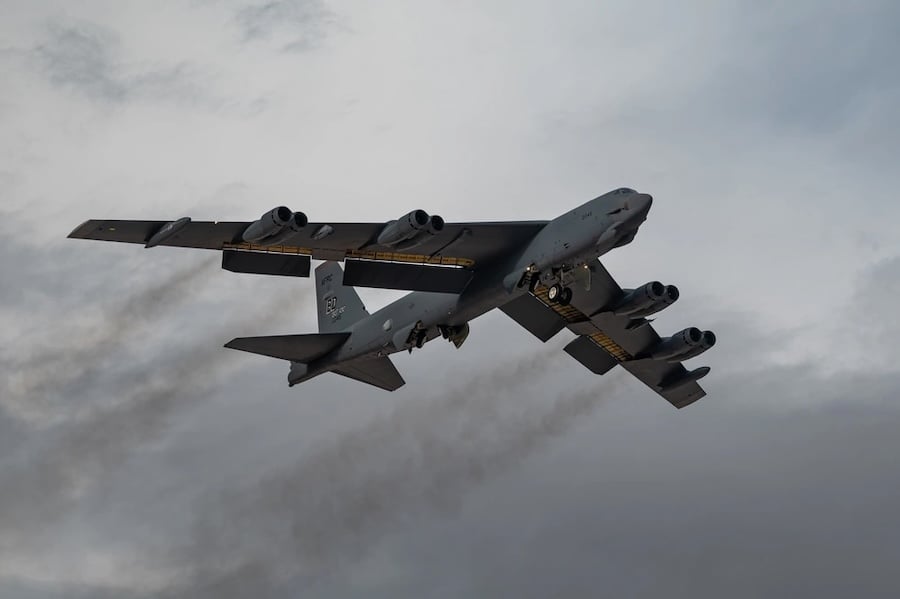
The work marks the next stage of the B-52 Commercial Engine Replacement Program. Rolls-Royce said development and qualification remain on the schedule set by the Air Force.
“We’re making significant progress on F130 engine development and qualification testing, and the B-52 re-engining program continues to move forward on schedule, at the pace defined by the U.S. Air Force,” said Gregg Pyers, senior vice president of the B-52 CERP/F130 program at Rolls-Royce. “Now we’re moving through the next phase of the test campaign, while assembly of the flight test engines is underway here in Indianapolis.”
The F130 program has completed its Critical Design Review and tests covering altitude performance, operability and sea-level performance. Rolls-Royce and Boeing have also completed Rapid Twin Pod testing of the propulsion-system configuration.
Day one at #AFANational. Two things we’re talking about at the Rolls-Royce booth: the F130 moving toward flight test for the B-52J, and the AE engine family that’s been powering the C-130J fleet for decades.
Deterrence has an engine. Readiness has an engine. Come see both at… pic.twitter.com/8R1ZurMK9k
— Rolls-Royce America (@RollsRoyceNA) September 14, 2026
Additional testing is now examining how the engine and integrated propulsion system will perform across the B-52’s operating environment. Ground crosswind tests using the final inlet and nacelle geometry are underway at NASA Stennis, while sea-level operability tests are continuing in Indianapolis.
Water-ingestion testing is planned in Montreal, followed by endurance testing in Indianapolis this fall. The endurance campaign will expose the engines to about twice the use expected during flight testing to demonstrate reliable operation.
Each element of the test program addresses a different operating risk. Crosswind tests cover taxi and takeoff conditions, while sea-level testing measures stall margin and water-ingestion trials assess engine performance in rain.
The F130 is based on Rolls-Royce’s BR commercial engine family, which has recorded more than 30 million flight hours. Rolls-Royce is adapting that established design to the B-52’s installation, electrical-power and military mission requirements.
“The commercial heritage of the F130 is a real advantage,” Pyers said. “We’re starting with proven BR-family technology that has accumulated more than 30 million flight hours, but we’re not simply taking a commercial engine and putting it on a B-52.”
Changes include modified engine externals to accommodate Boeing hardware and provide maintenance access within the twin-pod nacelle. Rolls-Royce has also modified the accessory gearbox and cooling system to meet the bomber’s electrical-power requirements.
Boeing is designing the inlet and serving as propulsion-system integrator for the program. The companies are working with the Air Force to ensure the inlet provides stable airflow across the B-52’s operating envelope.
Rolls-Royce in Germany supplies the baseline BR725 engines, which are converted to the F130 configuration in Indianapolis. The completed engines will undergo final acceptance testing at the site before delivery.
“We expect to begin delivering the flight-test engines to the Air Force in April 2027 to support aircraft modification and the flight-test program,” Pyers said. “The F130 is expected to remain on wing for the life of the aircraft, so the work we are doing now is about making sure we deliver the reliability and performance the Air Force will need for decades to come.”
The B-52J is expected to remain part of the U.S. strategic deterrent into the middle of the century. “The B-52J will fly into the middle of this century, and the engines that take it there are being assembled and tested here in Indianapolis,” Pyers said.