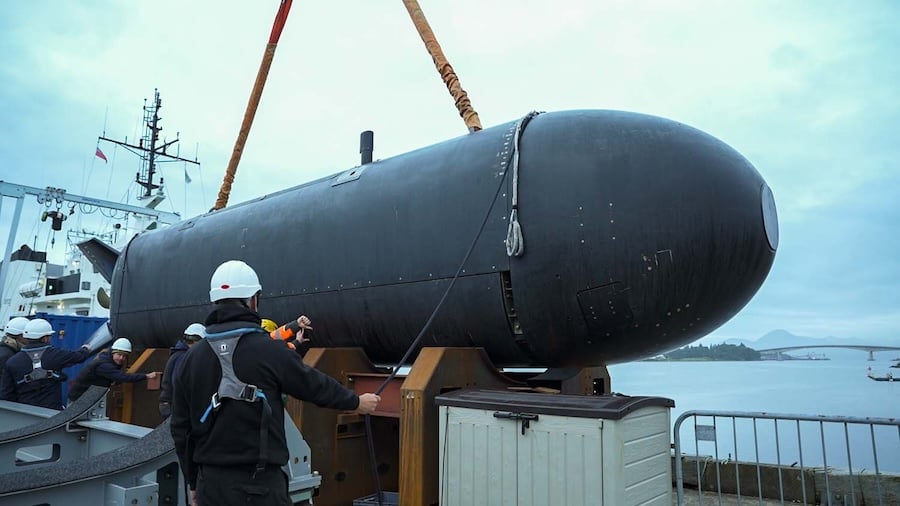
The three-week experiment used an inert, recoverable Mk48 Mod 4 torpedo at the British Underwater Test and Evaluation Centre near Kyle of Lochalsh. QinetiQ operated the range and supplied Hammerhead uncrewed surface vessels as targets.
Known as BROADSWORD in the United States and Trial Iron in the UK, the activity was delivered in six months under AUKUS Pillar 2. It begins a US-initiated series of increasingly complex trials aimed at bringing torpedo-launching uncrewed vessels into operational service.
Excalibur was fitted with a specialist management system to fire and control the weapon. The Royal Navy said neither the vessel nor the torpedo had originally been designed for this form of deployment.
“These trials mark a pivotal moment for AUKUS and show what the UK, Australia and the United States can achieve together,” said General Sir Gwyn Jenkins, the First Sea Lord. “In just six months, British and American teams, supported by industry, have delivered a credible fighting capability – one that also shows just how far we have come with the Hybrid Navy.”
QinetiQ operates the test centre for the Ministry of Defence through the Long Term Partnering Agreement. The trial marked the first use of the range by the US torpedo, Excalibur and Hammerhead.
Several months of planning preceded the activity to manage safety across the range. QinetiQ and Ministry of Defence maritime and trials specialists worked with the US Navy, Royal Navy and their contractors.
“This trial is a great demonstration of how we can rapidly support internationally significant strategic partnerships such as AUKUS, with our specialist test and evaluation capabilities and realistic targets playing a central role,” said Will Blamey, chief executive, UK Defence, at QinetiQ. “The strong relationships we hold with the Ministry of Defence, the Royal Navy and US Navy were key to making this trial a success, cementing how Government and industry can make a difference together to enhance defence ambitions.”
The experiment also involved the UK Submarine Delivery Group Autonomy Unit, part of the Defence Nuclear Enterprise, and Excalibur builder MSubs. QinetiQ said the firing demonstrated interoperability of payloads between allied platforms.
The Royal Navy said the integration showed an approach that could avoid developing costly, time-consuming bespoke vessels or systems. The programme’s operational objective is an uncrewed undersea warfare capability that reduces risks to personnel.
“The importance of this achievement cannot be overstated – this paves the way for a step change in underwater lethality, and shows how Navy Capability is planning to deliver new capabilities to the fleet,” said Lieutenant Commander David Iwanek, the UK trial director. QinetiQ described the activity as a world-first autonomous submarine torpedo-firing trial.
The Mk48 weighs more than 1½ tonnes, measures nearly six metres and is designed to destroy submarines and surface warships. Excalibur is a 12-metre Extra-Large Uncrewed Underwater Vessel that entered service in May 2025 to accelerate testing of advanced naval technologies.