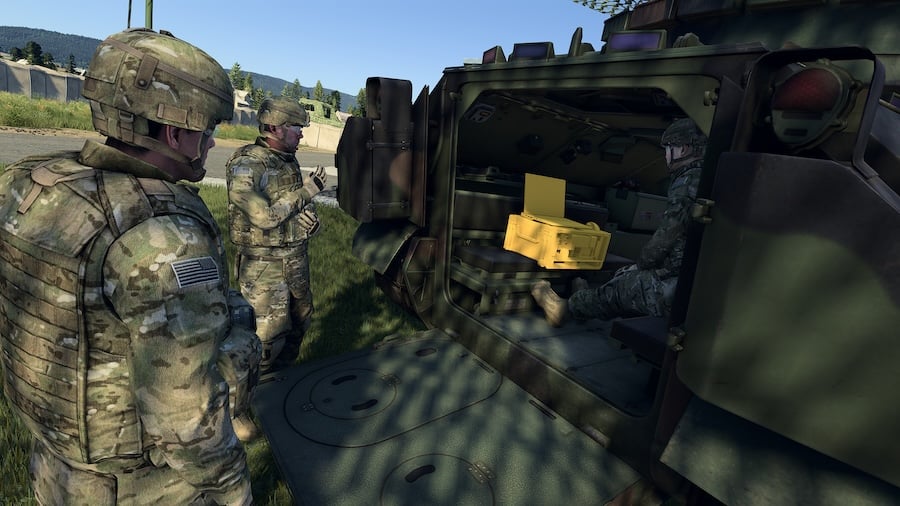
The Other Transaction Agreement supports the Army’s Force Development Innovation & Assessment initiative. OneArc said the installation will be the first use of a commercially available embedded trainer inside a U.S. Army combat vehicle.
“Crews need the ability to train wherever the mission requires, without being tied to fixed simulator facilities,” said Sergeant First Class Patrick Muir, 1st Cavalry Division Standardization Master Gunner. “The ECT supports Army FDIA by providing a single, adaptable system that enables precision and collective training across geographically dispersed locations using organic platform controls and procedures.”
Army crews will use the Embedded Collective Training system to complete the full progression of precision gunnery tasks during the assessment. The event will cover weapon systems, crew qualification and validation of the technology on a fielded combat platform.
The Army is seeking to reduce the time between introducing new equipment and preparing soldiers to use it in combat. Embedded training has historically arrived years after a platform entered service, if it was provided at all.
Units have instead relied on live-fire ranges and standalone simulators that are costly, difficult to schedule and separate from the vehicle’s crew stations. Installing the training system directly on the platform is intended to make instruction more accessible while reducing infrastructure requirements.
“By integrating a commercial embedded trainer directly on a combat platform already in the fight, the Army gains a repeatable model for pairing new equipment with training capability from day one, rather than treating training as a follow-on program years down the road,” said Rahul Thakkar, president of BAE Systems OneArc. “For a force under pressure to modernize on compressed timelines, the shift, from training as only a pre-deployment activity to training as a built-in capability, is central to what FDIA is designed to prove out.”
The kits are designed to support platoon-level collective training and distributed tactical maneuver after the initial crew-level phase. The same approach can be extended to other crewed and uncrewed ground platforms within OneArc’s network of capabilities and partners.
OneArc developed the system around the Army’s commercial-first approach to training technology. The company said the model can shorten the period between acquisition and training from years to months by reducing the development work associated with new systems.