The Congressional Research Service identified the uncertainty in its report, The Army’s XM30 Mechanized Infantry Combat Vehicle. CRS said Congress may examine how the Army plans to protect the vehicle against uncrewed aircraft and other aerial threats.
The Army has stated that the XM30 will carry an organic active protection system designed to detect, track and neutralize anti-tank threats. That system will use kinetic and passive countermeasures, but it remains unclear whether it will also provide organic counter-uncrewed aerial systems protection.
The distinction has become central to questions about the future of armored warfare. CRS noted that some observers believe uncrewed aircraft, loitering munitions and one-way attack drones may make armored fighting vehicles obsolete, while others argue that new defensive technologies can preserve their battlefield value.
The XM30 is intended to replace the M-2 Bradley, which has served with the Army since 1981. Repeated upgrades have left the Bradley approaching the limits of its ability to accommodate additional armor, electronics and defensive systems.
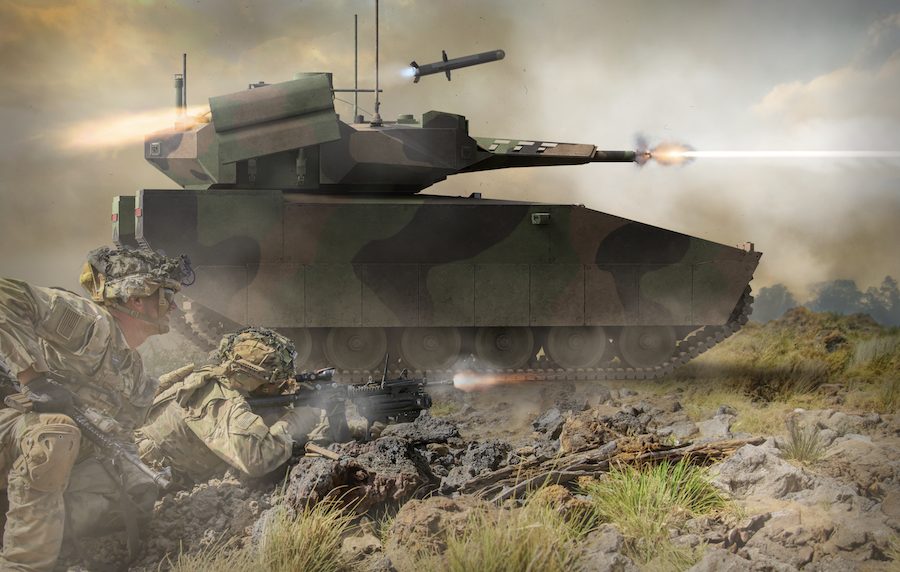
The new vehicle is designed to carry soldiers into close combat and provide firepower against enemy forces. It will be optionally crewed, allowing commanders to employ it with soldiers aboard or through remote-controlled operations without a crew inside.
The Army is also designing the XM30 around a modular open-systems architecture based on a service-owned standard. The approach is intended to make future technology and software upgrades faster and less expensive while preserving opportunities for industry competition.
General Dynamics Land Systems and American Rheinmetall Vehicles are competing under contracts worth approximately $1.6 billion combined. General Dynamics delivered its first Wolf prototype at the end of August 2026, followed by American Rheinmetall’s first Lynx prototype on September 1.
The 1st Cavalry Division at Fort Hood, Texas, is expected to receive two platoons of XM30 prototypes for operational testing. The vehicles are then scheduled to undergo further evaluation at the National Training Center at Fort Irwin, California, through March 2027.
The Army is seeking $547 million in fiscal 2027 procurement funding for 19 additional prototypes, with prime contractors yet to be identified. Awards will depend on company performance during rapid prototyping, testing and operational evaluations.
The Army is expected to select a winning XM30 design in fiscal 2027, while initial fielding is currently planned for fiscal 2029. The CRS assessment places the counter-drone question among the issues Congress may examine before the Bradley replacement reaches production.