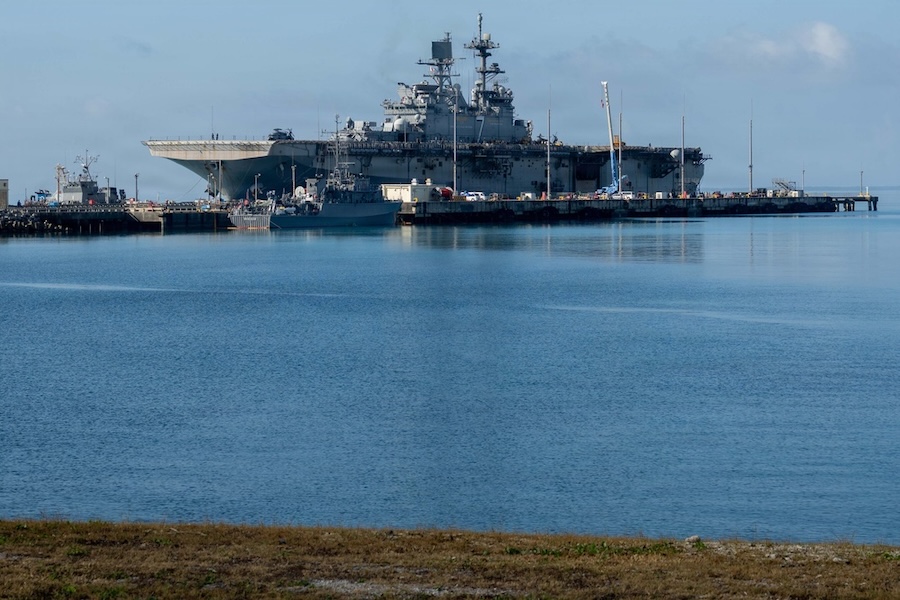
The forward-deployed Tripoli ARG includes the America-class amphibious assault ship USS Tripoli, the San Antonio-class amphibious transport dock USS New Orleans and the Whidbey Island-class dock landing ship USS Rushmore. With the embarked Marines of the 31st MEU, the Navy-Marine Corps team provides a flexible force able to operate at sea, on land and in the air.
The deployment began in the Pacific with routine operations and Exercise Iron Fist 26. The annual bilateral exercise with the Japan Self-Defense Forces included field training, close-air support, urban operations and simulated air, ground and amphibious assaults.
After Iron Fist, the Tripoli ARG and 31st MEU moved to the U.S. Central Command area of responsibility. The force arrived in the Middle East in March and enforced maritime blockade security in the northern Arabian Sea, supporting stability in key waterways and enabling follow-on joint operations.
“The MEU is designed for crisis response. This team proved the unmatched capability of a forward-deployed Marine Air-Ground Task Force (MAGTF) by seamlessly transitioning into combat operations mid-deployment,” said U.S. Marine Corps Col. Chris Niedziocha, commanding officer of the 31st MEU.
“The team adapted, never lost sight of the mission, and performed flawlessly under the most dynamic circumstances.” His comments placed the deployment in the context of crisis response and rapid transition to combat operations.
During the deployment, the Tripoli ARG and 31st MEU conducted more than 1,600 mishap-free flight hours of combat aviation missions. Those missions included precision strikes, the movement of 800,000 pounds of cargo and transport of 5,000 personnel.
The units also delivered intelligence support to joint force operations. They refuelled more than 300 aircraft ashore and underway during the deployment.
“I’m incredibly proud of our integrated team across the ARG, who have demonstrated extreme resilience and commitment to the mission during the dynamic and demanding deployment,” said U.S. Navy Capt. Timothy R. Carter, Commodore of Amphibious Squadron 11. “They answered our nation’s call, executed every mission with unwavering professionalism, and represented our country with honor.”
The Tripoli ARG is commanded by PHIBRON-11, the U.S. Navy’s newest and only forward-deployed amphibious squadron. PHIBRON-11 is assigned to Expeditionary Strike Group 7 and Commander, Task Force 76.
Forward deployed to Okinawa, the 31st MEU serves as a flexible, sea-based Marine Air-Ground Task Force. Together, the Navy and Marine Corps units routinely operate with allies and partners to support a free and open Indo-Pacific and remain ready for crisis response worldwide.
Within the U.S. 7th Fleet area, ESG-7 and CTF-76 conduct expeditionary warfare operations using Navy and Marine Corps capabilities. U.S. 7th Fleet is the Navy’s largest forward-deployed numbered fleet and regularly operates with allies and partners in the Indo-Pacific.