The findings were detailed in a report prepared by the Congressional Research Service and updated on August 12. The report highlights congressional concerns over the Navy’s decision to begin low-rate production before completing tests of a production-representative aircraft.
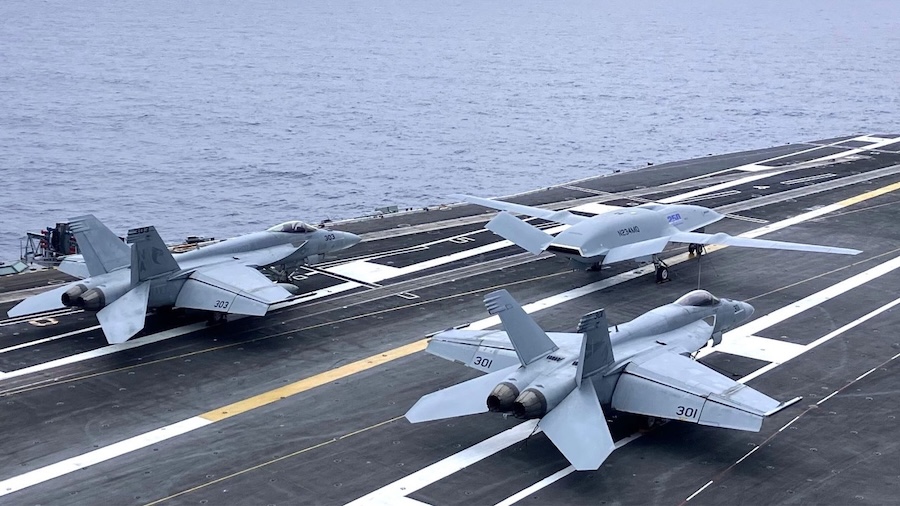
The MQ-25 is designed to become the Pentagon’s first uncrewed aerial-refueling aircraft. It would also be the Navy’s first carrier-based drone.
Its main mission will be refueling aircraft operating from US carriers. The Stingray will also support intelligence, surveillance and reconnaissance missions.
The drone is intended to extend the range of carrier-based combat aircraft. That capability could become more important as US carriers operate farther from potential threats.
The MQ-25 would also replace F/A-18E/F Super Hornets assigned to tanker duties. Those fighters could then return to combat missions.
The Navy plans to acquire 76 aircraft. The fleet would include 67 operational Stingrays and nine test and development models.
The service has requested $1.75 billion for the program in fiscal 2027. The funding would cover procurement and research, development, test and evaluation work.
The request includes three MQ-25 aircraft. It would also support the second year of low-rate initial production.
Pending House and Senate defense bills would provide the full amount. The figures were detailed in a Congressional Research Service report updated on Aug. 12.
Boeing is responsible for the MQ-25 air vehicle. Lockheed Martin is developing its mission-control software.
Boeing received the engineering and manufacturing development contract in 2018. The company completed the first developmental aircraft in mid-2025.
The Navy conducted the aircraft’s first flight in April 2026. It approved low-rate production one month later.
The first developmental flight had initially been planned for 2021. A revised baseline moved it to 2025, but the milestone slipped again.
The Pentagon now projects initial operational capability in 2029. That is two years later than the target set under the revised baseline.
Flight testing is expected to continue through the end of fiscal 2029. The Pentagon cited technical risk, production problems, schedule changes and a labor strike as causes of the delay.
Costs have also increased. The Pentagon’s $19.4 billion estimate includes procurement, development, testing and military construction.
The estimated acquisition unit cost is $255.8 million per aircraft. That figure includes more than the cost of manufacturing each drone.
The Government Accountability Office estimates the program at $16.6 billion when military construction is excluded. GAO calculated an acquisition unit cost of $218 million.
The GAO unit-cost estimate rose 4% from its 2025 assessment. Work to replace or manage obsolete components contributed to the increase.
Operating and support costs are also expected to exceed earlier projections. The Pentagon cited higher maintenance costs and revised estimates for manpower and fuel.
Future development spending is another factor. The cost pressure comes as the Navy moves from development into production.
GAO warned that production could outpace testing. Problems found during flight trials may require changes to aircraft already under construction.
Such changes could increase costs and cause further delays. A 2023 Pentagon inspector general audit raised similar concerns.
The inspector general recommended delaying the production decision until the Navy completed sufficient testing. It offered updated risk-management documentation as an alternative.
Navy officials said they revised the program’s risk assessment. They also delayed several program milestones.
The service still authorized low-rate production in May 2026. Testing of the production-representative aircraft had not been completed.
GAO also raised concerns about cost transparency. It said the Navy lacked data showing Boeing’s actual aircraft-production costs.
The watchdog linked that gap partly to Boeing’s fixed-price development contract. The Navy’s program office is working to obtain better cost data.
The MQ-25 must deliver at least 14,000 pounds of fuel at 500 nautical miles. That is close to the tanker capacity of an F/A-18E/F.
The payload is smaller than those of earlier dedicated Navy tankers. The Stingray’s uncrewed design could still reduce demand for fighters and crews assigned to refueling missions.
Boeing plans to build the aircraft in Mascoutah, Illinois. The company opened a $200 million factory at MidAmerica St. Louis Airport in 2024.
The MQ-25 will use the Rolls-Royce AE 3007N turbofan engine. The engine is produced in Indianapolis.
The aircraft is expected to carry the Cobham Aerial Refueling Store. The same system is used by tanker-configured Super Hornets.
The program also includes the Unmanned Carrier Aviation Mission Control System. It will provide mission planning, flight control and beyond-line-of-sight communications.
The Navy is buying ship-based and shore-based control stations. It is also acquiring mobile systems for carriers without permanent installations.
USS George H.W. Bush received the first shipboard control system in 2024. USS *Theodore Roosevelt* became the first fully operational MQ-25-compatible carrier in 2026.
Navy officials view the MQ-25 as a first step toward a carrier air wing with more uncrewed aircraft. Its control architecture could support other carrier-based drones in the future.
Congress provided $1.03 billion for the program in fiscal 2026. That was $10 million less than the Navy requested.
Lawmakers also provided $100 million in mandatory fiscal 2025 funding to accelerate production. The Pentagon did not seek similar mandatory funding through the 2026 reconciliation process.
Congress is expected to review the program’s cost data and production schedule. Cybersecurity testing and the impact of technical problems on manufacturing are also likely to receive attention.
The wider question is how the MQ-25 will shape future US carrier aviation. Its performance may influence Navy plans for other uncrewed aircraft and missions.
Source: Congressional Research Service.