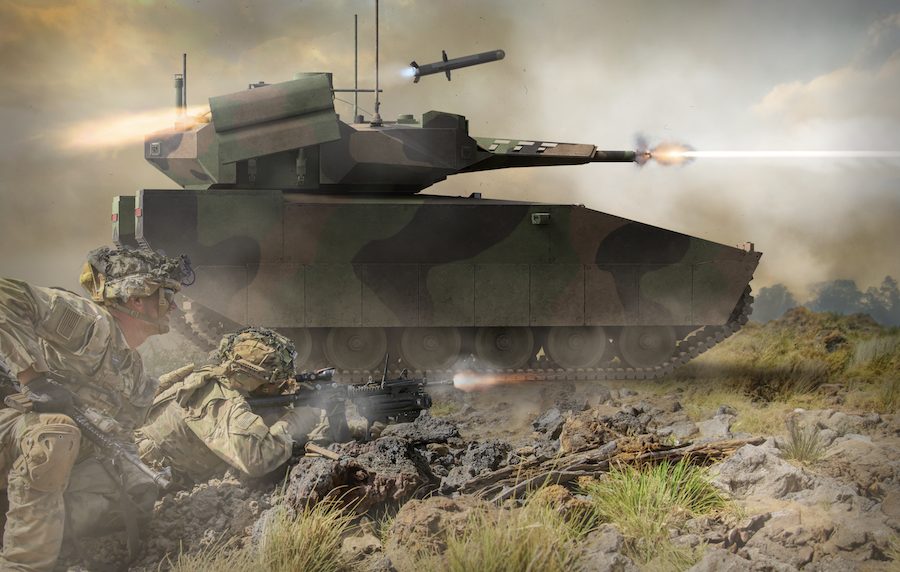
The delivery is part of a Phase 3/4 Engineering and Manufacturing Development contract valued at about $764 million. The contract covers digital design, physical prototyping and validation of the complete vehicle system.
“Delivering our first prototype to the Army is an important step as the XM30 Combat Vehicle program enters a more visible phase,” American Rheinmetall Chief Executive Officer Matt Warnick said. “Team Lynx now has the opportunity to show the Army that we can deliver on the promise of a modern replacement for the Bradley.”
The company plans to deliver the other seven prototypes later in 2026 for operational unit training. Those activities will proceed alongside technical evaluations under the Army’s Transformation in Contact 2.0 initiative.
Soldiers will begin field maneuvers after the vehicles complete initial military safety checks. The training period will culminate in large-scale combat simulations intended to assess the prototypes in operational conditions.
“Executing a parallel evaluation timeline requires a level of industrial agility that Team Lynx was built for,” Warnick said. “We are proving that the U.S. Defense Industrial Base can move at the speed of operational relevance, stripping years off traditional development timelines to get the right capability to the Warfighter.”
The prototypes are moving through a production network spanning several U.S. states. Turret fabrication takes place in Plymouth, Michigan, before hull and chassis integration is completed in Slidell, Louisiana.
Finished vehicles undergo automotive shakeout trials to verify mechanical readiness before returning to Louisiana for painting and final detailing. Each prototype is then inspected with the Defense Contract Management Agency before formal government acceptance.
The Lynx XM30 uses a modular design and adaptive open architecture intended to accommodate new technologies throughout its service life. Rheinmetall designed the platform for operating environments increasingly shaped by drones, precision weapons and electronic warfare.
The company describes the Lynx XM30 as the first vehicle of its kind to incorporate a hybrid-electric powertrain, providing additional power-generation capacity and battlefield mobility. The vehicle also uses secure real-time connectivity as part of its digitally integrated combat system.
American Rheinmetall is the prime contractor and leads the Team Lynx industrial group. Its partners include Textron Systems, Raytheon, L3Harris Technologies, Allison Transmission and Anduril Industries, supported by a growing U.S. supplier network.