Taiclet laid out that view during Lockheed Martin’s second-quarter 2026 earnings call, where senior management repeatedly pointed to allied demand, co-production and regional sustainment as important drivers of future growth. The company is positioning more manufacturing and support capacity overseas as NATO members seek greater industrial resilience and faster access to weapons and maintenance.
“We established a manufacturing footprint in allied countries prior to the rise of co-production requirements,” Taiclet said. He added that the ability to scale production, deployment and sustainment worldwide has become increasingly important as U.S. and allied forces respond to a changing threat environment.
That strategy represents a broader shift in how Lockheed Martin approaches international business. Rather than treating overseas customers primarily as export markets, the company is increasingly looking to place manufacturing, overhaul and repair capability in countries where U.S. and allied forces operate.
Taiclet said Lockheed Martin is deliberately expanding access to capital and skilled labor through international partners, including through co-production and regional sustainment programs. Each initiative is being assessed as an investment with an expected financial return once contracts are secured, he said.
Europe is emerging as one of the clearest examples of that approach. At the NATO summit, Lockheed Martin signed a memorandum of understanding with Rheinmetall aimed at creating what Taiclet described as the first European Center of Excellence for ATACMS production.
The company also welcomed a commitment by the United States, Germany, the Netherlands, Poland and Sweden to explore a dedicated PAC-3 missile maintenance facility in Europe. Taiclet described the initiative as a way of putting “allied capability closer to allied needs.”
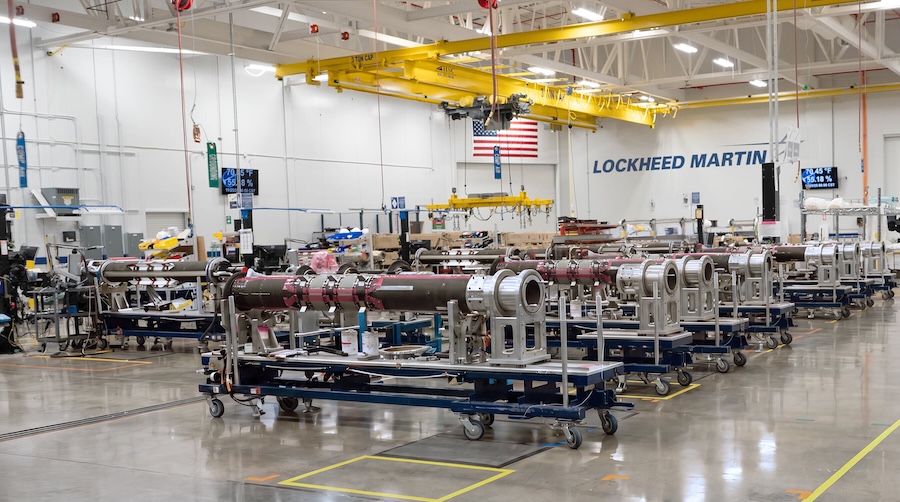
The proposed ATACMS arrangement with Rheinmetall goes further by illustrating how Lockheed Martin sees the geography of missile production changing alongside its customer base. Taiclet said the company is working to move the ATACMS production line into factory space in Germany, “where the customer base largely is now.”
Moving the line would also create additional room at Lockheed Martin’s Camden, Arkansas, facility for production of the newer PrSM missile, which uses a more automated manufacturing process. Rheinmetall would contribute factory space, workforce and investment in Germany, reducing the amount of additional infrastructure Lockheed Martin would have to build itself.
“We’ve got an international partner that’s going to provide floor space, factory space, talent that we need, and investment that we don’t have to then put in,” Taiclet said. He presented the model as one way to expand output more efficiently as demand for missile systems accelerates.
Missile defense is another area where Lockheed Martin is preparing for substantially higher production. Taiclet said the company is being asked to triple PAC-3 MSE production, quadruple THAAD output and increase PrSM production faster than previously expected.
The company’s confidence in sustained allied demand extends beyond missiles. Taiclet pointed to the F-35 as a program with long-term requirements from both the U.S. government and overseas allies, saying Lockheed Martin remains confident that its annual production rate of 156 aircraft can be sustained for some time.
Under the production mix discussed by Taiclet, aircraft not required by the United States would be allocated to allies and international partners. He argued that annual political and budget negotiations are unlikely to materially change the underlying military requirement for the fighter.
“The to-ing and fro-ing of the political budget cycles will not, in the long or medium term or even in the short term, I think, really adversely affect what the country needs and what our allies need to defend themselves,” Taiclet said.
Lockheed Martin management did not provide a forecast for NATO-wide defense spending or discuss a specific alliance spending target during the call. Its comments instead pointed to a broader assumption underpinning the company’s investment plans: demand for combat aircraft, missile defense, long-range fires and sustainment capacity among U.S. allies will remain elevated enough to justify new industrial capacity.
For Lockheed Martin, that means Europe is becoming more than an end market for U.S.-made weapons. The company’s strategy increasingly combines higher U.S. production with European manufacturing, maintenance and co-production, placing industrial capacity closer to customers while giving Lockheed Martin additional routes to scale output as allied requirements grow.