BAE Systems Maritime Australia is delivering the programme as part of the government’s continuous naval shipbuilding policy. It directly supports more than 2,500 jobs, mostly in South Australia, and another 5,000 positions across the national supply chain.
The Hunter class is intended to provide the Navy with an advanced anti-submarine warfare capability and support operations with allies and partners. The ships will combine Australian-made radar technology with advanced combat-system elements from the United States.
Deputy Prime Minister Richard Marles said: “The laying of the keel for the first Hunter class frigate demonstrates tangible progress in the delivery of a more capable, lethal and resilient surface combatant fleet for Australia.” He added: “The Hunter class frigates will provide a world-class anti-submarine warfare capability, designed to operate in complex maritime environments.”
David Shepherd, managing director of BAE Systems Australia – Surface Ships, said: “The Hunter class will form the backbone of the Royal Australian Navy’s fleet for decades to come, with its unique capabilities, weapons, sensors and modular mission bay enabling it to undertake a wide range of missions in addition to hunting submarines.” The modular mission bay is intended to give the frigates flexibility for operations beyond their primary anti-submarine role.
Shepherd said: “While today we have physically laid the keel of the first Hunter class frigate, the Hunter program itself has laid the foundations of a Continuous Naval Shipbuilding & Sustainment capability in Australia.” The programme ties delivery of the new fleet to the development of an enduring domestic shipbuilding base.
Minister for Defence Industry Pat Conroy said: “This Hunter class frigate program is already supporting thousands of high-skilled and well-paid jobs.” He added: “So, this is a landmark moment that demonstrates Australia already has the skilled workforce needed to undertake complex projects like this.”
South Australian Premier Peter Malinauskas said more than 2,500 people were working at Osborne on the Hunter frigates. He said BAE Systems had almost 600 tradespeople assigned to the project, including young workers trained through technical colleges.
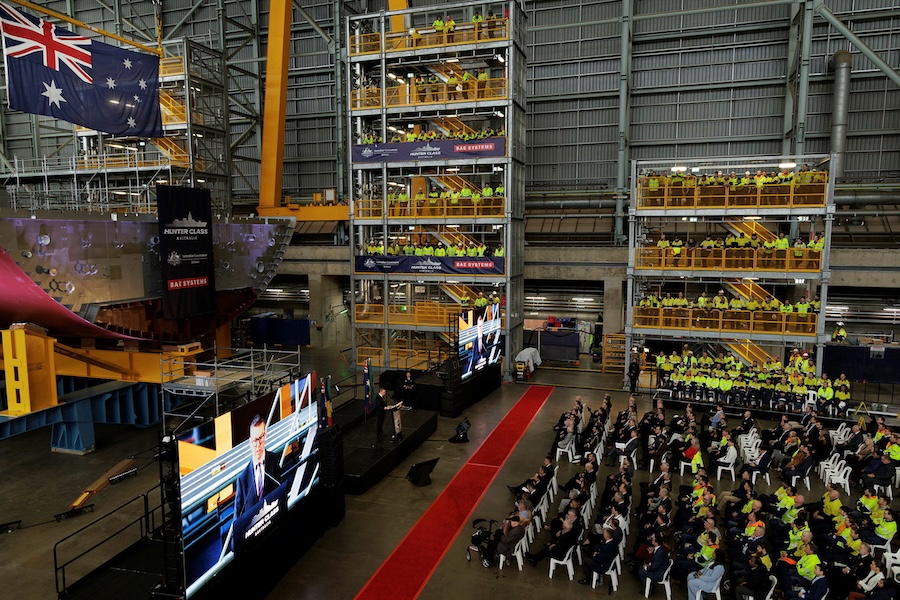
The keel-laying ceremony involved placing a coin beneath two blocks that form part of NUSHIP Hunter’s keel. Defence Industry Minister Pat Conroy and Chief of Navy Vice Admiral Matthew Buckley joined BAE Systems shipbuilders for the event.
Shepherd added: “This milestone is a proud moment for our workforce, our partners and the thousands of Australians contributing to a sovereign naval shipbuilding enterprise that will support Australia’s security and prosperity for generations.” The two keel sections will now be joined with further blocks to form the base of the ship.