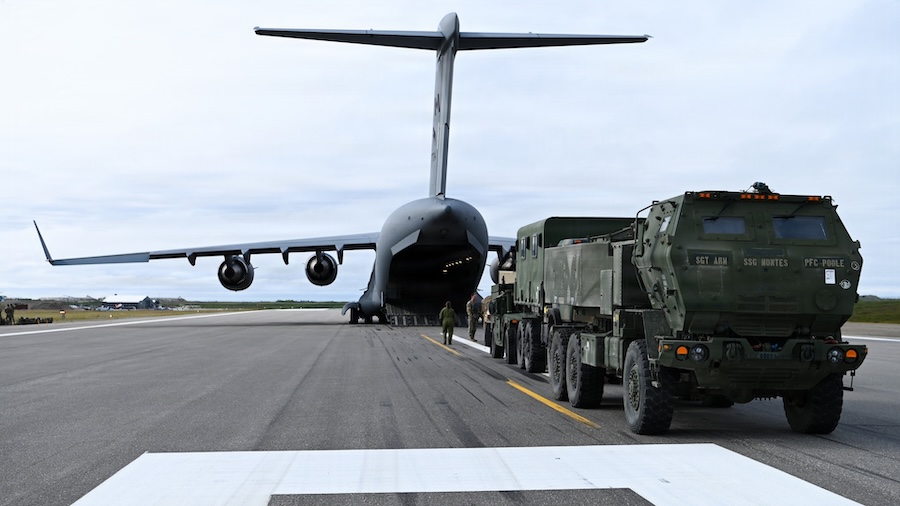
The aircraft flew the HIMARS from Joint Base Lewis-McChord, Washington, to Nome, Alaska, on July 31 in support of the 17th Field Artillery Brigade, I Corps. It stopped at Fort Wainwright along the way to pick up soldiers from the 1st Battalion, 5th Infantry Regiment, 1st Mobile Brigade Combat Team (Air Assault), 11th Airborne Division.
After the operation ended, the Royal Canadian Air Force returned to Nome on Aug. 10 and 11 to recover the launcher and participating U.S. Army personnel. The aircraft then transported them back to their home stations.
“Operations in the Arctic demand close cooperation between trusted partners and allies,” said Brigadier-General Cedric Aspirault, Director General Operations, Canadian Joint Operations Command. “The rapid deployment and recovery of U.S. Army capabilities aboard a Royal Canadian Air Force aircraft demonstrates how Canadian and American forces routinely operate together to strengthen awareness, readiness, and defence across North America’s northern approaches.”
The mission paired Canadian strategic airlift with U.S. Army forces operating in Alaska and tested the logistics required to move combat equipment into a remote Arctic environment. U.S. Northern Command said the deployment also reinforced interoperability between the two countries in support of homeland defense.
Operation TUNDRA MERLIN is intended to strengthen domain awareness and test the rapid employment of combat power across the Alaskan theater of operations. The exercise integrates assigned forces to improve readiness for operations in austere and geographically dispersed locations.
The Canadian airlift gave the operation a cross-border logistics component, moving a U.S. Army HIMARS system into and out of Nome over a short deployment period. The activity showed how the two countries can combine strategic transport and ground forces to support defense of North America’s northern approaches.