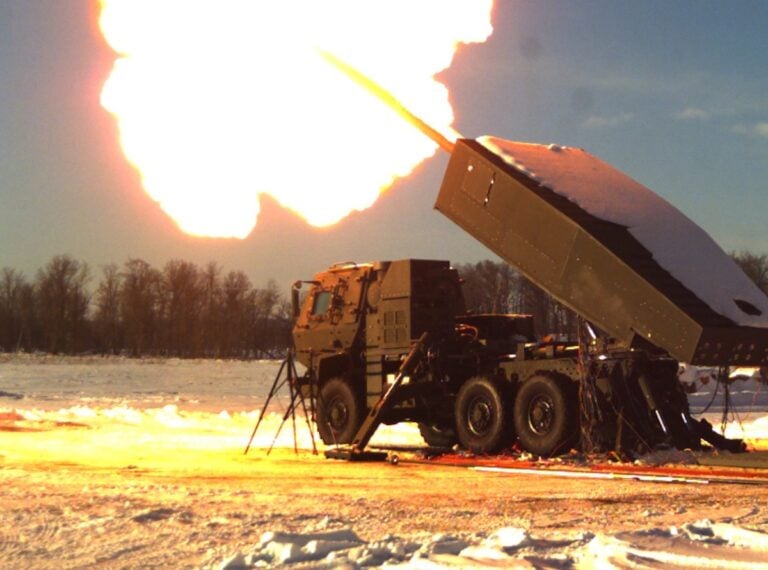

Two F-35As assigned to the 356th Fighter Squadron took off from Eielson Air Force Base on August 4 after refueling from a KC-135 Stratotanker, part of Operation TUNDRA MERLIN. The jets located the simulated target, executed what the Air Force termed a constructive kill, and transmitted the coordinates to an Army High Mobility Artillery Rocket System crew waiting nearby — linking a fifth-generation fighter’s sensors directly to a ground-based shooter in real time.
Two F-16 Fighting Falcons assigned to the 18th Fighter Interceptor Squadron flew a separate mission in the same airspace, conducting defensive counterair patrols. One of the jets carried the tail markings of Nellis Air Force Base in Nevada and the insignia of the Air Force Reserve Command, underscoring how far some of the participating units had traveled to take part.
The exercise leaned on what has become the F-35’s signature contribution to joint warfare: not just stealth, but the ability to find a target, understand what it is, and share that picture with anyone who needs it — instantly and without exposing the jet itself. In this case, that meant identifying a mock missile battery, confirming the kill, and cueing an Army rocket system to finish the job on the ground, collapsing a process that once required separate sensors, radios and coordination cells into a single, seamless handoff.
Soldiers from the Army’s 11th Airborne Division and the 17th Long Range Fires and Effects Brigade operated the HIMARS system and its supporting radar, turning the airborne targeting data into a ground-based strike capability.
Operation TUNDRA MERLIN falls under Alaskan Command and U.S. Northern Command, and is built around a single operational question: how fast can American forces detect and defeat a threat crossing into the Arctic approaches to North America. That question has taken on new weight in recent years as Russia has expanded its military footprint in the region, pushing U.S. defense planners to treat what was once a remote, low-priority frontier as an active piece of homeland defense.