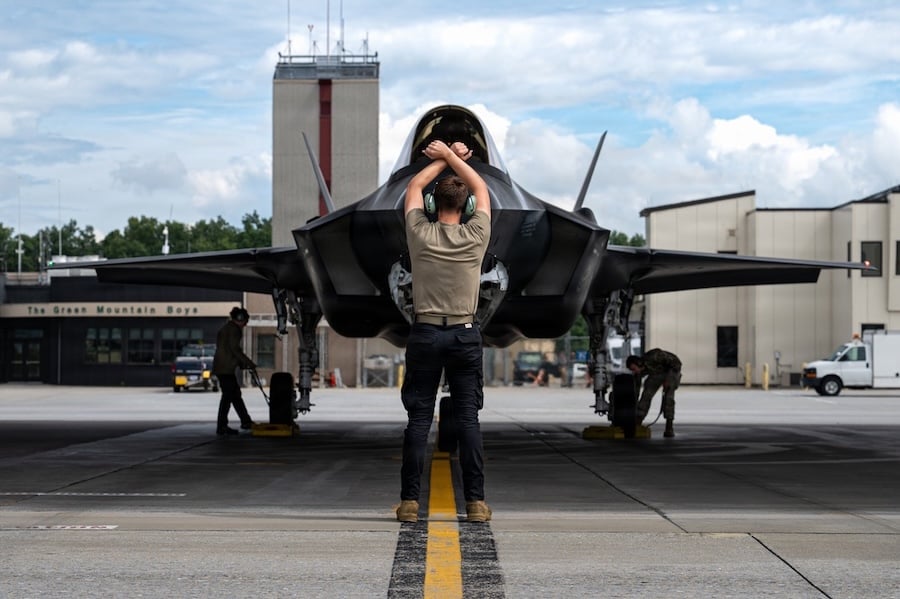
The assessment is detailed in the Modernized Selected Acquisition Report (MSAR): F-35 Lightning II Joint Strike Fighter (JSF) Program (F-35), FY 2027 President’s Budget. The U.S. Department of War report was effective April 21, 2026, and cleared for public release on Aug. 3.
More than 1,200 F-35s are operating from 48 bases and 12 ships across 20 nations, according to the document. The program delivered a record 191 aircraft in 2025 and is preparing to fund another 85 U.S. fighters in Lot 21.
Yet the report also sets out the financial and industrial pressures behind that expansion. The government’s estimate for one major modernization contract has climbed to $6.09 billion, the projected cost of Technology Refresh 3 has passed $2 billion and lifetime operations and support spending is approaching $1.4 trillion in then-year dollars.
At the same time, aircraft already in service continue to face parts shortages and inadequate depot-level repair capacity. Those constraints are limiting readiness across the broader fleet even though forward-deployed units have maintained high mission-capable rates.
The result is a program moving in two directions at once. The F-35 is becoming more capable and more widely deployed, but the cost and complexity of supporting that fleet are rising with it.
Fiscal 2027 plan funds 85 U.S. aircraft
The fiscal 2027 budget supports 38 F-35As, 10 short-takeoff-and-vertical-landing F-35Bs and 37 carrier-capable F-35Cs. The planned Lot 21 purchase therefore covers 85 U.S. aircraft.
Aircraft funding for the fiscal year totals about $17.88 billion. That includes $4.24 billion for research and development and $13.64 billion for procurement, while the engine subprogram receives almost $4 billion.
The budget also prioritizes 55 Block 4 capabilities. The department’s focus is on air superiority, suppression of enemy air defenses, weapons integration and the digital infrastructure needed to support those functions.
The wider program calls for 2,470 development and production aircraft. That total includes 1,763 F-35As, 280 F-35Bs and 413 F-35Cs, in addition to 14 development aircraft.
The report lists 872 aircraft as delivered against the U.S. program requirement. That figure should not be directly compared with the more than 1,200 aircraft operating worldwide because the latter includes the broader international fleet.
The F-35A active inventory is projected to rise from 521 aircraft in 2025 to 565 in 2026 and 601 in 2027. It is expected to reach 761 by 2031.
The F-35B inventory is forecast to increase from 184 aircraft in 2025 to 244 in 2031. The F-35C fleet is projected to grow from 147 to 273 aircraft over the same period.
Full-rate production was approved in March 2024, when the program also delivered its 1,000th aircraft. Even so, a large share of the planned fleet remains covered by the program’s extended low-rate initial production structure.
The approved low-rate quantity has grown from an original 465 aircraft to 1,185. That represents 48.3% of the planned procurement total of 2,454 aircraft, compared with 18.9% under the original baseline.
Acquisition bill exceeds $536 billion
The aircraft subprogram is expected to cost $316.70 billion in constant fiscal 2012 dollars, or $446.66 billion in then-year dollars. The engine adds $65.21 billion in constant dollars and $89.58 billion in then-year dollars.
Together, the aircraft and engine acquisition estimates exceed $536 billion in then-year dollars. That figure does not include the much larger cost of operating, maintaining and upgrading the fleet over its service life.
About $177.10 billion in aircraft funding had been appropriated by the reporting date, equivalent to 39.6% of the total then-year estimate. Expenditure stood at approximately $128.96 billion, or 28.9%.
Aircraft program acquisition unit cost is estimated at $128.22 million in constant fiscal 2012 dollars. That is 13.94% above the original baseline and 1.26% above the current baseline.
Average aircraft procurement unit cost stands at $96.10 million in constant dollars. It is 4.65% above the original baseline and 3.69% above the current baseline.
The engine’s program acquisition unit cost is estimated at $26.40 million in constant dollars. That is 20.07% above the original baseline, although it is 2.13% below the current baseline.
Average engine procurement unit cost is $19.22 million. The figure is 10.94% above the original baseline but 5.06% below the current baseline.
The report places recurring flyaway costs for the air vehicle at $66.7 million for the F-35A, $83.1 million for the F-35B and $82.1 million for the F-35C, measured in constant fiscal 2012 dollars. The corresponding engine figures are $11.3 million for the F-35A and F-35C and $27.2 million for the lift-system-equipped F-35B.
Record deliveries reduce the TR-3 backlog
Lockheed Martin delivered 191 F-35s in calendar 2025, the highest annual total in the program’s history. The deliveries included aircraft that had previously been withheld because of delays involving the new Technology Refresh 3 configuration.
The recovery helped reduce the inventory of completed aircraft awaiting acceptance. It did not eliminate the underlying software challenge.
The report says aircraft equipped with TR-3 hardware are now being delivered, but the production and release of complex software remain difficult. That distinction is important because much of the F-35’s planned combat growth depends on software running on the new hardware.
The department awarded Lockheed Martin a $24 billion contract in September 2025 for as many as 296 aircraft in Lots 18 and 19. Pratt & Whitney received a separate $6.6 billion award in March 2026 for F135 engines covering the same lots.
The contracts provide greater certainty for the production system, but performance data for current manufacturing work show continuing strain. Shortages, late assemblies and supplier problems remain visible across both the aircraft and engine programs.
Lot 18 carries a $1.29 billion schedule variance
The Lot 18 aircraft contract covers 148 fighters and was 59.6% complete by March 31, 2026. No Lot 18 aircraft had been delivered by that date.
The contract recorded a $1.29 billion unfavorable earned-value schedule variance. The figure measures the value of work completed against the contractual plan; it is not a direct estimate of additional cost or a specific delay measured in months.
The department attributed the variance to shortages of structural parts, difficulties in wing production and core coating, and delayed center and aft fuselages. Late tails and mission-system components added to the pressure.
Lot 18 recorded a favorable cost variance of about $99 million. The report links part of that result to engineering rates and tax agreements connected with work in Israel and Italy.
Earlier production lots have faced a similar combination of manufacturing and supplier problems. The Block Buy 2 contract for Lots 15 through 17 covers 398 aircraft, of which 359 had been delivered.
The contract was 97.5% complete but carried a $724 million unfavorable cost variance and a $460 million unfavorable schedule variance. Nonconforming parts, scrap, rework and work performed outside the planned production station all contributed.
Shortages affected TR-3 software, low-observable edges, wiring harnesses, clamps and radar modules. Delays also involved wings, radar systems, center fuselages and final assembly.
Lockheed Martin told the program that it did not anticipate those problems preventing the contract from being completed on time. The scale of the earned-value variances nevertheless shows the pressure required to hold the schedule.
TR-3 estimate passes $2 billion
Technology Refresh 3 is the computing foundation for many Block 4 capabilities. It replaces core processing, memory and cockpit-display hardware to support more demanding weapons, sensors and electronic-warfare software.
The current reported value of the third TR-3 phase is about $795 million. Lockheed Martin estimates the contract will cost approximately $1.94 billion at completion, while the program manager’s estimate stands at $2.01 billion.
The contract recorded a $1.17 billion unfavorable cost variance. It was more than 96% complete at the reporting date.
The report attributes the increase to the design and maturation of the Integrated Core Processor, Panoramic Cockpit Display and Aircraft Memory System. Delays among key suppliers added to the cost.
TR-3 problems have also affected modifications to aircraft already in service. Qualification delays involving the Integrated Core Processor have slowed the delivery of upgrade kits and complicated the retrofit schedule.
One modifications contract was affected by delays in L3Harris processor-module qualification. The program also shifted priorities to place greater emphasis on Block 4 modifications for the U.S. Marine Corps.
The pressure therefore extends beyond the cost of installing new hardware on the production line. It affects older aircraft, depot workloads and the schedule for fielding weapons and mission systems across different parts of the fleet.
Block 4 modernization estimate reaches $6.09 billion
A separate Follow-On Modernization Phase 2.3 contract provides one of the clearest measures of Block 4 cost growth. The effort began with a value of approximately $1.89 billion, while its current reported price has reached $3.28 billion.
The program manager now estimates the contract will cost $6.09 billion at completion. It was about 75% complete when the report was prepared.
The contract recorded a $571 million unfavorable cost variance and a $316 million unfavorable schedule variance. The report cites higher labor requirements resulting from software and firmware complexity.
Material expenses and supplier overruns related to the Drop 11 electronic-warfare configuration also contributed. The effort includes hardware kits supporting electronic warfare, interoperability and weapons integration.
Another Block 4 contract is valued at about $2.43 billion and was approximately 29% complete. It recorded a favorable cost variance of $49 million but an unfavorable schedule variance of almost $100 million.
Delayed module builds, electronic-warfare simulation hardware and late materials affected its performance. Staffing constraints and decisions to assign resources to other priorities added to the schedule pressure.
A separate development-foundation contract, valued at about $2.35 billion, was nearly 70% complete. It carried an unfavorable schedule variance of approximately $18 million, partly because of unpredictable supplier lead times for spares and repairs.
The department identifies the technical maturity of advanced Block 4 capabilities as a significant schedule risk. The combination of new hardware, dense software releases and multiple weapons leaves little separation between problems in one part of the program and delays elsewhere.
F135 production absorbs higher costs
The F135 engine program is dealing with its own cost and supply-chain pressures. The production contract for Lots 15 through 17 recorded a $906 million unfavorable cost variance.
The contract covers 430 engines and was about 96% complete. Pratt & Whitney had delivered 378 engines by the reporting date.
The department cited changes in overhead rates, purchase-order revaluations, scrap, inflation and long-term supplier agreements. Manufacturing complexity and higher material costs also affected the result.
Late hardware involved the LiftFan, fan, engine externals and high-pressure compressor. Those problems show that the pressure is distributed across several major modules rather than concentrated in a single supplier or component.
The Lot 18 engine contract covers 140 engines, with 22 delivered by the reporting date. It was approximately 61% complete.
That contract recorded a $41 million unfavorable cost variance but a $273 million favorable schedule variance. The positive schedule result was driven in part by the early procurement of long-lead hardware.
Costs under supplier agreements affected the fan, turbine exhaust and augmentor, and mechanical systems. Those pressures emerged even while the overall contract remained ahead of its earned-value schedule.
Engine upgrade promises longer service intervals
The F135 Engine Core Upgrade is intended to provide the power and thermal-management capacity needed for Block 4 and future capabilities. The department expects the upgrade to increase engine time on wing by between 16% and 25%.
Longer intervals between engine removals would support readiness and reduce maintenance demand. Reaching that objective, however, requires the program to complete a technically demanding development and manufacturing effort.
The upgrade’s risk-reduction contract was about 55% complete. It recorded a $6.7 million unfavorable cost variance and an $88.6 million unfavorable schedule variance.
Delayed engineering drawings, nonrecurring engineering constraints and procurement bottlenecks affected progress. Tooling problems, material delays and manufacturing failures were also cited.
The core upgrade sits within a broader Engine and Power Thermal Management effort. Integration of the new power and thermal-management unit may generate additional modification and retrofit work across the fleet.
Engine repairs add to sustainment pressure
Pratt & Whitney’s F135 performance-based logistics contract is also running above its current target price. The program manager estimates completion at approximately $4.84 billion, compared with a target of about $4.78 billion.
The original baseline underestimated the number and complexity of engine-module and component repairs. Additional damage was often discovered only after engines had been disassembled.
The contract also faced freight and support requirements that had not been fully incorporated into the baseline. Late depot inductions and the complexity of individual repairs added further pressure.
Material shortages created another conflict. Some components intended for sustainment were reassigned to support new-engine production.
That trade-off exposes one of the central tensions in the expanding F-35 enterprise. The same supplier base must support higher production, retrofit older aircraft and provide enough repair material to keep the operating fleet available.
Readiness remains constrained
The report says forward-deployed F-35 units continue to achieve high mission-capable rates. Performance across the broader fleet remains limited by shortages of spare parts and insufficient depot-level repair capacity.
The program is attempting to address the problem through a reset of the Global Support Solution. The work is intended to modernize sustainment planning, resize the global spares pool and improve maintenance performance.
The department is targeting an enterprise-wide mission-capable rate of 80% and a fully mission-capable rate of 65%. It aims to reach the 80% mission-capable objective by fiscal 2030.
The air vehicle is being supported through a multiyear sustainment contract containing four 12-month options. The agreement uses stronger incentives intended to link contractor payments more closely to fleet performance.
F135 support remains organized through annual sustainment contracts. The department is examining longer-term, outcome-focused arrangements for both the aircraft and engine.
The air vehicle sustainment contract for fiscal 2024 through fiscal 2028 recorded an unfavorable schedule variance of about $111 million, largely because invoices were running behind the contractual plan. It also reported a favorable cost variance of nearly $82 million, reflecting delayed work, staffing levels and lower material spending in several areas.
The program is also continuing its transition to the Operational Data Integrated Network. ODIN is intended to provide more secure and cyber-resilient hardware for maintenance, logistics and mission planning.
The ODIN hardware contract recorded favorable cost and schedule performance. Staffing and hiring remained difficult, but faster progress on hardware kits helped offset some of those constraints.
Lifetime sustainment estimate approaches $1.4 trillion
The latest operations and support estimate totals $596.36 billion in constant fiscal 2012 dollars. In then-year dollars, which account for projected inflation, the figure reaches approximately $1.395 trillion.
The estimate covers operations through 2083. It is $15.9 billion higher in constant-dollar terms than the independent estimate prepared in 2024.
The increase reflects additional basing plans and Foreign Military Sales assumptions. Changes to the calculation of non-maintenance parts, aircraft modifications, propulsion maintenance and combat-data support also contributed.
Other drivers include training, depot work and a fiscal 2027 backlog of repairable components associated with the Global Support Solution reset. Spending required to restore readiness can therefore increase the estimate in the near term, even when the work is intended to reduce future inefficiencies.
Maintenance is the largest single cost category, estimated at $212.62 billion in constant fiscal 2012 dollars. The F-35A accounts for $426.86 billion of total operations and support costs, compared with $74.88 billion for the F-35B and $94.62 billion for the F-35C.
The department expects the F-35A to remain more expensive to operate and sustain than the fourth-generation aircraft it replaces because of its greater capability. The aircraft combines low-observable structures with advanced sensors, mission systems and software-dependent support requirements.
The program has identified 60 affordability initiatives that it expects to save $23.3 billion in constant dollars. The projected saving reaches $52.2 billion in then-year dollars.
Without those measures, the operations and support estimate would be about 4% higher. Delivering the savings will be important if the services are to expand the fleet without allowing support costs to consume a growing share of their budgets.
Reliability differs sharply by variant
Operational-performance data show different results across the three F-35 variants. The F-35A and F-35C remain below their mission-reliability thresholds, while the F-35B exceeds its requirement.
The F-35A demonstrated mission reliability of 85.3% against a threshold of 93%. The F-35C achieved 92.2% against a 95% requirement.
The F-35B recorded 96.4%, exceeding its 95% threshold. Its stronger result offers a counterpoint to the maintenance and reliability challenges affecting the wider enterprise.
The program is pursuing a large portfolio of reliability improvements. Fifty-five projects have completed development or are being introduced into the fleet, while 64 are under contract.
Another 30 projects are expected to enter contracts during 2026 if funding remains available. The department has identified 52 additional candidates for possible future investment.
Combat-radius testing produced results above the minimum requirement for all variants but below their objective values. The F-35A demonstrated 657 nautical miles against a threshold of 590 and an objective of 690.
The F-35B achieved 492 nautical miles against a 450-mile threshold and a 550-mile objective. The F-35C recorded 667 nautical miles, compared with a threshold of 600 and an objective of 730.
All three variants met their sortie-generation requirements. Demonstrated rates were 3.22 sorties per day for the F-35A, 4.33 for the F-35B and 4.08 for the F-35C.
The F-35B also exceeded its short-takeoff-and-vertical-landing mission-performance threshold. It demonstrated results of 2,201 pounds and 2,094 pounds against a requirement of 1,500 pounds.
The F-35C achieved a carrier recovery speed of 142.7 knots. That met the threshold of less than 145 knots but remained above the objective of less than 140.
Wartime logistics footprint exceeds requirements
The report identifies the physical footprint needed to deploy and sustain the F-35 as another operational concern. Demonstrated results exceeded several maximum thresholds across the three variants.
The F-35A required the equivalent of 12.83 C-17 loads against a maximum threshold of eight. The F-35B recorded 8.39 loads against the same limit.
The F-35B required 51,500 cubic feet under the report’s L-class measurement, more than twice its 21,000-cubic-foot threshold. The F-35C required 51,400 cubic feet against a maximum of 46,000.
The department said the figures reflected a high-tempo wartime simulation and operational data showing greater demand for spares and support equipment. Increases in the size and weight of some equipment also expanded the footprint.
The result has implications beyond logistics spending. A heavier support package requires more strategic airlift and can make it harder to move quickly or disperse aircraft among smaller operating locations.
Weapons roadmap extends into the 2030s
The Block 4 roadmap sets out a broad sequence of U.S. and European weapons integrations through 2033. It links those weapons to new sensors, data links, electronic-warfare functions and low-observable carriage options.
Several near-term improvements are scheduled for 2026. A new F-35 In-A-Box simulation configuration is planned for July, followed by the replacement of Windows 7 with Windows 10 in training devices in August.
A beyond-line-of-sight UHF receive function is scheduled for September 2026 for retrofit aircraft operated by the United States, Britain and Australia. It will distribute track data through the Integrated Broadcast Service but will not provide the full two-way capability planned for later increments.
The same month is expected to bring an electronic-attack Protected Package Mode and moving-target employment of GBU-54 and GBU-38 bombs. A Tactical Data Recorder will support faster analysis and reprogramming against previously unknown emitters.
A larger capability package is scheduled for September 2027. It includes the AGM-88G Advanced Anti-Radiation Guided Missile-Extended Range, giving the F-35 a new weapon for suppression and destruction of enemy air defenses.
The AIM-9X Block II and II+ will receive a one-way data link. The aircraft is also scheduled to gain additional electronic-attack techniques, better emitter identification and support for generic network-enabled weapons.
Integrated Fire Control is listed for the same period. The capability is intended to improve the aircraft’s ability to use targeting data from a wider combat network.
The Joint Strike Missile is scheduled to receive network-enabled functionality in September 2027. LRASM C-1 and the network-enabled GBU-53/B StormBreaker, also known as Small Diameter Bomb II, are planned for the same date.
A tactical-penetrator version of Paveway IV is also included. Together, the weapons would broaden the aircraft’s options against moving, hardened, maritime and heavily defended targets.
Sensors and electronic warfare advance in stages
The first increment of the Multi-function Infrared Search and Track capability is scheduled for September 2027. A more complete second increment is planned for September 2031.
The Next Generation Distributed Aperture System is expected to reach an initial 80% configuration in September 2027. The report describes the system as necessary for TR-3 operational capability.
The new aperture system will not be backward-compatible with Lot 14 aircraft. That limitation may create another dividing line within the fleet and add to the demand for modifications.
Electronic Warfare Drop 11 is planned for September 2028. Cooperative ranging through Link 16 is scheduled for the same month, followed by another F-35 In-A-Box configuration in November.
The AIM-120D is expected to gain a two-way data link in September 2030. Link 16 electronic-warfare coordination and a dynamic mesh topology for the Multifunction Advanced Data Link are planned at the same time.
Electronic Warfare Drop 13 follows in September 2031. The roadmap also includes military-code GPS and Link 16 Capability Modification Navigation 4.
The sequence reflects the increasingly networked character of the F-35’s mission. New weapons depend not only on physical integration but also on the aircraft’s ability to receive, process and distribute targeting data in contested airspace.
Six internal missiles planned for 2030
The “Six in the Bay” modification is scheduled for September 2030. It would increase the F-35’s internal air-to-air missile load from four weapons to six.
The change is intended to preserve the aircraft’s low-observable configuration while increasing its combat persistence. It would be particularly relevant in missions where external weapons would increase radar visibility.
The roadmap does not treat the missile-capacity increase as an isolated modification. It sits alongside improved air-to-air data links, sensor upgrades and greater electronic-warfare coordination.
That combination is designed to give the aircraft more weapons and better information for employing them. The schedule, however, leaves the capability several years behind the first major group of Block 4 weapons.
Satellite communications support long-range kill chains
Satellite-enabled connectivity becomes a larger part of the roadmap from 2031. Starshield and the Protected Tactical Waveform are planned to provide beyond-line-of-sight track-data exchange through Ku- and Ka-band communications.
The capability is intended to support long-range kill chains by allowing targeting information to move beyond the line-of-sight limitations of tactical aircraft networks. A separate phase will add two-way video in September 2031.
Beyond-line-of-sight voice communications are not scheduled until September 2035. The staggered plan shows that satellite connectivity will be introduced through several increments rather than a single software release.
Other communications improvements include Link 16 cooperative ranging, electronic-warfare coordination and the new CMN4 standard. The roadmap also introduces SATURN anti-jam UHF communications in 2033.
Maritime-strike capability grows through 2033
The F-35’s maritime-strike roadmap begins with network-enabled Joint Strike Missile and LRASM C-1 capabilities in 2027. Those weapons will give operators additional options against ships at extended ranges.
A low-observable pylon for LRASM, JASSM and JASSM-ER is scheduled for September 2032. The pylon is intended to reduce the signature penalty associated with carrying large weapons externally.
A separate low-observable pylon for AARGM-ER is planned for September 2033. The aircraft is also due to receive long-range synthetic-aperture-radar identification, maritime identification and wide-area sea-search functions that year.
The sequence will gradually combine long-range weapons with better target detection and classification. Full maritime capability will therefore emerge over several software and hardware releases rather than through one integration milestone.
Meteor and SPEAR 3 are scheduled to reach their final planned configurations in September 2032. Their inclusion provides a European dimension to a roadmap otherwise dominated by U.S. weapons.
Nine test aircraft support Block 4
The scale of the modernization effort is placing more demand on the F-35 test enterprise. The program plans to acquire nine fully instrumented flight-science aircraft to replace its aging test fleet.
The department is also expanding laboratory capacity and the use of digital testing. Digital twins, threat emulation and the Reprogramming Enterprise Mission Data Engineering environment are intended to reduce pressure on physical flight testing.
Those tools must reproduce interactions among weapons, sensors, electronic warfare, communications and mission-data software. A problem in one area can delay several capabilities tied to the same release.
The report warns that the number and complexity of advanced Block 4 capabilities create significant schedule risk. Possible retrofit work associated with new power and thermal-management equipment may add another demand on engineering and depot resources.
International demand reshapes the program
The F-35 has seven cooperative partners: Australia, Canada, Denmark, Italy, the Netherlands, Norway and Britain. The report lists 12 Foreign Military Sales customers: South Korea, Japan, Israel, Belgium, Singapore, Poland, Finland, Switzerland, Germany, the Czech Republic, Greece and Romania.
International participation now affects almost every part of the enterprise. Foreign demand influences annual production, unit costs, pilot training, base construction, maintenance capacity and the distribution of spare parts.
The report’s unit-cost assumptions include 593 aircraft for cooperative partners and 579 for FMS customers. The addition of the Czech Republic, Greece and Romania has extended the program’s reach across Europe.
That growth creates economies of scale, but it also requires more training capacity and a larger global support network. Several countries are building facilities at the same time, while the availability of U.S.-based training infrastructure is becoming increasingly limited.
Central and Eastern Europe builds an F-35 network
Romania plans to acquire 32 F-35As under a case valued at approximately $6.33 billion. Its first eight aircraft are scheduled to arrive at Ebbing Air National Guard Base for training in 2031, followed by the first aircraft at Câmpia Turzii in 2032.
The Czech Republic is acquiring 24 F-35As under a $4.55 billion case. Training-aircraft deliveries are expected in the third quarter of 2029, with the first aircraft arriving in the country in 2031.
Construction at Čáslav is on the critical path for the Czech program. The report says the work remained on schedule when the assessment was prepared.
Poland is buying 32 F-35As under a case valued at about $4.59 billion. Eight aircraft had been delivered for pilot training in the United States, while the first arrival in Poland was forecast for May 2026.
Work is continuing at Poland’s two main operating bases. The second base was expected to be ready in the fourth quarter of 2026, and an Air Operations Center in Warsaw had entered design review.
The three programs are creating a future concentration of F-35 operators along NATO’s eastern flank. Their development will increase demand for regional training, maintenance and logistics arrangements during the next decade.
Greece, Finland and Germany prepare for deliveries
Greece plans to acquire 20 F-35As under a case valued at approximately $3.54 billion. Its first training aircraft are scheduled for late 2028, with the first arrival in Greece planned for mid-2030.
Finland’s program covers 64 aircraft and has a reported value of $10.79 billion. Its first eight fighters began arriving in January 2026 for training in the United States.
The first aircraft is scheduled to reach Finland in September 2026. The country is activating four bases simultaneously and has adjusted its training program to the latest delivery schedule.
Germany is acquiring 35 F-35As under a case valued at about $6.48 billion. Its first in-country aircraft is planned to arrive at Büchel in 2027.
The establishment of the German operating site is described as one of the program’s largest schedule risks, although the report says the work remains on track. Construction began in November 2024.
A subsequent amendment added U.S. training facilities and increased the value of the German case. The additional work reflects the infrastructure required to introduce the aircraft before permanent national training capacity is fully established.
Switzerland plans sovereign maintenance capability
Switzerland is buying 36 F-35As under a case valued at approximately $5.57 billion. The first eight aircraft are scheduled to support training at Ebbing in 2027.
The remaining 28 are expected to come from the final assembly facility in Cameri, Italy. The arrangement gives Switzerland a direct connection to the European F-35 production and support network.
The Swiss package includes a national airframe maintenance, repair, overhaul and upgrade facility. Construction is progressing at Payerne, with additional work planned at Meiringen and Emmen.
Belgium is also expanding its F-35 infrastructure. It opened its first facility at Florennes in October 2025 and had received four aircraft in the country.
Belgium requested 11 additional fighters in August 2025. Implementation of the expanded case was anticipated during summer 2026.
Italy proposes a European training center
Italy has proposed establishing a European F-35 training center at Trapani. The plan is intended to address rising international demand and increasingly limited training capacity in the United States.
Initial training could begin in late 2028, with full operational capability planned for late 2033. The United States supports the proposal, but the report says no firm U.S. service resources have been committed.
The governance of pooled aircraft and other shared assets also remains unresolved. Those decisions will determine how costs, instructors, aircraft and training slots are divided among participating countries.
A European center would represent a significant shift in the F-35 training model. It would also reinforce Italy’s existing position in the program through the Cameri final assembly and maintenance infrastructure.
Australia and Canada adjust fleet plans
Australia has received all 72 F-35As covered by its confirmed acquisition plan. Its broader program of record remains 100 aircraft, but the report provides no timetable for ordering the remaining 28.
Australia declared full operational capability on July 7, 2025. The milestone had originally been planned for December 2023.
A maintenance depot at Williamtown is expected to open one dock for non-Australian aircraft in 2028. That capacity will allow the country to support a wider share of the regional fleet.
Canada plans to acquire 88 aircraft, with pilot training scheduled to begin in October 2026. The first fighters are expected to arrive in Canada in 2028, and deliveries are planned to conclude in 2032.
Delays to permanent infrastructure have led Canada to prepare an interim operating arrangement at Cold Lake from October 2028. The permanent facilities are not expected to become available until the third quarter of 2031.
Denmark expands its fleet
Denmark has increased its planned F-35 fleet by 16 aircraft, taking the total from 27 to 43. The additional fighters are divided among Lots 20, 21 and 22.
The expansion reflects a wider trend among European operators that are increasing combat-aircraft capacity after making their initial F-35 commitments. It will also increase Denmark’s long-term requirements for pilots, maintainers, facilities and spare parts.
The report records a production incident involving a Danish Lot 17 aircraft damaged by a 270-volt battery fire. The fighter was still scheduled for delivery in September 2026 alongside three Lot 18 aircraft.
Norway’s operational milestone slips
Norway has received all 52 of its F-35As. One aircraft is assigned to Naval Air Station Patuxent River for environmental-effects testing of the Joint Strike Missile.
Norway’s full operational capability milestone moved from December 2025 to December 2026. The report identifies completion of JSM integration as a high-risk factor for meeting the revised target.
The delay illustrates the difference between receiving a full aircraft fleet and completing every national capability needed for operational employment. Weapons integration can remain on the critical path after the final aircraft has arrived.
The Netherlands, meanwhile, deployed 12 F-35s to Mountain Home Air Force Base in January 2026. Dutch activity has also included operations from Schiphol Airport.
The country’s Lightning Forge event tested hot-pit refueling, rapid pilot changes and the employment of live munitions. Those activities focused on the ability to generate combat power quickly from a dispersed operating structure.
Britain weighs F-35A purchase
Britain is completing its first tranche of 48 F-35Bs with aircraft from Lot 17. It announced in June 2025 that it intended to acquire 12 dual-capable F-35As, although the purchase schedule remained dependent on its Defence Investment Plan.
The potential order would add a conventional-takeoff variant to a British fleet built around the carrier-capable F-35B. It would also broaden the country’s role within NATO’s dual-capable aircraft mission.
The report states that six Royal Air Force F-35Bs deployed to Akrotiri in March 2026. According to the document, an aircraft from 617 Squadron shot down an Iranian drone over Jordan on March 3.
The engagement was described as the first combat kill by a British F-35. It marked another operational milestone for the aircraft outside U.S. service.
Israel advances national F-35I upgrades
Israel’s approved program covers 75 aircraft under a case valued at approximately $12.82 billion. Three TR-3 aircraft were delivered in January 2026, with another two planned for December to complete its first 50-aircraft case.
The first ferry flight for Israel’s third squadron is scheduled for 2028. The expansion is proceeding alongside efforts to integrate weapons and systems developed for the Israeli F-35I configuration.
Israel is accelerating work on the SPICE 1000B precision-guided weapon through an interim project called SPICE Lite. The approach is intended to provide an operational capability before the full integration program is completed.
The country is also studying the integration of extended-range external fuel tanks and an Israeli electronic-warfare pod. Those projects would expand range and national mission-system options while creating additional testing and certification requirements.
Japan and South Korea expand infrastructure
Japan had received 47 F-35As and eight F-35Bs by the reporting date. A February 2026 amendment added eight F-35As and three F-35Bs in Lot 21.
Japan was also coordinating another package of eight F-35As and three F-35Bs for Lot 22. Four FMS simulators planned for Komatsu require additional funding because of higher costs.
South Korea is establishing a third F-35 squadron at Kunsan. Site-activation work is scheduled to begin in the first quarter of fiscal 2027.
Aircraft delivered between 2027 and 2030 will initially operate from Cheongju while construction continues at Kunsan. Completion of the Kunsan facilities is not expected until 2034.
Singapore plans to station 12 F-35Bs permanently at Ebbing Air National Guard Base. The first aircraft is scheduled to arrive during the fourth quarter of fiscal 2026.
Its eight F-35As will be based at Tengah in Singapore. The first is planned for the fourth quarter of fiscal 2029, with the base expected to be ready on the same schedule.
Expansion raises the stakes for execution
The report describes an aircraft program with growing military reach and an expanding base of international customers. It also shows how that growth is increasing pressure on production, software development, testing, logistics and sustainment.
TR-3 and Block 4 remain central to the F-35’s future combat value. Their contractual performance shows the cost of integrating greater processing power, more advanced electronic warfare and a widening range of networked weapons into an aircraft already operating worldwide.
The program has demonstrated that it can recover deliveries after a major disruption. Its next test is whether it can achieve a similar recovery in modernization and sustainment while production continues to rise.
The planned Lot 21 purchase will add another 85 U.S. aircraft, and foreign fleets will continue to expand through the 2030s. Without more reliable parts supply, greater depot capacity and firmer control over Block 4 costs, each increase in fleet size will also increase the financial and operational consequences of unresolved problems.