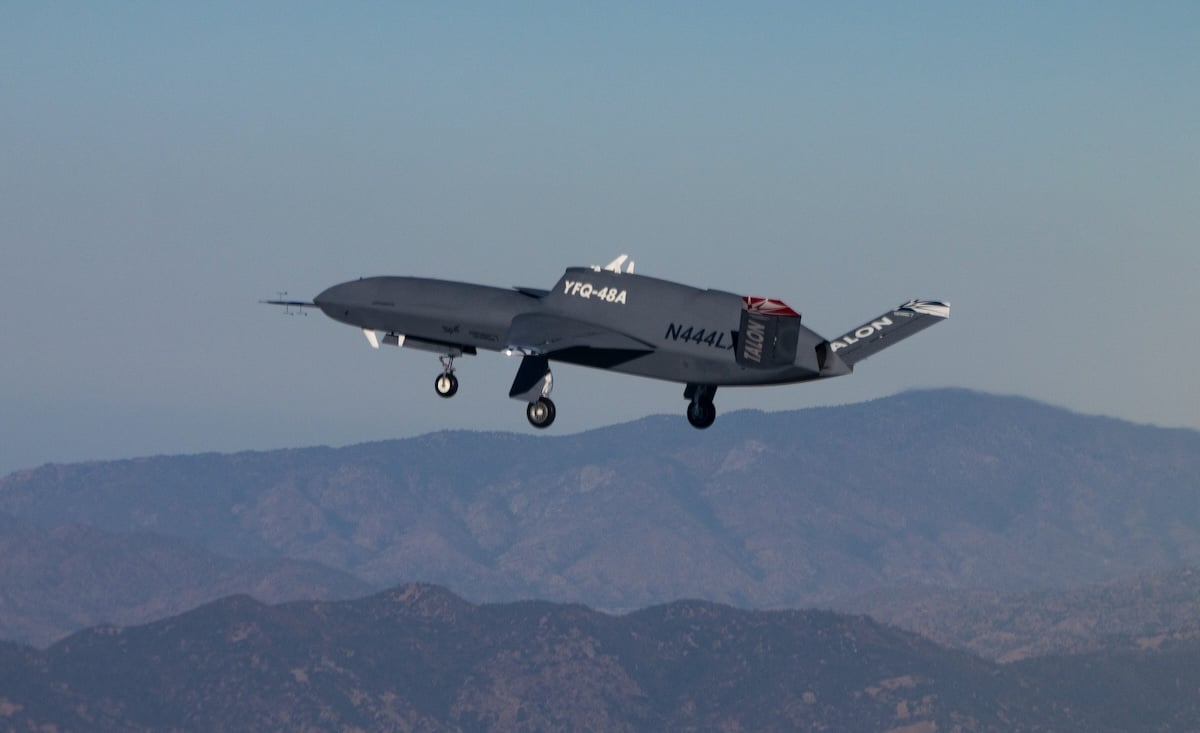
The flight advances Northrop Grumman’s internally funded Project Talon portfolio, which focuses on autonomous airpower capabilities. The company said changes to aircraft design and manufacturing reduced part count and overall weight, supporting affordable production at scale.
“Our customers made it clear they need autonomous systems that can be fielded faster and more affordably without sacrificing mission effectiveness,” said Craig Woolston, vice president and general manager for research and advanced design at Northrop Grumman. “We listened.”
Talon Blue features a high air intake, wide wheelbase and integrated weapons bay. Northrop Grumman said those features support flexible operational concepts and varied mission requirements for U.S. and allied partners.
“Talon Blue’s first flight is one step toward a new generation of autonomous capabilities,” Woolston said. “Every flight and lesson strengthens our broader autonomy work and sharpens what comes next.”
The company said the flight draws on seven decades of autonomy experience and more than 500,000 autonomous flight hours. Lessons from the aircraft will contribute to its broader development of autonomous systems.
The portfolio also includes Talon IQ, an autonomous testbed operating on the Scaled Composites Model 437 aircraft. Powered by Northrop Grumman’s Prism Mission Autonomy software, it offers a government reference architecture intended to accelerate autonomy development.
Northrop Grumman said Talon IQ reduces the time and cost required to introduce new mission capabilities. Alongside Talon Blue, it provides the company and its partners with a means to develop, test and field autonomous capabilities tailored to changing threats and operational needs.