The company is combining lower-cost commercial electronics with software-defined radios and artificial intelligence. That model is intended to make advanced electronic warfare available across more platforms while allowing capabilities to be updated in the field.
“EW is necessary in just about every defensive and offensive system being produced today,” said Patrick Creighton, vice president and general manager of Electronic Warfare at L3Harris. The company sees access to the electromagnetic spectrum as a requirement for the survivability and effectiveness of modern forces.
Traditional electronic warfare hardware was expensive, heavy and built for specific programmes. That limited wide-frequency sensing and jamming systems to larger platforms and customers able to fund specialised equipment.
“Rapid advancements in the commercial marketplace are making increasingly capable hardware available at lower cost, enabling us to deliver advanced software-based capabilities on top of that hardware far more affordably,” Creighton said. L3Harris plans to use those components to support a wider range of military missions.
Under the modular approach, customers select a form factor, software-defined radios and commercial hardware based on their frequency requirements. L3Harris then adds an open middleware layer that can host capabilities supplied by the company or third parties.
The software capabilities, described by L3Harris as skills, can be added, replaced or reconfigured after deployment. This allows the same equipment to perform several roles rather than remaining tied to one mission.
“These are no longer single-solution capabilities but genuinely multifunctional systems,” Creighton said. “A single system can be adapted for defensive operations, offensive missions or intelligence collection.”
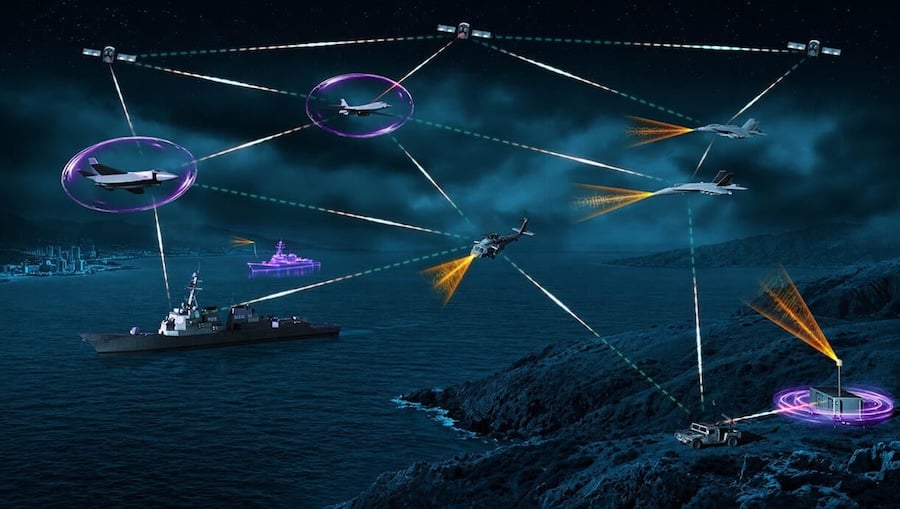
L3Harris is pairing the modular hardware with Distributed Spectrum Collaboration Operations, or DiSCO. The enterprise-level electromagnetic battle-management architecture brings together battlefield sensors, data links and communications methods.
The company said artificial intelligence and machine learning within DiSCO can reduce the time needed to identify unknown signals from months to minutes. The architecture was created with cloud providers, follows open standards and has been demonstrated with third-party software.
“As modular, disparate systems continue to proliferate, an electromagnetic battle management system becomes essential for coordinating non-kinetic sensors and effectors,” Creighton said. “This is where our DiSCO ecosystem comes in.”
The open design is also intended to prevent customers from becoming dependent on one supplier. It allows systems and software from different companies to be incorporated into the same operational architecture.
L3Harris is already using its Deceptor electronic warfare capability on unmanned platforms and in air-launched effects. DiSCO is intended to coordinate these distributed systems and turn separate payloads into a manageable combat capability.
“The decisions made today determine the advantage we’ll hold a decade from now,” Creighton said. “We cannot afford to fall behind in the invisible battle that decides every visible one.”