
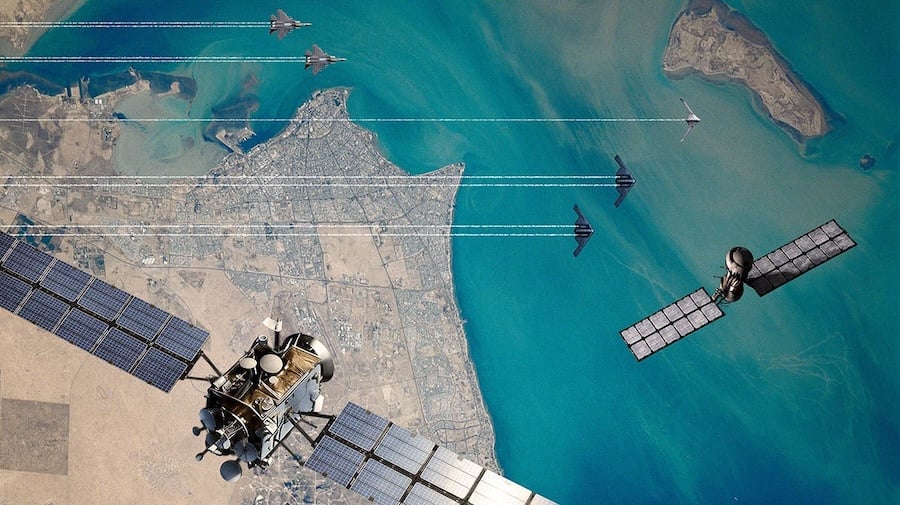
RASOR gives operators access to multiple constellations through different orbits, frequency bands and waveforms. L3Harris said the architecture can automatically redirect data when jamming, cyberattacks or other threats block a communications path.
The approach is intended to eliminate dependence on a single satellite constellation, frequency or link. That redundancy is designed to preserve targeting data, sensor feeds and command-and-control traffic during contested operations.
“Every element of the kill chain is built to perform under fire,” said Shawn Miller, President, Spectrum Superiority, Communications & Spectrum Dominance, L3Harris. “Our hybrid SATCOM solutions ensure connectivity meets that exact same standard to eliminate single points of failure so the warfighter is never left in the dark.”
Beyond-line-of-sight communications allow aircrews and ground commanders to exchange data across distances that conventional systems cannot cover. The growth of commercial satellite networks has added new communications routes alongside dedicated military infrastructure.
L3Harris said adversaries have developed the ability to deny, degrade or destroy satellite communications. An architecture built around one constellation or pathway can therefore create a point of failure during a conflict with a peer opponent.
RASOR stands for Rapidly Adaptable Standards-compliant Open Radio. Its modular, open architecture can host third-party hardware and software, allowing new waveforms and technologies to be added without replacing the full terminal.
“Commanders cannot wait on slow procurement cycles when the battlespace evolves daily,” Miller said. “We designed RASOR so operators can integrate new waveforms and partner technologies.”
The planned certification would allow RASOR to carry mission data across military and commercial infrastructure under demanding security and integrity requirements. Its architecture is also designed for integration with existing systems and use across different joint-force platforms.
L3Harris is offering the technology to the U.S. Air Force for command, control, communications and battle management. The system uses a non-proprietary architecture and provides the government with property rights to critical chassis, modules and software.
The model is intended to give the Air Force greater control over upgrades and long-term sustainment while reducing dependence on proprietary suppliers. L3Harris said it would also support secure data sharing and mission coordination among forces operating from dispersed locations.