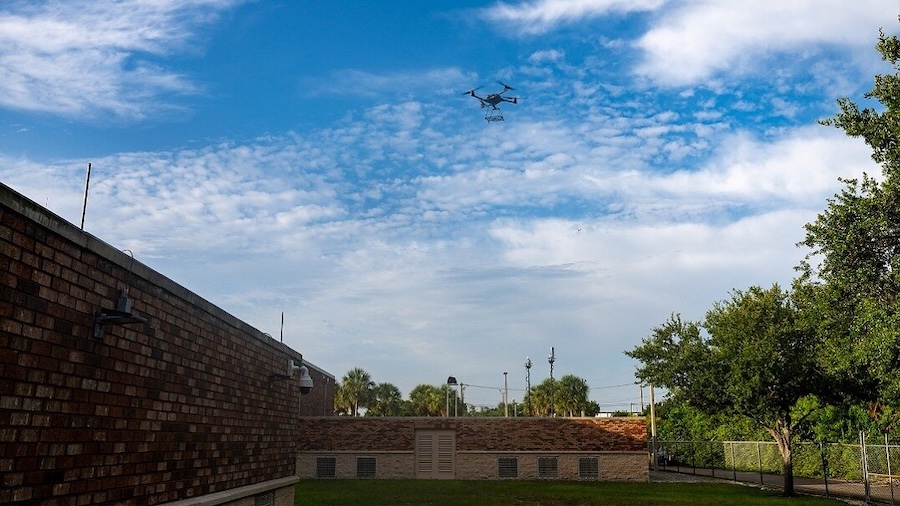
The live demonstration took place in the Miami area in July with Verizon, NVIDIA, Keysight Technologies, ODC and Astris AI. The system detected unmanned aircraft and maintained track custody during flight using existing Verizon 5G network spectrum and commercial technologies.
“Commercial technology is helping us rethink how we protect America’s most critical infrastructure. Our recent live demonstration of NetSense Airspace Awareness-as-a-Service showed how commercial 5G networks can detect and track unauthorized drones in real time – without requiring new hardware,” Lockheed Martin CEO Jim Taiclet said.
“Working with Verizon, NVIDIA, Keysight Technologies, ODC, and Astris AI, we validated an open-architecture approach that can evolve as threats change, integrating new sensors, interceptors, and mission applications without replacing the underlying platform. This is American innovation at work: bringing together the best commercial and defense technologies to help protect airports, public venues, and other critical assets faster, more affordably, and at scale.”
NetSense combines Lockheed Martin warning and tracking technology with ODC’s AI-native Radio Access Network software, NVIDIA’s AI Aerial platform and Keysight’s radio-frequency simulation technology. The system uses artificial intelligence to analyze RF disturbances, predict a drone’s flight path and issue real-time alerts.
Lockheed Martin said the demonstration showed that existing cellular networks can provide UAS sensing without recapitalizing the underlying infrastructure. The approach is designed to provide a path to wider deployment before future 6G Integrated Sensing and Communication networks become available.
“As drones become more affordable and accessible, airspace awareness technology needs to evolve rapidly to outpace potential threats. That’s why we developed the NetSense solution,” said Sarah Hiza, senior vice president, Technology and Strategic Innovation at Lockheed Martin.
“By working within the established 5G network spectrum, we’re able to collaborate with the commercial technology industry and deploy a solution that’s ready at the time of need.” Lockheed Martin said the open architecture can also support new sensors, interceptors and mission applications without requiring replacement of the underlying platform.
Potential applications include airports, power plants, schools, hospitals, stadiums and other large public venues. City, state and federal government customers could also use NetSense for airspace monitoring and automated alerts.
“By applying AI to the RF signal measurement data already traversing our 5G infrastructure, we can effectively turn our network into an intelligent sensing platform,” said Anil Guntupali, senior vice president of Technology and Product Development at Verizon. “By collaborating with Lockheed Martin to apply intelligence to our existing 5G spectrum, we’re proving that the most complex security problems often have an answer embedded in the network.”
Lockheed Martin plans to deliver NetSense as a subscription service that connects with customers’ existing security operations. Pilot deployments are planned for the second half of 2026 and early 2027, with broader commercial availability scheduled for 2027.
Early deployments will be limited to selected customers with an urgent requirement for the capability. Lockheed Martin also plans a roadmap toward wider use across 5G networks and future integration with 6G systems.