
Taiclet highlighted the milestone during Lockheed Martin’s second-quarter 2026 earnings call, pointing to QuadStar as one of several weapons programs where the company is seeking to move faster through development and testing.
“In May, at White Sands Missile Range, the QuadStar seeker completed its flight test as part of the Next Generation Short Range Interceptor competition, validating some key risk reduction milestones for the Army’s Stinger replacement on a very compressed six-month schedule,” Taiclet said.
The Next-Generation Short-Range Interceptor, or NGSRI, competition is intended to deliver the Army’s future replacement for the legacy Stinger, placing QuadStar in a program centered on renewing the service’s short-range air-defense capability.
Taiclet’s emphasis was less on individual technical specifications than on the speed with which Lockheed Martin moved the candidate through a major risk-reduction event, describing the six-month timetable as unusually compressed.
The QuadStar effort also reflects a broader development strategy outlined by Taiclet in which Lockheed Martin increasingly moves ahead of traditional acquisition timelines when it sees a clear operational requirement.
“We’re not waiting on orders or contracts to close evident mission gaps for our military services and those of our allies,” Taiclet said.
Back in May, Lockheed Martin said the QuadStar missile had successfully completed the NGSRI Seeker Characterization Flight Test, calling it a critical risk-reduction milestone that cleared the way for continued testing as the Army moves toward the next phase of its Stinger replacement effort.
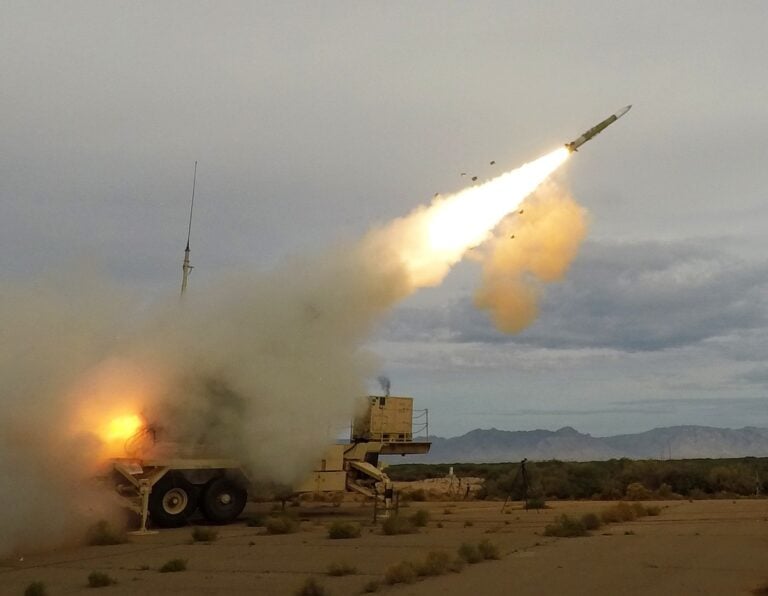
During the event, a QuadStar missile launched from a Command Launch Assembly and flew a tactical trajectory while demonstrating seeker performance at a range exceeding the capability of the legacy system, according to Lockheed Martin.
The test was designed to verify the seeker’s ability to capture imagery, process signals onboard the missile and maintain target tracking in flight, giving the company an opportunity to demonstrate several of the sensor and guidance functions central to the interceptor.
Lockheed Martin said the test also confirmed performance of the Command Launch Assembly, critical system functions, the seeker technology and the broader QuadStar interceptor.
The company is positioning the seeker to support engagements against unmanned vehicles as well as rotary-wing and fixed-wing threats, while stressing affordability alongside performance.
Lockheed Martin said the design incorporates AI-driven signal processing and a modern open-systems architecture intended to support faster updates and modular upgrades over the life of the weapon.
The May test followed a three-month sprint from QuadStar’s first flight to the Seeker Characterization Flight Test, adding to the compressed development timeline later highlighted by Taiclet during the earnings call.
“Our team’s shared mission, innovative approach and agility were essential to achieving this milestone,” Randy Crites, vice president of Lockheed Martin Advanced Programs, said in the May announcement.
“The successful SCFT demonstrates we remain on course to deliver a next-generation interceptor that will defend our warfighters and allies well into the future,” Crites said.
Chris Murphy, Lockheed Martin’s NGSRI business development lead, said completing the seeker characterization in under six months demonstrated the speed and flexibility the company was bringing to the Army requirement.
“We remain committed to delivering highly capable, readily manufacturable and affordable solutions that meet the Army’s immediate and future needs,” Murphy said.
Taken together, the May test results and Taiclet’s subsequent comments show Lockheed Martin pushing QuadStar through the Army’s risk-reduction process while making development speed, manufacturability and affordability central elements of its pitch for the Stinger replacement.