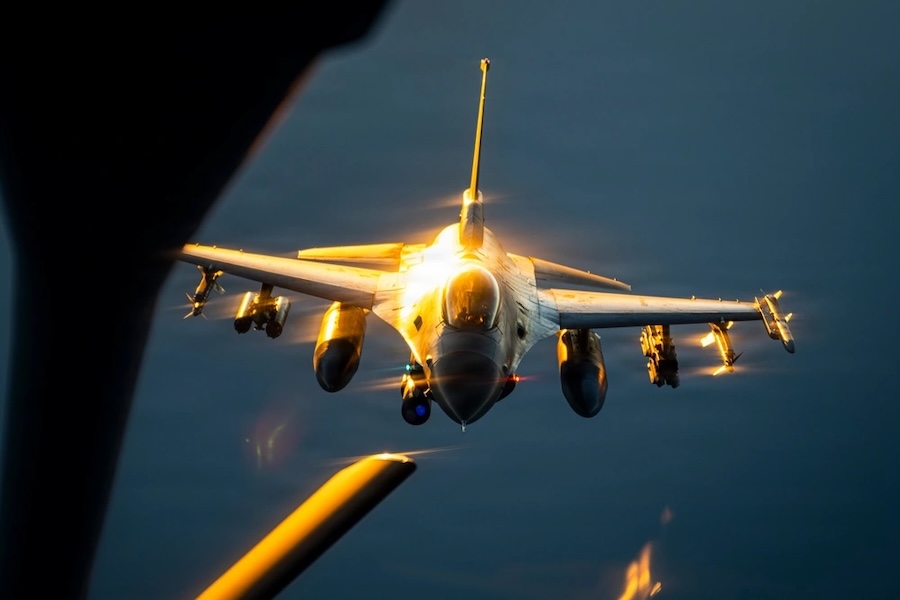
The orders add to an installed base of about 2,800 F-16s operating in 29 countries. Lockheed Martin says the global fleet has completed more than 14 million sorties and accumulated over 21 million flight hours.
The Block 70/72 combines a new-production airframe with radar, cockpit and safety technologies derived from more recent combat-aircraft programs. Lockheed Martin describes it as the most advanced fourth-generation F-16 produced to date.
Northrop Grumman’s APG-83 active electronically scanned array radar sits at the center of the aircraft’s sensor package. The system shares hardware and software features with F-22 and F-35 radars and is designed to provide faster all-weather targeting, greater situational awareness and more detailed digital mapping.
Pilots receive radar and targeting information through a high-resolution Center Pedestal Display with color moving maps, larger air-to-air situation displays and zoom functions. The cockpit can also integrate Lockheed Martin’s Sniper Advanced Targeting Pod and Legion-ES infrared search-and-track system.
The aircraft incorporates the Automatic Ground Collision Avoidance System developed by Lockheed Martin to prevent controlled flight into terrain. Since entering U.S. Air Force service in 2014, the system has saved multiple pilots and aircraft, according to the company.
Weapons flexibility remains another central element of the F-16 offering. Lockheed Martin says more than 36 years of integration work with the U.S. Air Force and foreign military sales customers has produced over 3,300 certified carriage and release configurations for more than 180 weapons and stores.
The Block 70/72 airframe has a rated structural life of 12,000 hours, more than 50% beyond that of earlier production F-16s. Lockheed Martin says this should provide at least 40 years of service for most operators without expected major structural repairs over the aircraft’s lifetime.
Conformal fuel tanks increase fuel capacity and range without reducing aerodynamic performance, while an improved engine forms part of the production configuration. Martin-Baker’s US18E ejection seat adds an electronic sequencer, neck and head protection, a larger parachute and a modular design intended to reduce maintenance requirements.
The F-16 industrial network includes more than 500 U.S. suppliers across 41 states and 28 international suppliers in 12 countries. Lockheed Martin estimates the program generates about 46,000 direct and indirect jobs in the United States and roughly 55,000 worldwide, with a global economic impact of $7.5 billion.