
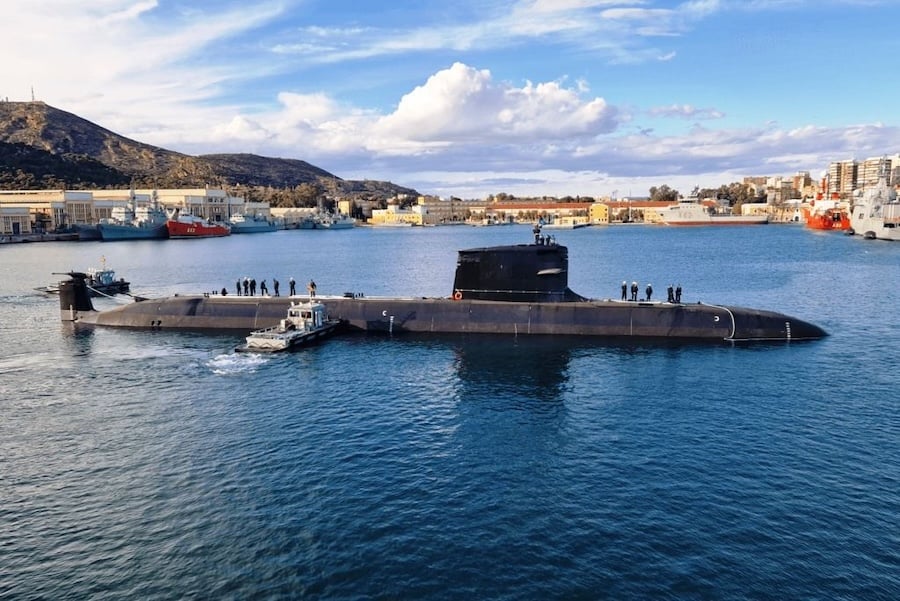
The trials began in June at Navantia’s Cartagena shipyard. They tested the AIP system in its final onboard configuration before its section is joined to the submarine’s pressure hull.
The specialised section is 12 metres long and weighs about 400 tonnes. It remains inside a testing facility built to validate the system under representative operating conditions.
The trials began with the first loading of liquid oxygen and bioethanol. The system uses those materials to produce hydrogen for a fuel cell that generates electricity and charges the submarine’s batteries underwater.
Navantia classifies the installation as a third-generation AIP system. It produces hydrogen on demand from liquid fuel instead of storing the gas onboard.
The technology is intended to keep S-80 submarines submerged for weeks. Conventional submarines relying only on lead-acid batteries typically have an underwater endurance of several days.
Longer submerged operations will improve the Spanish Navy’s ability to avoid detection. Navantia said this would also strengthen the service’s deterrence capability.
The Cartagena test facility can simulate the submarine’s forward and aft sections. It can also reproduce conditions including diving depth and speed.
Engineers demonstrated underwater power generation and battery charging across a range of operating conditions. The results will help Navantia prepare for Harbour Acceptance Trials after the S-83 is launched.
The system previously completed Factory Acceptance Tests on land. It also demonstrated its ability to charge the batteries of the S-81, the first submarine in the class.
Navantia Chairman Ricardo Domínguez said the campaign confirmed the system’s readiness and the capabilities of Spain’s defence industry. “All of this further confirms the technological maturity of the system and demonstrates the national industry’s capacity for innovation and for delivering complex technological developments.”
The S-80 programme covers four submarines for the Spanish Navy. The S-82 is undergoing harbour and sea trials, while the S-83 and S-84 remain under construction in Cartagena.
The class combines the AIP system with advanced combat systems, sensors and a design for long-endurance operations. Navantia said the programme supports Spain’s strategic autonomy and its contribution to Spanish and European security.