
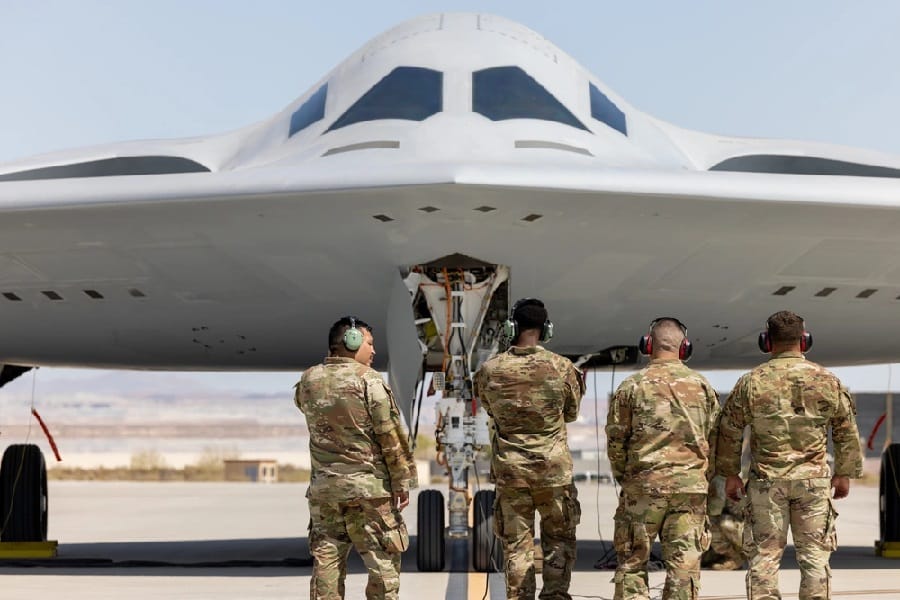
Gen. Dale White, director of Critical Major Weapon Systems, said during the Air Force’s Life Cycle Industry Days conference in Dayton, Ohio, in late July that the B-21 acquisition effort had accelerated by roughly 25% following a one-time $4.5 billion funding increase provided through the 2025 reconciliation legislation. He said the first operational aircraft is expected to be “on the ramp” at Ellsworth Air Force Base in South Dakota in 2027.
The Pentagon has requested $6.1 billion for the B-21 program in fiscal 2027, supporting a transition from development and flight testing toward a larger production and fielding effort. White said Northrop Grumman is expected eventually to produce seven operational B-21s a year.
The latest Air Force assessment follows the addition of a second B-21 to flight testing at Edwards Air Force Base in California. Expanding the test fleet is intended to increase the pace of flight evaluations and weapons integration ahead of operational deployment.
Northrop Grumman’s own financial and production disclosures point to the same shift toward higher activity on the program. Aeronautics Systems sales rose 13% in the second quarter of 2026, driven in part by higher B-21 volumes, while the segment delivered a 10.3% operating margin.
The company also raised its full-year Aeronautics Systems sales forecast to about $14 billion. Chief Financial Officer John Greene said the revised outlook reflected higher B-21 sales as the program continued to ramp, together with increased volumes on mature production programs.
That production ramp is also shaping Northrop Grumman’s investment profile. Greene said the company expects capital expenditures of $1.85 billion in 2026 and spending equivalent to about 4.5% of sales in both 2027 and 2028, specifically citing infrastructure needed to support B-21 production.
Northrop Grumman Chief Executive Officer Kathy Warden said during the company’s second-quarter 2026 earnings call on July 21 that the B-21 was among the major programs benefiting from investments made over several years. She said the company had invested not only in new capabilities but also in the manufacturing capacity needed to respond more quickly when demand increases.
“We also have been investing in capacity,” Warden said during the Q2 2026 earnings call. She said having production capacity already available allows Northrop Grumman to take on work it otherwise might not have been positioned to deliver and bring revenue forward once customer demand materializes.
The more consequential question is how large the B-21 production requirement ultimately becomes. Asked during the earnings call whether the Air Force was considering increasing the program beyond 100 aircraft, Warden said an agreement with the service allows it to examine both faster output and a larger program of record.
“The agreement we reached with the Air Force does allow them to consider accelerating production into a larger program of record,” Warden said. Northrop Grumman is participating in the analysis, and she expects the Air Force to reach a conclusion by the end of 2026.
The review gives the B-21 program an additional industrial dimension beyond the currently planned production ramp. If the Air Force opts for faster output or a larger fleet, Northrop Grumman would need to support higher aircraft volumes while maintaining the program’s testing and fielding schedule.
Execution on the bomber has remained strong, according to Northrop Grumman management. Greene said there had been “good execution throughout the year” on B-21, supporting a positive direction for overall program profitability.
Northrop Grumman also views the Raider as one of the principal programs supporting longer-term growth. Greene cited B-21 alongside Sentinel and weapons demand among the drivers that should allow the company to accelerate revenue growth over time relative to its historical performance.
Warden has tied the production push to a broader effort to move advanced defense technologies into service more quickly. In her opening remarks during the Q2 2026 earnings call, she said Northrop Grumman was working with customers to accelerate development and delivery of next-generation capabilities while investing in advanced factories to increase production rates and volumes.
The B-21 represents the next step in the company’s flying-wing stealth bomber lineage, following the B-2 Spirit. Warden described the B-2 and B-21 as examples of Northrop Grumman’s signature flying-wing technology and said the company was operating with “a sense of urgency” to deliver advanced systems in response to the changing threat environment.
Designed to penetrate advanced air defenses and carry both conventional and nuclear weapons, the B-21 is intended to replace the B-1 Lancer and B-2 Spirit over time. It will operate alongside modernized B-52 Stratofortress bombers, which are expected to remain part of the U.S. strategic bomber force for decades.
The first operational delivery to Ellsworth in 2027 will therefore mark only the beginning of the Raider’s transition into the force. Northrop Grumman is already increasing investment and production activity while the Air Force determines whether the sixth-generation bomber should ultimately be built faster and in greater numbers than originally planned.