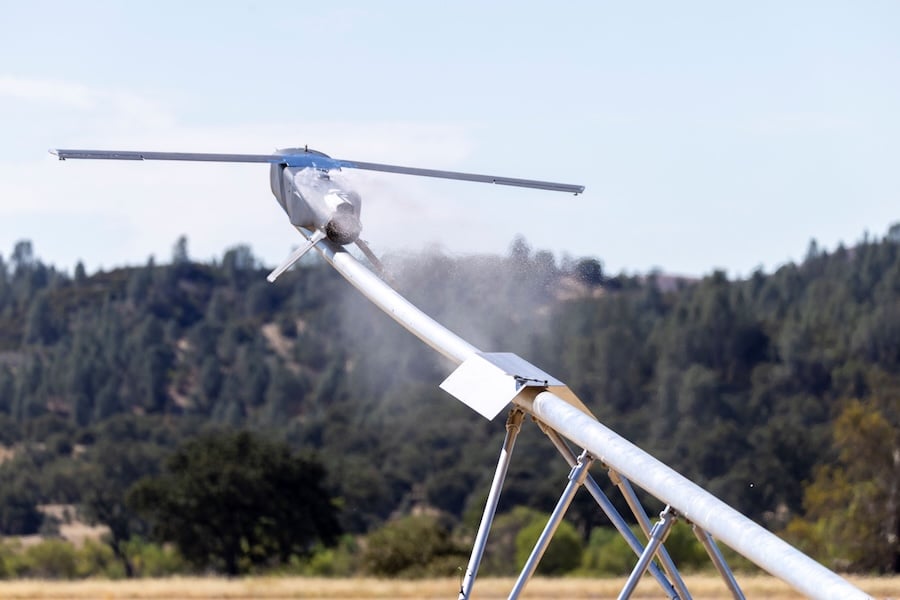
The test paired Lumberjack with magnetic-navigation sensors supplied by SandboxAQ. Northrop Grumman said the companies moved from setting the integration objective to flying the capability in one month.
The system uses quantum sensors to measure small variations in the Earth’s magnetic field. Those readings allow the aircraft to navigate independently of GPS, including over open water.
The demonstration showed that the navigation system could resist jamming and operate in a GPS-denied environment. It also proved that Lumberjack could be launched, flown and recovered repeatedly for military training.
“Lumberjack showcases not only ‘best-of-breed’ technology across industries, but our ability to integrate quickly has moved us from vision to operational reality in a rapid timeline,” said Max Schuster, Northrop Grumman’s Lumberjack program manager. “Adding quantum sensing to an adaptable autonomous platform like Lumberjack advances mission capability in GPS-denied environments.”
Lumberjack is a Group 3 uncrewed aircraft developed for one-way attack, loitering-munition and launched-effect missions. Its equipment includes an electronic-warfare suite, tactical data links, surveillance technology and precision-strike capabilities.
The latest flight brought together the air vehicle, an integrated mission kit, artificial intelligence and SandboxAQ’s hardware and software. Northrop Grumman said the platform’s modular design allows new capabilities from industry partners to be added quickly and affordably.
Lumberjack was designed and developed within 14 months of its first flight. Northrop Grumman has since used successive tests to expand the aircraft’s capabilities.
Northrop Grumman acts as the mission-systems integrator and provides many of the technologies used to sense, detect and deter battlefield threats. ESAero, a wholly owned subsidiary of AV, supplies the air vehicle and supports its systems integration.
The combination of jam-resistant navigation and recoverability gives military users a reusable platform for testing and training. It also supports the drone’s intended role in missions conducted under contested electromagnetic conditions.
Northrop Grumman said its autonomous platforms have recorded more than 500,000 flight hours. The company’s uncrewed portfolio includes Lumberjack, MUX TACAIR and Project Talon.