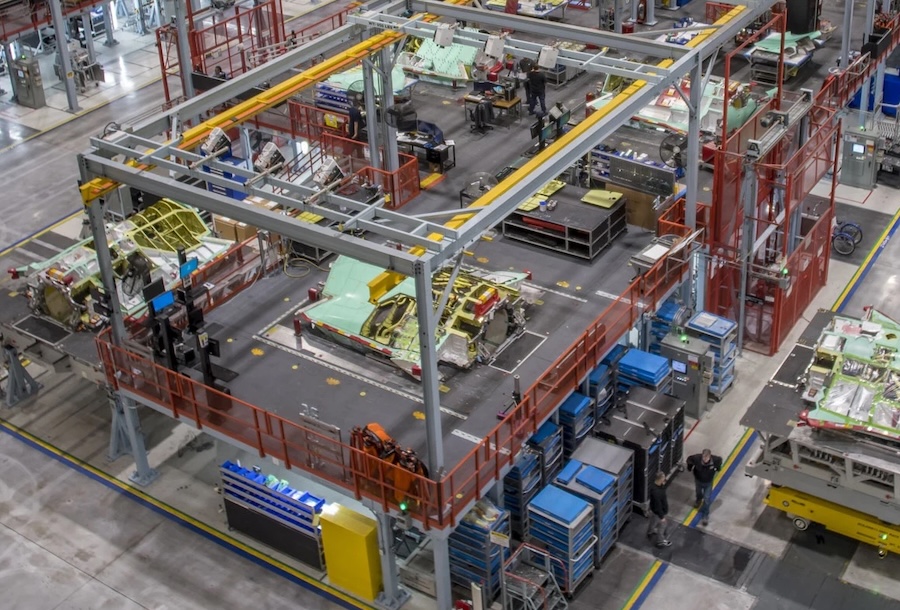
“1,600 F-35 center fuselages delivered on schedule. With a center fuselage completed every 30 hours, our teams are building at the pace needed to support the F-35 fleet,” Northrop Grumman said in a social media statement.
The production line began operating in 2011 and had delivered more than 1,400 center fuselages by July 2025. Northrop Grumman announced the 1,500th delivery on Jan. 12, 2026, before raising its disclosed total to 1,600.
The U-shaped facility is located at the company’s Aircraft Integration Center of Excellence and contains more than 115 build stations and 22 automated systems. Northrop Grumman designed the line to improve quality, safety and affordability while sustaining a production interval of 1.25 days.
Digital manufacturing tools have also helped the company shorten production and training timelines. Northrop Grumman said its use of augmented and virtual reality reduced center fuselage assembly time by 35% and the technician learning curve by 20%.
“We knew that automation and robotics would be key to meeting the F-35 program’s goal of continued high-volume production,” said Glenn Masukawa, vice president and general manager of Northrop Grumman’s Air Dominance division. “We also needed to be affordable, which implied a lot of cost reductions over time.”
Northrop Grumman drew on practices from the U.S. automotive sector when developing the automated system. “We teamed up with KUKA Systems North America, a Detroit-based automation technology company that specialized in integrating assembly lines for the automotive industry,” said Scott Johnson, F-35 center fuselage integrated product team lead.
“We blended their understanding of automation and automotive production lines with our expertise in aerospace tooling. The resulting Integrated Assembly Line (IAL) represents the best production practices from both industries,” Johnson added.
The line can produce center fuselages for the conventional takeoff and landing, carrier, and short takeoff and vertical landing variants using common production infrastructure. “All three variants use the same base tooling,” Johnson said. “Our secret sauce, however, is Northrop Grumman’s very robust global supply chain.”
Components for each aircraft arrive in containers known as shadow boxes, which use foam cutouts to organize the parts required for a specific center fuselage. “This simple but very effective process means that we have near-perfect accuracy in installing the right part on the right jet,” Masukawa said.
Northrop Grumman has served as a principal member of the Lockheed Martin-led F-35 industry team since 2001, supporting development, production and sustainment across the program. Beyond the center fuselage, it produces the AN/APG-81 active electronically scanned array radar, components for the integrated communications, navigation and identification system, and wing skins.
The company also sustains the Electro-Optical Distributed Aperture System and provides modernization and fleet-support services to U.S. and international customers. Northrop Grumman said it has invested more than $13.5 billion in U.S. infrastructure and research and development to support current and future national-security requirements.