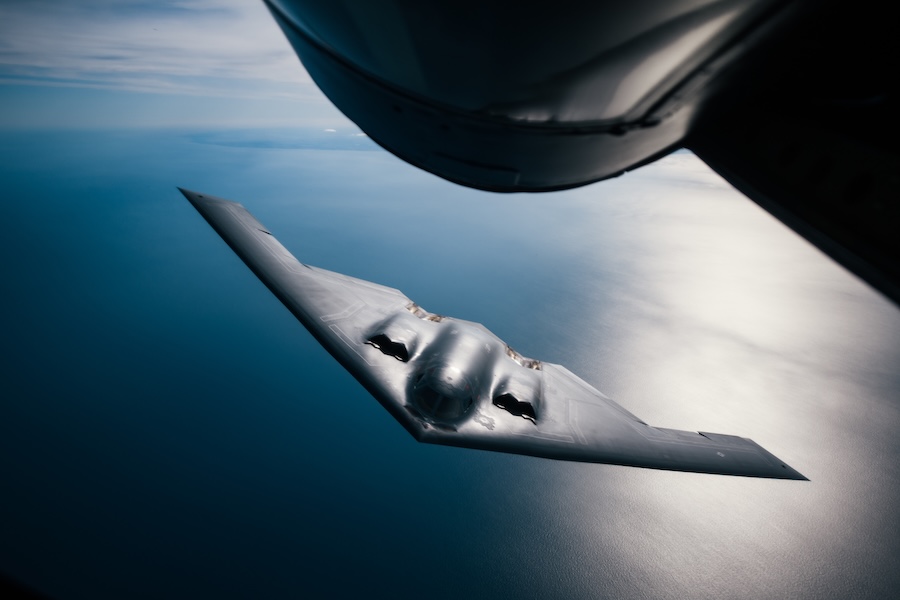
“The B-2 is the nation’s only operational deep-strike, nuclear stealth bomber. It’s the backbone of strategic deterrence, delivering unmatched capabilities and air superiority when it matters most,” Northrop Grumman said in a social media statement.
The B-2 was designed to penetrate sophisticated air defences and reach heavily defended targets that could be difficult for conventional aircraft to approach. Its low-observable characteristics reduce its infrared, acoustic, electromagnetic, visual and radar signatures.
The Air Force says the combination of stealth, aerodynamic efficiency and a large payload gives the bomber greater freedom of operation at high altitude. The aircraft has an unrefuelled range of about 6,000 nautical miles, or 9,600 kilometres, supporting intercontinental missions.
The B-2 can carry up to 60,000 pounds, or 27,216 kilograms, of conventional or nuclear weapons. It flies at high subsonic speed and has an operating ceiling of 50,000 feet.
Its low-observable design combines a flying-wing configuration with composite materials and specialised coatings. Many details of the processes used to reduce the aircraft’s detectability remain classified, according to the Air Force.
The bomber operates with two pilots, with a pilot seated on the left and a mission commander on the right. Its four General Electric F118-GE-100 engines each produce 17,300 pounds of thrust.
Northrop Grumman is the B-2’s primary contractor, supported by an industrial team that included Boeing Military Airplanes, Hughes Radar Systems Group, General Electric Aircraft Engine Group and Vought Aircraft Industries. The aircraft achieved initial operating capability in April 1997 and remains an operational element of the U.S. bomber force.