
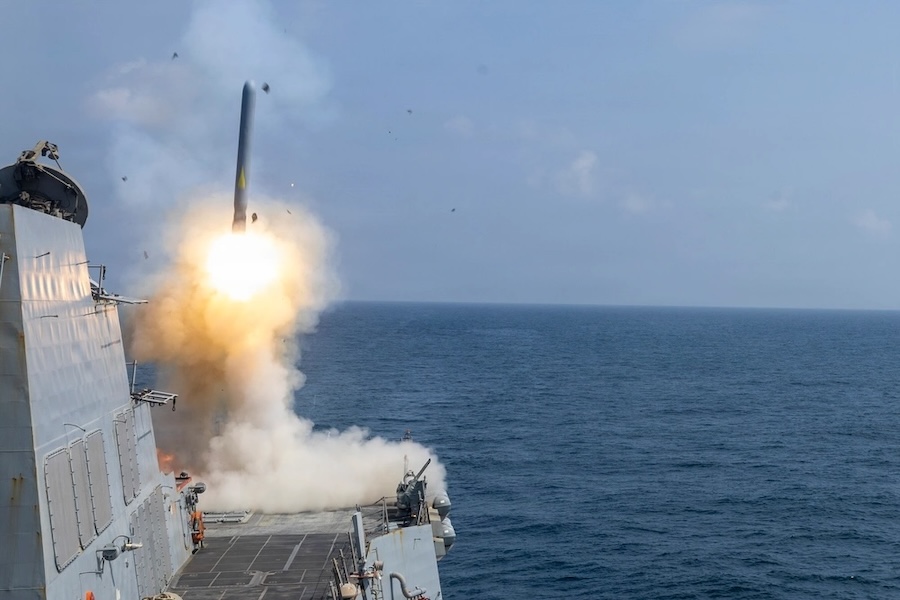
The figures were published in Operation Epic Fury: Report to the United States Congress, April 1, 2026–June 30, 2026, the first quarterly Inspector General assessment of the operation. The report provides a detailed account of the forces, weapons and logistics required to conduct and sustain the campaign.
The United States launched Operation Epic Fury on February 28 in coordination with Israel’s Operation Roaring Lion. Major combat operations continued until an April 7 ceasefire, though U.S. military activity in and around the Strait of Hormuz remained part of the mission.
The campaign was intended to destroy Iran’s ability to project military power and prevent it from acquiring nuclear weapons. General Dan Caine, chairman of the Joint Chiefs of Staff, described the broader mission as disrupting, degrading, denying and destroying Iran’s ability to conduct and sustain combat operations.
American air and ground strikes targeted Iranian ballistic missile garrisons, air defense sites and storage facilities for cruise missiles and unmanned aircraft systems. U.S. forces also attacked command centers, naval forces, mine-warfare assets and parts of Iran’s defense industrial base.
Operations around the Strait of Hormuz included strikes against Iranian naval and coastal defense targets. U.S. forces also conducted defensive counter-air missions, demonstration transits and mine-hunting operations using unmanned underwater vessels.
The Pentagon had begun repositioning forces months before the campaign started. Thousands of personnel, hundreds of advanced fighter aircraft and dozens of aerial refueling tankers moved into the region alongside the USS *Abraham Lincoln* and USS *Gerald R. Ford* carrier strike groups.
At the height of the conflict, the U.S. force included more than a dozen fighter squadrons, more than a dozen destroyers and more than a dozen air defense batteries. The deployment also included THAAD missile defense systems, HIMARS launchers, counter-drone equipment and part of the 82nd Airborne Division.
Two carrier strike groups provided continuous coverage during the reporting period, supported by their air wings and accompanying destroyers. The USS *George H.W. Bush* arrived in late April to replace the USS *Gerald R. Ford*, which returned to Norfolk after a 326-day deployment.
The campaign drew support from U.S. combatant commands operating well beyond the Middle East. European bases provided a launch and sustainment network, while at least six warships were reassigned from the Pacific to support maritime operations and the blockade of Iran.
U.S. Cyber Command and U.S. Space Command carried out non-kinetic operations against selected targets and monitored Iranian electronic-warfare and jamming activity. Caine said coordinated cyber and space operations disrupted Iranian communications and sensor networks during the opening days of combat.
U.S. Strategic Command provided long-range strike capabilities from the continental United States and other bases. American forces dropped dozens of 2,000-pound penetrating guided bombs on deeply buried missile launchers across southern Iran during the first 11 days.
The April 7 ceasefire did not end U.S. operations in the region. A naval blockade imposed six days later redirected more than 140 vessels, disabled 10 non-compliant ships through kinetic action and permitted more than 50 vessels carrying humanitarian assistance to pass.
The Pentagon estimated the cost of Operation Epic Fury at $33.4 billion as of June 29. The total included $22.3 billion for expended munitions, $3.7 billion for equipment losses and $7.4 billion in incremental operational obligations.
The Inspector General said most information collected from federal agencies had not been independently verified or audited. The campaign figures therefore reflect assessments provided by U.S. Central Command, the Pentagon and other government organizations cited in the report.