
The disclosure appeared in an Aug. 27 CRS report titled “U.S. Army’s Patriot Air and Missile Defense System”. Golden Dome is intended to combine a range of capabilities into a broader network protecting the United States from aerial attacks by any adversary.
Formal requirements for Patriot units are not believed to have been submitted for the program. CRS said Congress may examine which threats Patriot would be assigned to counter within the wider Golden Dome architecture.
Patriot is designed to detect, track and engage aircraft, unmanned aerial vehicles, cruise missiles and short-range or tactical ballistic missiles. Its mobile configuration allows units to protect designated military assets and locations.
The system can operate independently, but it is designed to deliver its greatest value as part of a layered defense. Patriot can work alongside the Terminal High Altitude Area Defense system to provide integrated and overlapping protection against different classes of threats.
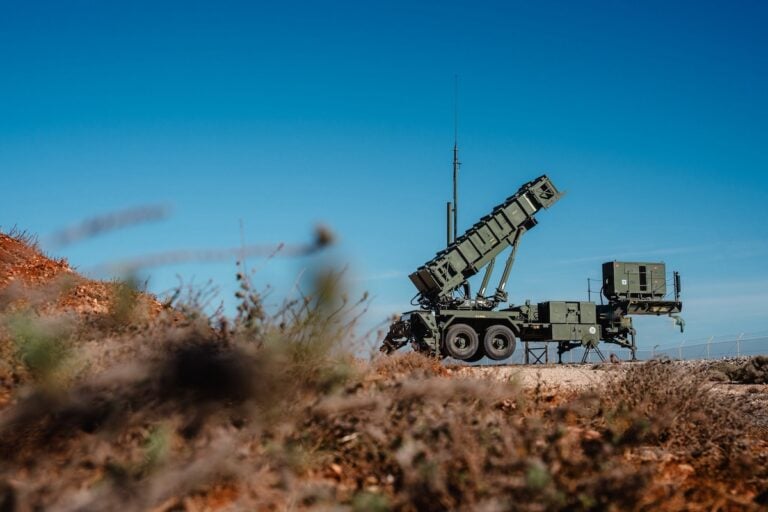
Each Patriot unit includes a radar, engagement control station, missile launchers and interceptors. The radar can track and prioritize more than 100 potential targets at ranges exceeding 100 kilometers.
A vehicle-mounted launcher can carry between four and 16 interceptors, depending on the missile variant. It can be positioned separately from the radar and engagement control station and prepared to fire in less than nine seconds.
Patriot’s missile family provides commanders with interceptors suited to different missions. The RTX-produced PAC-2 Guidance Enhanced Missile uses blast-fragmentation technology and is employed against aircraft and cruise missiles.
Lockheed Martin produces the PAC-3 Missile Segment Enhancement, the current generation of the PAC-3 interceptor. The high-velocity missile uses hit-to-kill technology to engage tactical ballistic missiles, cruise missiles, air-breathing threats and unmanned aerial systems.
PAC-3 MSE has been integrated into Patriot systems operated by the United States and international partners. It has also been integrated with the U.S. THAAD system, expanding its place within layered missile defense operations.
RTX, formerly Raytheon, serves as the prime contractor for the Patriot system, while Lockheed Martin manufactures PAC-3 MSE interceptors. The Army is also reportedly working to develop and acquire newer Patriot missile variants offering greater capability and improved cost-effectiveness.
Patriot’s potential Golden Dome role comes while the Army is expanding its active force. The service currently operates 15 Patriot battalions and plans to add one battalion annually from fiscal 2029 through fiscal 2031.
A four-battery battalion equipped with the Integrated Battle Command System and Lower Tier Air and Missile Defense Sensor carries an estimated procurement cost of $1.792 billion. The CRS report did not specify whether Golden Dome would draw on existing formations or require additional Patriot units.
Congress may also review the production rates needed to support the Army, foreign partners and any future homeland defense requirements. CRS identified domestic manufacturing capacity, access to critical materials and the potential use of foreign production lines as areas for consideration.
Patriot has been acquired or requested by governments across Europe, the Middle East and the Indo-Pacific. That international footprint gives the system an established base of operators alongside its central role in the U.S. Army.
The interceptor family is also being considered for use beyond land-based Patriot units. The Navy reportedly plans to integrate PAC-3 MSE missiles aboard some Aegis guided-missile destroyers, with Lockheed Martin anticipating an initial land-based test in early 2027 and initial operational capability in 2028.
Golden Dome remains under development, and Patriot’s exact place within the architecture will depend on future requirements. Its ability to engage aircraft, drones, cruise missiles and tactical ballistic missiles gives defense planners a mature capability to consider for the program’s layered homeland defense network.