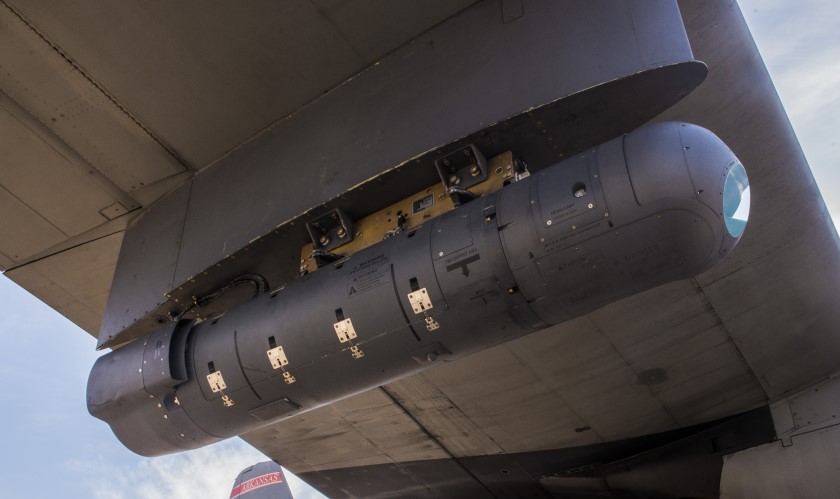
The display reflects how drone threats are changing the role of combat aircraft and their onboard systems. Rafael is presenting LITENING 5 as a multi-mission asset, not only as a precision targeting pod.
LITENING 5 is used on more than 25 aircraft types by 28 air forces worldwide. Rafael says the system has proved central to the full engagement chain in demanding threat environments.
In counter-drone missions, the pod supports automatic detection, tracking, identification and terminal guidance. Its electro-optical tracking system is designed to improve detection of small and fast-moving aerial threats.
Once a target is detected and tracked, LITENING 5 can support several weapon options. Rafael says these include radar-guided missiles, heat-seeking missiles and laser-guided rockets.
That gives operators flexibility to match the response to the threat. Rafael says the approach offers a precise and lower-cost way to counter small aerial targets at scale.
The pod uses a multispectral sensor suite. It combines mid-wave infrared, short-wave infrared and large-aperture colour imaging.
Advanced image processing and automatic target-tracking algorithms help maintain target tracks at tactically relevant ranges. Rafael says these capabilities are important against low-signature airborne threats.
The system also supports battle damage assessment and ground moving target indication. The latest generation can also include an optional synthetic aperture radar for all-weather targeting.
Germany’s Bundestag last year approved 90 LITENING 5 pods for the Luftwaffe’s Eurofighter Typhoon fleet. Rafael says the decision reflects demand for real-time connectivity and data-sharing in networked air operations.
Those functions support integration with manned-unmanned teaming architectures. Rafael presents this as part of a wider shift in air combat operations.
Rafael Chief Executive Officer Yoav Tourgeman says LITENING’s value lies in linking sensors, algorithms and shooters inside a widely deployed targeting system. He says recent operational use shows that onboard sensing and processing can shape engagement outcomes as much as the munition itself.