
The Air Force Life Cycle Management Center disclosed the awards on Aug. 26 after they were signed on Aug. 21. The service initially obligated $46.01 million to Raytheon and $34.95 million to Boeing from fiscal 2026 aircraft procurement funds.
Raytheon received a $603 million indefinite-delivery, indefinite-quantity contract to produce and sustain AN/APQ-188 radars. The stated value is a maximum ordering ceiling rather than a guaranteed payment.
The AN/APQ-188 uses an active electronically scanned array and will replace the mechanically scanned AN/APQ-166. The existing radar entered service on the B-52 in the late 1980s and has a stated range of 277.8 kilometers.
The replacement is designed to improve all-weather navigation, target detection and tracking. It is also intended to provide performance and maintenance characteristics comparable to the AN/APG-82(V)1 radar used by the F-15EX Eagle II.
Raytheon received the original radar development award in July 2019. The AN/APQ-188 draws on technologies used in the company’s radar families for F-15 and F/A-18 aircraft.
Northrop Grumman’s competing proposal based on the AN/APG-83 Scalable Agile Beam Radar was not selected. Boeing received a separate $162.97 million order for Bomb Rack Modernization System equipment linked to the radar conversion.
The Boeing package includes mission computers, avionics, displays and cooling equipment. Two processors will connect the radar with other B-52 systems and operate as mission computers.
Navigation and radar-navigation stations will receive two high-resolution 8-by-20-inch touchscreens. The installation will also include handheld radar controllers and new thermal-management equipment.
Raytheon will perform work in Mississippi, California, Texas and Georgia through Aug. 31, 2031. Boeing will complete its work in San Antonio, Texas, by Dec. 20, 2028.
The radar program has slipped from an earlier schedule that called for production to begin in 2024. A June 2026 Government Accountability Office report cited environmental testing, software development, parts procurement and difficulties fitting the radar into the bomber’s nose.
The reported problems contributed to a 15% increase in program costs. The first AN/APQ-188 was later installed on the B-52H known as *Die Laughin’ Jester* for flight testing at Edwards Air Force Base.
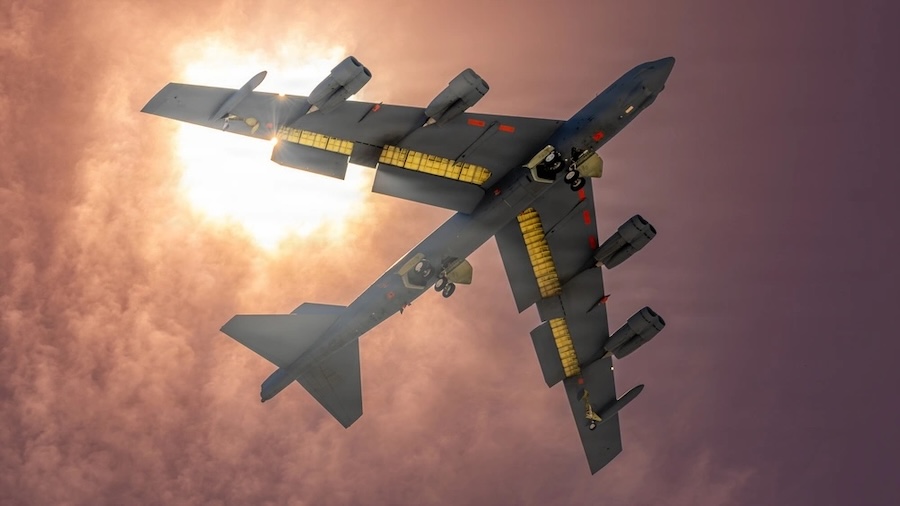
The aircraft crashed at Edwards on June 15, 2026, killing all eight crew members aboard. The radar program forms part of the wider conversion of B-52H aircraft to the B-52J configuration.
The B-52J program will replace the bomber’s Pratt & Whitney TF33 engines with Rolls-Royce F130 turbofans. Other planned upgrades cover cockpit displays, communications, diagnostics, electronic warfare systems and Link 16 data exchange.
The modernization will improve resistance to electronic interference and the ability to locate threat emitters. The B-52J is also expected to carry the future Raytheon AGM-181 Long-Range Stand-Off cruise missile.
The aircraft is planned to carry as many as 20 of the new weapons. At least part of the planned 76-aircraft B-52H fleet is expected to reach the B-52J standard by the end of the decade.
The upgraded Stratofortress is intended to remain in service into the 2050s. It will operate alongside the newer B-21 Raider rather than being replaced when the stealth bomber enters the force.